
Call 01582 935272

St Ippolyts · 15 road miles east

Roofers in St Ippolyts

Re-roofing questions for St Ippolyts houses, 14.5 road miles east of Dunstable, 28 minutes by road: how old a covering is, what pitch it needs and what the council must be told.

Get a written quote

Call 01582 935272WhatsApp us

Council
North Hertfordshire
Road miles
15
Conservation area
St Ippolyts
Building control
Hertfordshire BC Ltd

Brook End Farm, the Cottage Loaf and re-roofing here

St Ippolyts is a village in Hertfordshire. Leaving Dunstable eastwards, it is 14.5 road miles to get there, and the journey takes about 28 minutes. At the 2021 Census, St Ippolyts parish had 2,077 usual residents. North Hertfordshire Council receives planning applications for the parish and has designated St Ippolyts Conservation Area, one of the district's 44 (in its words, "North Hertfordshire has 44 Conservation Areas"). A boundary line on a map settles nothing for a single house, so the council is asked before any plan for a roof is firm.

Hertfordshire Building Control Ltd, which North Herts Council owns jointly with other Hertfordshire local authorities (01438 879990), handles building control. When a re-roof means staging over a pavement, Hertfordshire County Council is the highway authority for that pavement; we arrange the licence with our scaffolder. Replacing a whole covering is described on the roof replacement and new roofs page and slate on the slate roofing page. The planning guide explains the ordinary tests.

  1. 01Church of St IppolytsListed Grade I and in Church of England use, the church takes roof repairs through the faculty system.
  2. 02Brook End Farmhouse and barnThe farmhouse and the barn north-east of it are both Grade II, so listed building consent is the route for changes to their roofs.
  3. 03The Cottage LoafGrade II listed, the Cottage Loaf cannot be re-covered in a way that alters its character without consent.
  4. 04Replacement coveringsA new covering 15 per cent or more heavier than the old one needs Building Regulations approval.
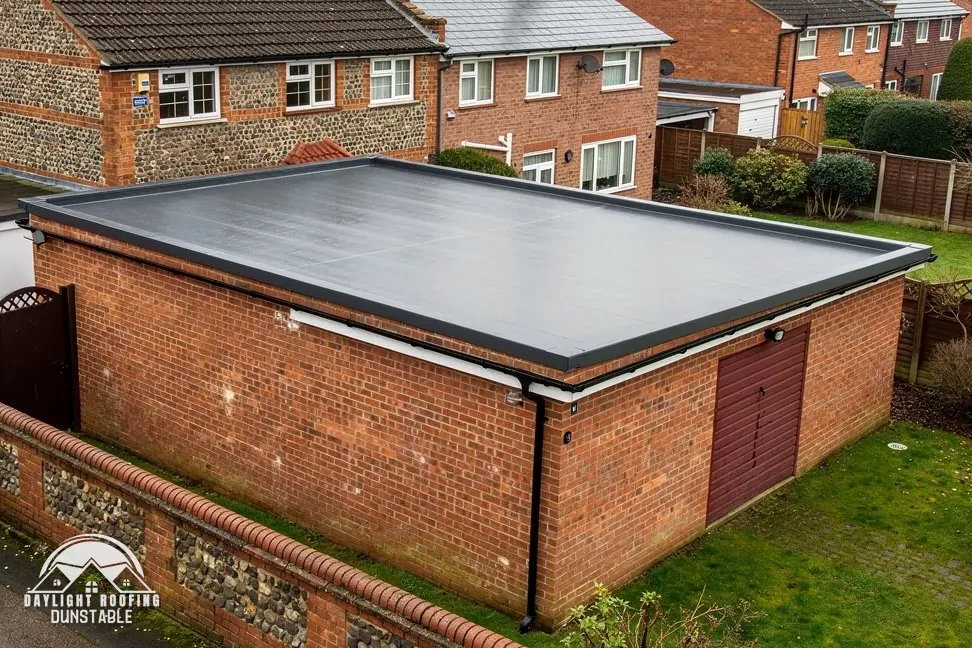
A brick garage with a new flat roof in a back garden

The roof, in plain words

Pitch
The steepness of a slope, given as an angle in degrees.
Headlap
How far one course of tiles or slates overlaps the one below.
Re-cover
Stripping off the covering and fitting a new one over the same structure.
Rafter
A sloping beam that runs down from the ridge under the battens.

The plain-as-day roof check

St Ippolyts roofs: four covering and pitch checks

4 checks about 3 minutes to read

  1. Age and wear of the covering
  2. The pitch of each slope
  3. Fixings, underlay and battens
  4. What a full re-roof sets in motion

01 Age and wear of the covering

Look at the slopes in low sun, preferably from across the road, which shows up flaking, crumbling edges and tiles that have lost their surface. Count the tiles you can see sitting out of line. A roof that has needed repairs in several places is telling you something about the whole covering and not just those tiles. Do not climb on it to find out, and note each observation with its date, since changes from one season to the next say more than a single look, and do not rely on a neighbour's roof as a guide to yours, because every roof has its own history of weather and repair.

Published lifespans for the main coverings are approximate, and they differ between sources. HomeBuilding gives Welsh slate as "100+ years", clay tiles as "60-80 years" and plain concrete tiles as "40-50 years". The BRE determined a minimum life expectancy of 60 years for clay tiles only, so no single age fits every roof.

02 The pitch of each slope

Pitch matters when a covering is changed, because each product has its own limit. Standing back from the house, you can judge roughly how steep a slope is: a shallow roof sheds water slowly, while a steeper one throws it off quickly. Porch and lean-to roofs can sit at a shallower angle than the main roof, which is where a swap in covering can fail, and the pitch of every slope has to be known before a product is chosen, including the dormer cheeks and any bay roofs.

Marley lists 35 degrees as the minimum for its clay Ashdowne tile and 15 degrees for its Lincoln clay pantile, so the product has to suit the slope, and a roofer who quotes without asking the pitch has missed the point. For natural slate, Cupa says BS 5534 "indicates" a minimum pitch of 20 degrees at moderate exposure, with a 500 mm slate and a 115 mm overlap; on any pitch below 25 degrees, hook fixings are ruled out. The slate roofing page goes into the detail of slate.

03 Fixings, underlay and battens

From the loft hatch you can see the underside of the tiles and the battens running across the rafters. Gaps in the underlay, rusty nail heads, battens that have split or rotted and tiles that hang loose all deserve a note, along with the tiles themselves. A torch held at an angle shows daylight where it should not be, and a damp patch on a batten marks the line of a leak. Rafter feet that look dark and soft at the wall plate deserve a photograph and a message to 07880 284133.

Marley points out that BS 5534 "isn't required by law". Since the 2015 amendments, "mortar could no longer be relied upon as the only means of securing the roof covering", and the standard's minimums "will always be superseded by the generation of a Fixing Specification, which is site specific". BS 5534:2014+A2:2018 is the current edition, and a specification is drawn up for the roof being covered, not for the village around it, so two neighbouring houses can need different fixing details.

04 What a full re-roof sets in motion

Stripping a whole covering changes the legal picture. The roof may be heavier or lighter than before, the insulation above or below the rafters may have to be improved, and a scaffold has to stand safely beside the house. These are matters for the survey before any price is written down. A re-roof also gives the chance to look at the fascias, the flashings and the gutter brackets while the old covering is off, because a new covering on a worn roofline wastes the work.

A covering "15 per cent or more" heavier needs approval, and Approved Document A treats a roof load "increased by more than 15%" as a significant change. For energy, Approved Document L asks that a roof more than half renovated be brought up to the improved figure of 0.16 in Table 4.3 where feasible, with 0.35 as the threshold. Which? Trusted Traders list "Replacing entire roof on an average three-bedroom house." at "£7,000-£21,000", excluding VAT (November 2025).

The dashed ring takes in the nearest towns and villages we cover around St Ippolyts. Map tiles © Esri; map data © OpenStreetMap contributors.

St Ippolyts re-roofing and consent questions

01How can the age of a St Ippolyts roof covering be judged from the ground?

Look for surface loss, crumbling edges, moss packed between tiles and a pattern of repairs in several places. None of that gives a number of years, because published lifespans are approximate and differ: HomeBuilding gives "60-80 years" for clay tiles and "40-50 years" for plain concrete tiles. Separately, the BRE determined a minimum life expectancy of 60 years for clay tiles only. A survey of the actual roof tells you far more than an age guess, and the written price comes after it.

02What third-party price ranges exist for re-roofing a house in St Ippolyts?

Which? Trusted Traders list "£7,000-£21,000" for an average three-bedroom house, excluding VAT, from 11 traders surveyed in November 2025. HomeBuilding says "a standard three-bedroom semi with a 65m² roof and plain concrete tiles may cost between £10,000 and £15,000", and Welsh slate "might reach £18,000". MyJobQuote: "The average new roof costs around £5,250 in the UK." Those are guide figures, and a published range says nothing about access, the number of slopes or the height of the eaves, and when the survey is finished, the price for a particular house is set down on paper as one sum.

03What consent route covers St Ippolyts church roof repairs?

The Church of St Ippolyts (Church of England) is listed Grade I (National Heritage List entry 1347411, first listed 27 May 1968). For a church that is in use, the faculty system applies in place of listed building consent, and "the faculty jurisdiction of the Church of England" is the phrase that governs it. List B of the faculty rules takes in lead replaced like for like, and that needs the archdeacon's written notice alone. Exterior work can raise its own planning question, and the council can answer it.

04Do the listings at Brook End Farm and the Cottage Loaf affect their roofs?

The Barn at Brook End Farm 35 Metres to North East of House is Grade II (entry 1175336, first listed 28 May 1987), Brook End Farmhouse is Grade II (entry 1102510, first listed 27 May 1968) and The Cottage Loaf is Grade II (entry 1347413). Roof work on a listed house stays within permitted development, but listed building consent from the council comes into play for anything "in any manner which would affect its character as a building of special architectural or historic interest", so a covering is not ordered until North Hertfordshire Council has been asked, and a plan of the existing roof helps that discussion.

05What does Hertfordshire County Council ask of a scaffold on a St Ippolyts road?

The county council, as highway authority, licenses scaffolding on its roads. Hertfordshire County Council charges £134 for a licence of 14 days and £59 for each further week, and states "It usually takes 3 weeks to process an application." A walkway 1.2 m wide must be left on the footway, and the council's page says you could be fined up to £5,000 for scaffold erected without a licence. Staging for a re-roof is arranged this way: we arrange the licence with our scaffolder, and it sits inside the one written price.

06Which Planning Portal tests decide whether a St Ippolyts re-roof needs an application?

Two limits apply together: "Less than 25 per cent of the total 'building envelope'" and "Less than 50 per cent of the roof is affected". A full new covering touches over half the roof, which takes it past the limit, so Building Regulations approval is needed whatever the material. The Planning Portal's main page says "In most situations, this work will need Building Regulations approval." Building control is Hertfordshire Building Control Ltd, or a registered building control approver, and either can be asked before work starts.

07Does the village conservation area alter the position for a St Ippolyts re-roof?

North Hertfordshire District Council designated the St Ippolyts Conservation Area. Whether this house sits inside it is for the council to confirm, and an Article 4 direction can remove further permitted development rights, so we check with the council first. When re-roofing a house needs permission is set out in the planning guide. A conservation area adds questions for the council about appearance and character, and a photo sent to 07880 284133 starts the enquiry. A change to a different covering is the kind of question the council answers house by house.

08Do the energy rules reach a St Ippolyts re-roof?

Approved Document L (2021), para 11.3, asks for the entire element to be raised to standard wherever feasible once over half of it has been renovated, and para 4.13 sets a "simple payback of 15 years or less" for that relaxation. Table 4.3 sets the threshold at 0.35 and the improved value at 0.16 W/m²K. A flat roof re-covered with a new membrane is renovation under the same section, and a replacement roof window must meet 1.4 W/m²K or Window Energy Rating Band B. AD L 2026 applies only from 24 March 2027, when the tables are renumbered 3.2 and 3.3.

09Which villages around St Ippolyts are covered as well?

Little Wymondley, Hitchin, Ickleford, St Paul's Walden and Stevenage are covered, every one on a page of its own that gives the council for that place. Council areas do not follow village names, and a parish can sit across a boundary, so send a postcode and a roof photo to 07880 284133 to settle which page and which council apply to your address. What one of those pages says about conservation areas, churches or consent routes belongs to that place and should not be read across to another.

Get a written price for your roof

10-year workmanship guarantee, in writing

Tell us about your roof

Call WhatsApp Written quote