
Call 01582 935272

Pirton · 14 road miles north-east

Roofers in Pirton

Loft, conservatory and insulation questions for Pirton roofs, 14.3 road miles north-east of Dunstable, 28 minutes by road, beside a Grade I church and a scheduled monument.

Get a written quote

Call 01582 935272WhatsApp us

Council
North Hertfordshire
Road miles
14
Conservation area
Pirton
Building control
Hertfordshire BC Ltd

Hammond's Farm, Toot Hill and the roofs of Pirton

Heading north-east from Dunstable, Pirton is 14.3 road miles away, about 28 minutes on the road. The 2021 Census recorded 1,452 usual residents in Pirton parish. Planning decisions for Pirton rest with North Hertfordshire Council, which has designated Pirton Conservation Area; in the council's words, "North Hertfordshire has 44 Conservation Areas". Where the boundary runs is its to say, so questions about a particular house go to the council before work is arranged, and an Article 4 direction can remove further permitted development rights.

Building control in Pirton is provided by Hertfordshire Building Control Ltd, which North Herts Council owns jointly with other Hertfordshire local authorities (01438 879990). Staging on a lane or footway needs a licence from Hertfordshire County Council, the highway authority, which we arrange with our scaffolder. The roof replacement and new roofs page covers whole coverings, the skylights and roof windows page covers openings in a slope, and the planning guide answers the usual planning queries.

  1. 01St Mary's, PirtonSt Mary's is a Church of England church, listed Grade I, and its roof repairs go through the faculty system rather than listed building consent.
  2. 02Three Gables and Hammond's FarmThree Gables, Hammond's Farmhouse and the farm building at the yard entrance are Grade II* listed, so consent governs changes to their roofs.
  3. 03Toot Hill monumentThe motte and bailey castle and shrunken village is a scheduled monument near Pirton, and works there have to be authorised.
  4. 04Conservatory roofsOn the Planning Portal, "A new roof must comply with building regulations", and so we check the route with building control before work starts.
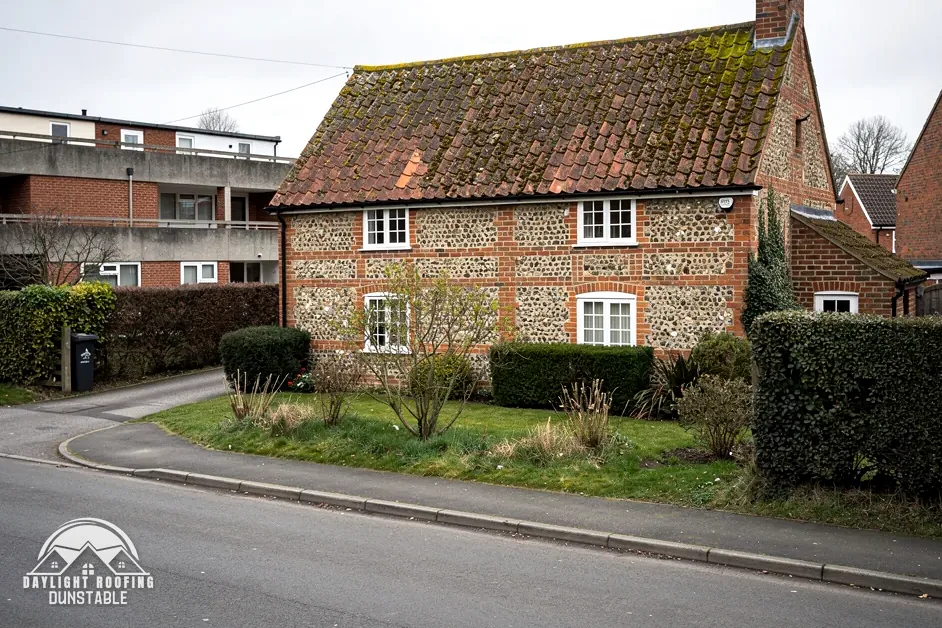
A flint and brick cottage with a clay tile roof beside a quiet road

The roof, in plain words

Open-cell foam
Foam sprayed under a roof that holds air pockets, in contrast to closed-cell.
Rooflight
A window unit raised on an upstand above the roof line.
U-value
A figure for how fast warmth leaks through a wall or roof; lower is better.
Roost
A place where bats shelter, protected whether or not occupied.

The plain-as-day roof check

Pirton roofs: four loft and glass checks

4 checks about 3 minutes to read

  1. Timber in the loft
  2. A conservatory roof
  3. Birds and bats under the tiles
  4. Loft insulation and what pays for it

01 Timber in the loft

Open the hatch after a spell of wet weather and shine a torch along the rafters from the joists. Dark staining, white tide marks, damp insulation or a sour smell all point to moisture getting in or condensing. Daylight through a gap means water can get in as well as light. Condensation can leave the underside of the covering beaded with drops in cold weather. Stay on the joists and never put a foot on the ceiling between them.

A photo taken from the hatch can go to 07880 284133, and we will look at it. If the underside of the roof has been sprayed with foam, the RICS consumer guide says the timber "cannot be fully seen or inspected", so a roofer can report only on what is visible. Any question about foam is worth raising before a survey is booked, and the roof replacement and new roofs page explains where it matters.

02 A conservatory roof

Glass, polycarbonate and tiled conservatory roofs wear out in different ways, and each needs a different look from inside as well as outside. Look for cloudy or cracked panels, slipped glazing bars, green streaks along the bars, and a stain on the wall plate where the roof meets the house. A drip on a wet day shows that a seal has failed somewhere above. Check the junction with the house wall too, where flashing can lift.

HomeBuilding says polycarbonate roofs "have a typical lifespan of 10 years". For glass and tiled roofs it quotes the managing director of Roofing Megastore, who says glass "will likely last in excess of 30 years" and tiled "will typically last in excess of 50 years with little maintenance being required". MyJobQuote gives £3,200 to £6,000 as the 2026 average for a conservatory roof replacement (20 October 2026). The Planning Portal puts it plainly: "A new roof must comply with building regulations". Which route applies is a question we put to building control before work starts.

03 Birds and bats under the tiles

Droppings on the loft floor, a scatter of straw or twigs, or scratching at the eaves can mean an animal is using the roof. Seeing one flying in at dusk is a reason to stop and make a note of where. Nothing should be blocked up or pulled out until the roofer has been told, because roof work can disturb a protected animal, and birds and bats are protected under different rules.

For wild birds, the Wildlife and Countryside Act 1981 covers anyone who "intentionally" takes, damages or destroys the nest of any wild bird while that nest is in use or being built. Bats are covered more strictly: damaging or destroying a breeding site or resting place is an offence under the Habitats Regulations, with no intent test. In its bat guidance GOV.UK includes the activity "repairing or replacing a roof", and a licence from Natural England may then be required.

04 Loft insulation and what pays for it

Thick insulation on the loft floor keeps the rooms below warmer, but it leaves the space above colder, and that colder void can collect moisture on the timber and the felt above it, which is why the roof ventilation described on our other pages needs to stay clear. When insulation has been laid over a wet patch, the timber beneath can rot unseen, so mark any stain you can see before it is covered.

HMRC's Notice 708/6 sets a zero rate of VAT on installing energy-saving materials, and insulation in "roofs or lofts" is listed, for supplies "made between 1 May 2023 and 31 March 2027", with the reduced rate of 5% after that. GOV.UK's list of schemes open in England pays for insulation, loft insulation among it, and for heating, but not for roof replacement or repair, and GOV.UK says the Energy Company Obligation "is closing on 31 December 2026".

The dashed ring takes in the nearest towns and villages we cover around Pirton. Map tiles © Esri; map data © OpenStreetMap contributors.

Pirton loft, glass and foam questions

01Can a Pirton roof with spray foam underneath be sold or mortgaged?

The picture is mixed. In March 2023 RICS reported "concern within specific sectors of the lending market", such as equity release mortgages. Government guidance published on 22 October 2026 says: "Many mortgage providers are open to lending on properties with spray foam, subject to their own requirements." Energy Saving Trust adds that "some lenders may ask for extra checks". Removal "will not always guarantee that they will still lend", so a specialist surveyor and your own lender are the people to ask. For removal, Checkatrade gives around £3,200 as the total for a three-bedroom detached house (July 2026).

02Which Pirton roof jobs are a matter for building control?

Taking off a whole covering falls outside the second of the Planning Portal's limits of "Less than 25 per cent of the total 'building envelope'" and "Less than 50 per cent of the roof is affected", so it needs approval. Pirton's building control is Hertfordshire Building Control Ltd (operations team 01438 879990), which North Herts Council owns jointly with other Hertfordshire local authorities, with a registered building control approver as the other option. The same Planning Portal guide treats a covering "15 per cent or more" heavier as needing approval whatever share of the roof is involved, so the survey takes the weight of the existing covering into account before a new one is chosen.

03Which consent route applies when Pirton's St Mary needs roof work?

St Mary's, Pirton, stands at Grade I on the National Heritage List (entry 1347110, first listed 27 May 1968) and belongs to the Church of England. While in use, it comes under "the faculty jurisdiction of the Church of England", so the faculty system takes the place of listed building consent. List B of the faculty rules covers lead or other roof covering put back like for like, where the archdeacon's notice in writing is what is required. Outside works on St Mary's may also need planning permission, which the council decides under the ordinary planning tests.

04What is listed at Hammond's Farm, and what does that mean for roofs?

Three Gables is Grade II* (entry 1103185, first listed 24 October 1988), Hammond's Farmhouse is Grade II* (entry 1175235, first listed 9 June 1952), and the Farm Building at Entrance to Yard at Hammond's Farm is Grade II* (entry 1295388). A change that would affect a building's character as one of special architectural or historic interest needs listed building consent. A new covering in another material is the sort of change that can do so, so the council hears of any new covering before it is chosen, and a farm building with a large roof is no exception.

05Does the Toot Hill monument affect work on houses in Pirton?

The Toot Hill motte and bailey castle and shrunken medieval village at Pirton is a scheduled monument (National Heritage List entry 1012325). Works to a scheduled monument must be authorised. Scheduled monument consent runs on its own track and is not part of listing: the Secretary of State grants it, applications are sent through Historic England, and listed building consent plays no part. The list entry for the monument carries a map, so an owner whose land meets it can see where the scheduled ground runs, and scheduled monument consent is a separate process from anything needed to re-cover a Pirton house.

06What will Hertfordshire County Council charge for scaffold on a Pirton lane?

Hertfordshire County Council issues scaffold licences for the county's roads, not North Hertfordshire Council. Hertfordshire County Council's fee is £134 for 14 days and £59 for every week after, and "It usually takes 3 weeks to process an application." The council wants 1.2 m of the footway kept clear for walkers, and says a fine of up to £5,000 follows if there is no licence. Staging on the highway is part of some roof jobs, and when it is, we arrange the licence with our scaffolder as part of the job. Roads that are trunk roads belong to National Highways and are a different matter.

07Is a Pirton house inside the village conservation area?

North Hertfordshire District Council designated the Pirton Conservation Area, and only the council can confirm whether a particular house lies within it. An Article 4 direction can remove further permitted development rights, so we check with the council first. A designation leaves repairs possible, and the council is better placed than a roofer to say what an owner has to apply for. A house can sit near a boundary line without crossing it, which is why the address matters. The planning guide covers the ordinary tests; to begin an enquiry, send 07880 284133 your postcode and a photograph.

08When is a Pirton conservatory exempt from the energy rules?

Approved Document L (2021) allows the exemption on five conditions together: a conservatory at ground level; a floor area no larger than 30 m²; Part K glazing; something solid between it and the house, whether wall, door or window; and heating kept separate, because "The heating system of the dwelling is not extended into the conservatory or porch". Swapping in a solid replacement roof is a separate point: building control is asked about the route, and the walls and frame below have to carry whatever new roof goes on. The skylights and roof windows page covers glazed openings.

09Which places around Pirton are covered by the same team?

Shillington, Lower Stondon, Ickleford, Hitchin and Meppershall each have their own page. They sit under more than one council: Pirton's is North Hertfordshire Council, whereas a neighbouring parish may fall under another, and each page names the council for its own place and carries the other details recorded there. A message to 07880 284133 giving the postcode, with a picture taken from the lane, names the right council for your address, and the roof replacement and new roofs page describes the work after a survey.

Get a written price for your roof

10-year workmanship guarantee, in writing

Tell us about your roof

Call WhatsApp Written quote