
Call 01582 935272

Yardley Hastings · 29 road miles north

Roofers in Yardley Hastings

Yardley Hastings lies north of Dunstable, 29.1 road miles and a 43-minute drive away, and each roof there is surveyed before one written total price is put in writing.

Get a written quote

Call 01582 935272WhatsApp us

Council
West Northamptonshire
Road miles
29
Conservation area
Yardley Hastings Conservation Area
Building control
West Northamptonshire

Yardley Hastings roofs, from Court Parlour to Old Rectory

Yardley Hastings stands in West Northamptonshire Council's territory. At the 2021 Census, Yardley Hastings parish had 744 usual residents. A roof application goes before that council, whose building control is its own team, while the Planning Portal's guide supplies the test for a re-roof. The village has a conservation area, designated by West Northamptonshire Council. For a house on or close to the older streets, ask the council about the address before a scope is drawn, since a boundary in the conservation area brings extra planning questions for external work, and a house beyond it never meets them.

Several of the buildings named here carry high listing grades, and a listing, a conservation area and a plain unlisted house are three different cases that the council handles separately. The planning guide gives the national roof rules. Lead, tile and slate work are described under leadwork, pitched roofing and roof repairs, and for each of them the roof is examined before a price is written, so the figure rests on the roof that is there.

  1. 01Church of St AndrewListed Grade II*, National Heritage List entry 1041535, first listed on 3 May 1968, and a Church of England church.
  2. 02The Court ParlourListed Grade I, entry 1190579, first listed on 3 May 1968, the highest grade among the entries named here.
  3. 03The Old RectoryListed Grade II*, entry 1041541, first listed on 3 May 1968, the same date as the Court Parlour.
  4. 0443, High StreetListed Grade II, entry 1371306; roof work there begins with a question to West Northamptonshire Council.
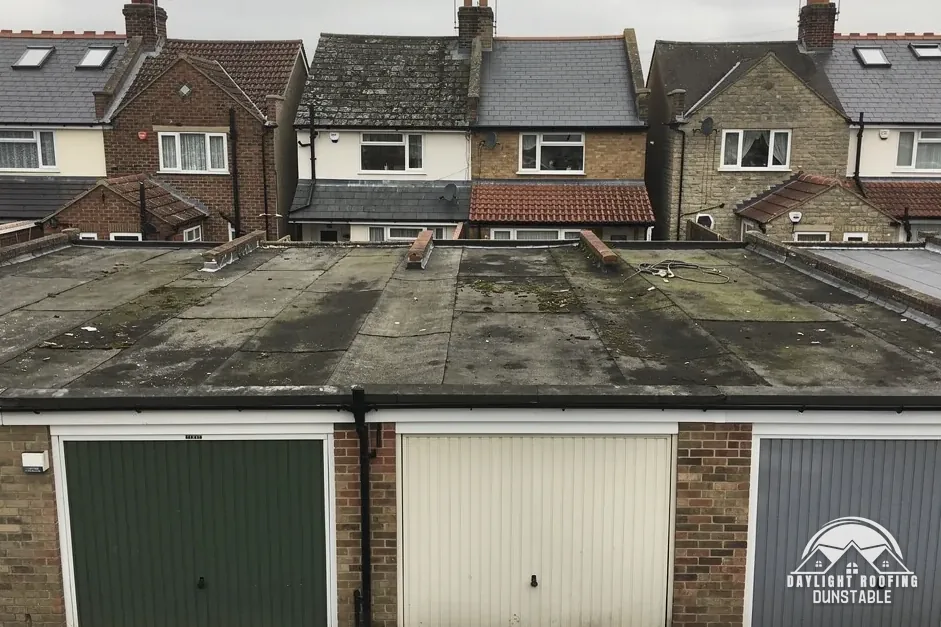
Row of flat-roofed brick lock-up garages with worn felt

Yardley Hastings lead and standards words

Lead code
A number, 3 to 8, naming how thick the rolled lead is.
BS 5534
The British Standard for laying slates and tiles on pitched roofs.
Minimum pitch
The shallowest slope a particular tile or slate is made to work on.
Rafter
A timber laid on the slope, carrying the battens, which rises toward the ridge.

The plain-as-day roof check

Four things to read in a listed-village roof

4 checks about 3 minutes to read

  1. Lead by the sheet
  2. Which standard governs which job
  3. How shallow can a clay roof go
  4. A look from the loft hatch

01 Lead by the sheet

Lead in rolled sheets is made to BS EN 12588 in codes 3 to 8, and code 4 is 1.80 mm thick. Two makers, Calder and Ecobat, publish charts that give different weights for some codes: code 3 is 14.97 kg/m² to Calder and 15.0 to Ecobat, and code 6 is 30.05 to Calder and 30.10 to Ecobat. A weight is therefore only meaningful with its maker named.

Which code suits which detail is a specification question, and there is no single code for every job. Where old lead lies around a stack, in a valley or along a parapet gutter, the first checks are for splits at folds, for lifted edges and for corrosion at the fixings. What the lead is, and how far the failure has spread, decides whether a repair is a patch or a replacement. A split along a fold can be mended where the rest is sound, while lead that has thinned across a whole length cannot, and the survey says which case the roof is.

02 Which standard governs which job

BS 5534:2014+A2:2018 is the current edition, a code of practice, for laying slates and tiles, and it supersedes +A1:2015, which is withdrawn. BS 8612:2018 is current too, and it is the standard behind capping that is clipped or screwed on dry. BS 5250:2021 is current and under review; it concerns moisture in buildings. For flat roofs with continuously supported flexible coverings, BS 6229:2025 has replaced the 2018 edition.

A British Standard is guidance, and Marley points out that installing to BS 5534 "isn't required by law". That does not make it optional for a careful job. Nor does it replace Building Regulations, which are law. A listed house or a house in a conservation area can add its own demands on top, and the council can be asked about both before the survey is booked, so that nothing in the plan has to be undone.

03 How shallow can a clay roof go

Marley sets a minimum pitch for each product. Among its clay tiles, Canterbury is 40°, Ashdowne 35°, Hawkins 30°, Acme Single Camber 30° and the Lincoln pantile 15°. Among its concrete tiles, Mendip is 15° and a Mendip variant is listed at 12.5°. Canterbury, Ashdowne and Lincoln are product names and not places, so none of them says anything about a Yardley Hastings roof.

A like-for-like re-cover on an old roof can only be judged once the pitch is known, because a tile sold for one pitch can let water back in on a shallower one. Measure the slope from a gable end with a protractor, or let the survey take it. If a new covering is 15 per cent or more heavier than the old, the Planning Portal says Building Regulations approval is needed and that a structural engineer or surveyor should be consulted.

04 A look from the loft hatch

Up there, the roof shows what its outer face hides. Shine a torch across the roof's inner face from the hatch, keeping your feet on the landing and off the ceiling boards, and look for daylight at the ridge or round a chimney, for dark tide-marks on the rafters, for wet or flattened insulation, and for beads of condensation on the felt or the nail points. Mark any spot you find with a note on the ceiling below.

A stain on a rafter that is dry and old may be the mark of a leak that has stopped, and one that is damp or spreading has not. Pictures from the hatch, sent to WhatsApp on 07880 284133, give a surveyor a head start. The slope above the spot is then examined, and any other fault is reported in plain terms before the price. A loft with no hatch light is easier to read with a torch held low across the timbers, so shadows show up the wet patches.

The dashed ring takes in the nearest towns and villages we cover around Yardley Hastings. Map tiles © Esri; map data © OpenStreetMap contributors.

Yardley Hastings roof questions, lead to listed houses

01Lead has curled away from a Yardley Hastings chimney. How soon does it matter?

Lifted lead lets rain behind the stack, and the wet can reach the roof timbers and the ceiling below, so it matters before the next hard shower. Look at the apron along the base of the stack and the strip up each side for splits, lifted edges and gaps. Send a photograph to WhatsApp on 07880 284133 for an opinion. The survey that follows checks the lead, the pointing round it and the flaunching above, and explains any other fault it found, plainly, before the price. A loose lead apron can also let a bird or a bat in behind it, which is worth mentioning if you have seen either near the stack.

02What route do works to the roof of St Andrew's take?

St Andrew is a Grade II* Church of England church (entry 1041535). Services are still held there, so any work is decided inside "the faculty jurisdiction of the Church of England" in place of listed building consent. Where a repair only puts back what was there, the archdeacon's notice, given in writing, may be the only step, without a full faculty. A planning question about exterior work is separate again, and West Northamptonshire Council answers it. A house in Yardley Hastings goes through the council, never the church, like any other house roof in the village.

03Is my Yardley Hastings house inside the conservation area?

Yardley Hastings has a conservation area, designated by West Northamptonshire Council, and only West Northamptonshire Council can say if your own address lies within its boundary. Give the council the street name and the postcode. The reply changes which planning questions apply to work on the outside, and it costs a short call to obtain. Listing is a different matter again, and a house can be listed, in the conservation area, both or neither, with each status answered on its own.

04The Court Parlour is Grade I. Does a listing that high affect roofs nearby?

A listing belongs to one entry. The Court Parlour (entry 1190579) is Grade I, and The Old Rectory (entry 1041541) and the church are Grade II*. Living next to a listed building creates no need for listed building consent on an unlisted roof, which is judged on its own facts. A house that is itself listed needs listed building consent for work altering its character, and the council decides which repairs do. Send it your address and a short account of the job, and file the answer with the deeds.

05Does a householder arrange the scaffold licence for a High Street job?

The scaffolding company, not the householder, applies to West Northamptonshire Council for a section 169 licence under the Highways Act 1980, and we arrange it with our scaffolder when the job calls for scaffold in that position. The licence matters only where scaffold reaches over the pavement or the carriageway; a scaffold set up wholly in a private garden avoids it. The survey checks how the front of the house meets the street, the width of the pavement, and where vehicles are parked, which decides where poles can go and for how long they can stand there.

06Can I cover storm damage with a tarpaulin myself?

Covering a roof is a job for someone trained to work at height, so do not climb up in wind or wet. From inside, protect what you can: move furniture, set a bucket beneath the drip and photograph the damage first, before a single thing is shifted. A make-safe is the temporary measure that stops further harm until a proper repair, and the repair is priced after a survey. Tell your insurer if a storm caused the damage, keep every receipt, and write down when the water first came in, since dates help any claim and any later repair.

07What helps a survey visit go smoothly at a Yardley Hastings house?

Make sure a ladder can reach the front and back of the roof, which can mean a gate left unlocked or a car moved off the drive. Say where water has shown, and when. A photograph or two on WhatsApp helps. From outside, the survey looks at the ridge, verges, valleys, lead, gutters and eaves. Anything an owner has already seen from the loft hatch, such as a damp rafter or daylight at the ridge, is worth mentioning too. A dog shut in another room and a note of any known neighbours' boundary issues make the visit quicker.

08Why do clay tiles have different minimum pitches from one another?

Each product is made with its own profile, lap and weight, so its maker sets the shallowest slope on which it sheds water. In Marley's table the clay minimums run from 40° for Canterbury and 35° for Ashdowne then 30° for each of Hawkins and Acme Single Camber, and 15° for the Lincoln pantile. All five are product names from one maker, not places. The slope in place decides which tile suits it, so the pitch is measured ahead of choosing any covering, since the choice has to fit it. A tile that needs 35° is the wrong tile for a slope of 30°, whatever its colour or its price.

09Which council handles roof applications and building control here?

Roof applications go to West Northamptonshire Council, and so does building control, which it runs itself. The Planning Portal's guide gives the test for a re-roof, and stripping a whole roof affects more than 50 per cent of it. An Article 4 direction can remove further permitted development rights, so we check with the council first, and the route is put to the council before work begins. Ask about a specific address, not the village in general, since the reply may differ for two houses on one road, with a listing or a boundary between them. A short written note of the reply, with the date, saves repeating the question to anyone else involved in the job, whether a landlord, a lender or a buyer.

Get a written price for your roof

10-year workmanship guarantee, in writing

Tell us about your roof

Call WhatsApp Written quote