
Call 01582 935272

Olney · 25 road miles north-west

Roofers in Olney

Olney sits 25 road miles north-west of Dunstable, where the council's Article 4 wording shapes roof jobs and each one ends in a single written total.

Get a written quote

Call 01582 935272WhatsApp us

Council
Milton Keynes City
Road miles
25
Conservation area
Olney Conservation Area
Building control
Milton Keynes Council

Roofs near Peter and Paul and Orchard Side

Olney, a Buckinghamshire town under Milton Keynes City Council, is 25 road miles north-west of Dunstable; the road takes about 34 minutes. At the 2021 Census, Olney parish had 6,598 usual residents. Milton Keynes City Council is the planning authority that decides a roof application in Olney, and it first designated the Olney conservation area on 10 March 1969. The council's conservation page says "Milton Keynes has 27 conservation areas", a count that takes in the entire city. Listed buildings below carry their grade and list entry number so each can be checked on the National Heritage List.

Olney is one of two places where Milton Keynes City Council describes what its conservation-area Article 4 direction takes in. In the Olney conservation area every dwellinghouse is affected, but only for extensions or alterations, porches and painting exterior walls, and the council's pages ask whether materials are "maintained as existing and matched where replacement is required", noting that repairs which do not "materially affect the external appearance" are not development. Anything else is a question for the council, so check with Milton Keynes City Council whether an Article 4 direction applies. The planning guide covers the national roof rules.

  1. 01Peter and Paul churchSaints Peter and Paul church is listed Grade I, entry 1125308, first listed on 17 November 1966, a Church of England church.
  2. 02Cowper and Newton MuseumGilpin House, Orchard Side, is listed Grade II*, entry 1125295, first listed on 3 March 1952.
  3. 03Cross Keys HouseOlney Wine Bar and Cross Keys House is listed Grade II*, entry 1332279, first listed on 3 March 1952.
  4. 04The Vicarage and CoachhouseListed Grade II*, entry 1158059, so any roof change calls for a conversation with the council first.
  5. 05Olney BridgeA scheduled monument, entry 1006936, near Olney; works there need authorisation in advance.
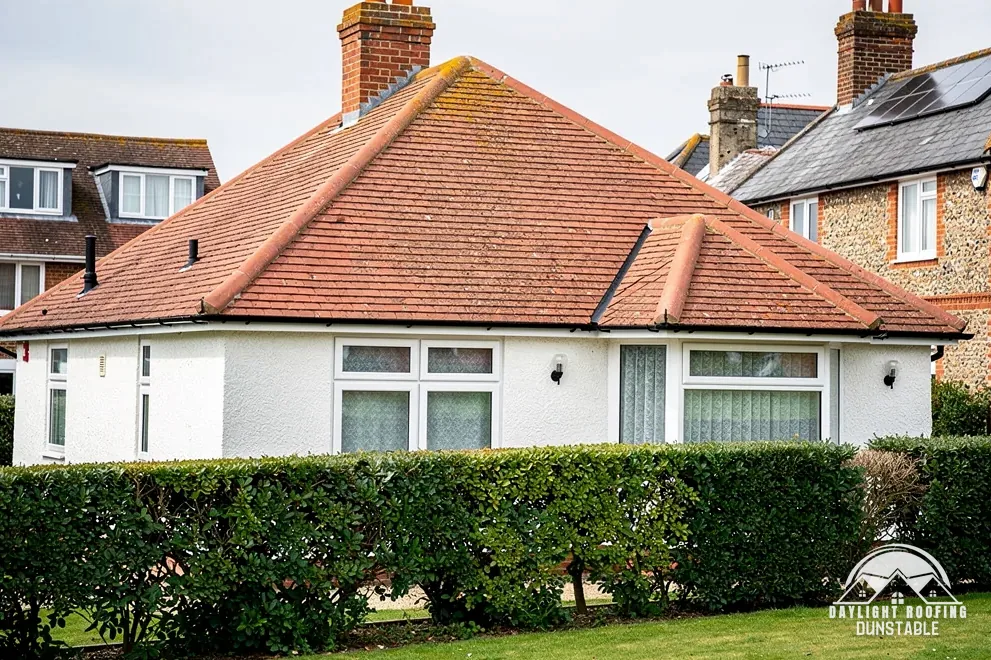
An interwar hipped bungalow with a clay tile roof and a bay window

Olney roofing, said plainly

Like-for-like
A repair using the same material, in the same pattern, as what was there.
Cheek
The vertical side of a dormer, which can be clad in lead.
Conservation rooflight
A roof window fitted flush with the slope instead of raised above it.
Welt
A folded seam where two sheets of lead are joined.

The plain-as-day roof check

Matching, flat tops, dormer cheeks and flush windows in Olney

4 checks about 3 minutes to read

  1. Matching what is already there
  2. Flat tops on shops and extensions
  3. Lead on a dormer cheek
  4. Flush rooflights in a conservation area

01 Matching what is already there

In the Olney conservation area, the council's Article 4 pages ask whether the "exterior brick, slate and stonework" is "maintained as existing and matched where replacement is required". For a roof that means the covering: if slate was on the house, a repair in slate sits within the council's description of a repair, and a change to a different covering should be raised with the council.

Lifespans help judge what is worth keeping. HomeBuilding's figures, updated 30 September 2025, give Welsh slate 100+ years, Spanish slate 75-100, reclaimed Welsh slate 50-80 and clay tiles 60-80. BRE determined a minimum life expectancy of 60 years for clay tiles, quoted by Marley. A slate roof with a few slipped slates is a candidate for repair, and one with failing nails across the whole slope may not be. Slates that slide out can be a sign the nail has rusted through, which an inspection along the eaves can confirm, and the survey checks how far it extends. The slate roofing page describes both routes.

02 Flat tops on shops and extensions

A flat roof over a rear extension or a shop-back needs its own look: ponding after rain, a surface that has cracked or blistered, a join that has opened along a seam, upstands pulling away from the wall, and an outlet or gutter that is clear. Commercial flat roofs are priced after a survey.

The current flat-roof code is BS 6229:2025, which deals with flexible waterproof coverings laid on continuous support; the 2018 edition is withdrawn. HomeBuilding gives EPDM 25-30 years, GRP 25-30 and felt 10-15, while Less gives EPDM 30 to 50 years, GRP 25 to 40 and torch-on felt "10 to 20 years depending on quality and installation". The two sets of figures are both given and not merged. The flat roofing page covers membranes.

03 Lead on a dormer cheek

Each dormer carries its own small roof and two cheeks, the side walls, which can be clad in lead. Stand back and look at the cheek for splits across a fold, lead that has slipped on its fixings, and staining on the ceiling inside below the dormer. The junction where the dormer roof meets the main slope is a joint that moves, and the front edge of the dormer roof, where it meets the window frame, is another place where a stain can start on the ceiling inside.

Lead is made to BS EN 12588 in codes 3 to 8, and the code is a thickness: code 4 is 1.80 mm. Calder and Ecobat publish different weights for some codes, so any weight is given with its maker. MyJobQuote says correctly installed lead flashing "can last for over 80 years". On the lead roofing and leadwork page the work is set out, and the code for an Olney dormer is chosen after the survey.

04 Flush rooflights in a conservation area

A window fitted flush with the slope, a so-called conservation rooflight, is a roof window in the words of Approved Document L: one "in the same orientation as, and in plane with, the surrounding roof". A unit standing on a kerb is a rooflight, "out of plane with the surface of the roof on a kerb or upstand". The labels matter, because the U-value limits differ, and a quote that mixes the two words is a reason to ask which product is meant.

A replacement roof window must reach 1.4 W/m²K or a WER at Band B minimum, in AD L 2021, while a rooflight must reach 2.2 W/m²K. Neither figure answers a planning question, and a window in a side slope has conditions in the planning guide that do not depend on the rating, and in the Olney conservation area the first call is to the council, since a change to the outside of a house can raise Article 4 and listing points that a heating figure does not touch.

The dashed ring takes in the nearest towns and villages we cover around Olney. Map tiles © Esri; map data © OpenStreetMap contributors.

Olney roof questions, with the council's wording

01Is replacing a few slates in Olney a repair or an alteration?

Milton Keynes City Council's Olney wording separates the two: the direction reaches extensions or alterations, while repairs that do not "materially affect the external appearance" are not development. Slates renewed in the same slate and pattern fall on the repair side of that line. A different material, a different pattern or a change in the roof's appearance from the road should go to the council. A photograph on WhatsApp to 07880 284133 gives us a picture to study beforehand, and the survey reports plainly what it finds, other faults included.

02What exactly does the Olney Article 4 direction take in?

Milton Keynes City Council says every dwellinghouse in the Olney conservation area is affected, but only for any extensions or alterations, the erection of porches, and the painting of exterior walls. The council's pages add that repairs which do not "materially affect the external appearance" are not development. For anything outside that list, check with Milton Keynes City Council whether an Article 4 direction applies. Whether an address is inside the conservation area is also the council's to confirm, and a quick call with the street name settles it before any covering is chosen.

03Whose consent does Saints Peter and Paul church need for roof repairs?

The church carries Grade I listing (list entry 1125308), and it is a Church of England church. While worship continues there, it falls under "the faculty jurisdiction of the Church of England", and the faculty system replaces listed building consent. For a like-for-like re-covering, written notice given by the archdeacon may be enough, short of a full faculty. External work may separately need planning permission, tested in the usual way. Listed houses nearby, such as The Vicarage with its coachhouse, follow listed building consent instead.

04Do Olney Bridge and the listed houses fall under one consent route?

No. Olney Bridge is a scheduled monument (entry 1006936), near Olney, and any works there need authorising first, through scheduled monument consent, which the Secretary of State grants. Gilpin House (entry 1125295), Olney Wine Bar and Cross Keys House (entry 1332279) and The Vicarage with its Coachhouse (entry 1158059) are listed Grade II*, so work that affects their character needs listed building consent. A scheduled monument never uses the listed building route, and applications for consent at Olney Bridge go to Historic England.

05What counts as a trigger for Building Regulations on an Olney re-roof?

The Planning Portal puts two limits on re-roofing: "Less than 25 per cent of the total 'building envelope'" and "Less than 50 per cent of the roof" affected, with no application "normally" needed inside both. A whole-roof re-cover exceeds the second limit. Milton Keynes City Council's own building control team is on 01908 252721 in office hours and 01908 226699 out of hours; 01908 691691 is the council's main line. Approval also follows a covering that is 15 per cent or more heavier than the old one.

06Who licenses scaffolding on an Olney street, and for how much?

Where a scaffold blocks an Olney footway or lane, section 169 of the Highways Act 1980 calls for the highway authority's licence, which here means Milton Keynes City Council. Milton Keynes City Council's list shows £189 for scaffolding up to 1 month, excluding VAT, and £694 for complex scaffolding. We arrange the licence with our scaffolder, and the Olney quote takes in the scaffold the work needs. A tall frontage on a through road means the access gets looked at when the roof is surveyed, since the scaffold may need to stand on the footway.

07Does a homeowner who signs for roof work at home have time to change their mind?

Yes. Signing for roof work at your own front door allows a change of mind. Under the Consumer Contracts Regulations "the cancellation period ends at the end of 14 days after the day on which the contract is entered into", counted from the day after. An earlier start is possible only on a written request, and work already begun at your request may have to be paid for. There is no cancellation right where "the consumer has specifically requested a visit from the trader for the purpose of carrying out urgent repairs or maintenance". Citizens Advice runs the consumer helpline on 0808 223 1133.

08What are the time limits if an Olney insurer disputes storm damage to a roof?

The Financial Ombudsman Service says "For most complaints, a business has up to 8 weeks to consider a complaint", and separately a consumer has 6 months "from the date on the final response". Its storm definition reads: "a storm usually involves violent winds, usually with rain, hail or snow". Dated pictures of damage, shot before anything is moved, belong on file, because "usually look at expert reports and photos" is how the ombudsman describes its approach, and the pictures support any survey report. The ombudsman is on 0800 023 4567, and an insurer's own complaints process comes first.

09How can an Olney homeowner find out whether their street is at flood risk?

Flooding is judged site by site. GOV.UK's long-term flood risk service speaks to areas only, and the Environment Agency's flood map for planning covers a plot's zone in a planning application; neither forecasts a single house. Roof drainage is separate: downpipes and gutters are matched to the roof area behind them, and an overflowing gutter is a fault in the house's own drainage. The roof survey looks at gutters and outlets together, and at whether water is falling clear of the wall.

Get a written price for your roof

10-year workmanship guarantee, in writing

Tell us about your roof

Call WhatsApp Written quote