
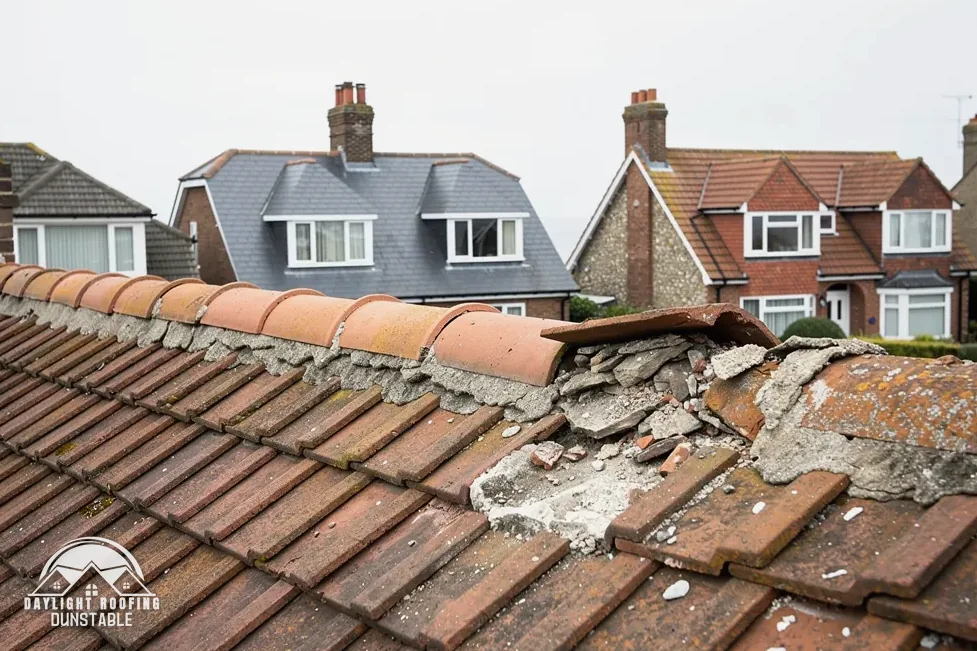
Start on the ground, with the whole roofline
The safest first look is from the pavement or the lawn, and a ladder can wait. Binoculars help. Circle the house and take each slope in turn, because whatever you spot you will want words for when you phone a roofer or write to an insurer, so the next few lines name the parts.
At the highest point, ridge tiles cap the joint between two slopes. Verges are the sloping outer edges at each gable end. Flashings are strips of metal, lead among them, that seal the gap between a slope and the wall or chimney stack rising beside it. Gutters and downpipes carry water clear of the eaves. Every one of these can be seen from below, and every one can be photographed.
| Part | Look for | Photograph |
|---|---|---|
| Ridge | Tiles out of line or missing | The full ridge line |
| Verges | Edge tiles displaced | Each gable end |
| Main slopes | Gaps or slipped tiles | Each slope square on |
| Flashings | Lifted or bent metal | Chimney and wall joints |
| Gutters | Sagging or detached runs | Eaves and downpipes |
Fallen tiles or a broken chimney pot on the lawn deserve a picture before anything is picked up, and so does debris in the gutters. A look from below will miss some faults, since a hairline crack can sit behind a tile that looks sound. Even so, it gives you a record and a vocabulary to work from.
Inside the loft: daylight and damp
The loft shows what the ground cannot. Choose a bright day, turn the loft light off and wait a minute for your sight to settle. A thin line of daylight through the covering marks a slipped or cracked tile, or a tear in the felt beneath. Follow the ridge with your eyes and check around the chimney, where a joint between two materials has more movement to cope with.
Then hunt for damp. Dark patches on the timbers, soggy insulation, drips on the loft floor and a musty smell all show that water has come in. A torch held low along the underside of the roof picks out marks that a ceiling light flattens. Stand on the joists, or on boards bridging them, and keep off the ceiling boards in between, which will not take a person's weight.
Downstairs, look at the ceilings and the tops of the walls beneath the damaged area. A brown ring, a bubbling patch of paint or a ceiling that has begun to sag deserves a report that day. A stain proves that water reached that spot, though the fault itself may sit somewhere else, because water can run along a timber or a membrane before it drops. That is why the loft view and the outside view belong together.
A bucket and a dust sheet under a drip buy time while you decide on the next step, and the guide to roof repairs sets out the kinds of repair a damaged roof can need.
Photographs before anything is moved
Photographs matter if the damage may become an insurance claim. The Financial Ombudsman Service, which settles complaints between customers and insurers, says it will "usually look at expert reports and photos" when a storm claim is disputed. A set of clear pictures, taken before anything is cleared, is inexpensive evidence to gather.
Take each picture twice, once wide to show where on the house the damage sits and once close to show the damage itself. Add the loft view, any damp or staining indoors, and any debris that has landed in the garden or on a car. If a tile has come down, photograph it where it lies and then again once it has been picked up. Your phone stamps the date on each file.
Report the damage to the insurer before any repair is arranged, and find out what it requires of you. Where a refusal rests on an exclusion written into the policy, the ombudsman is clear about who carries the burden: "The insurer has to prove that the exclusion applies", for example with an inspection report. That sentence concerns disputes, and the first step is plainly to report the damage so the claim can begin.
Claims are between you and your insurer. A photograph sent to WhatsApp on 07880 284133 gets looked at, and the storm damaged roof and insurance guide covers the steps in more detail.
What the ombudsman counts as a storm
Policies can cover storm damage, so the meaning of the word matters. The Financial Ombudsman Service gives its working definition: "a storm usually involves violent winds, usually with rain, hail or snow". Its next sentence widens the field: "Rain, hail or snowfall by itself can constitute a storm." It also states: "We take into account the Beaufort Scale."
A gale is therefore not the only weather that can qualify. A sustained downpour, a hailstorm or heavy snow can each be a storm in the ombudsman's eyes, depending on the facts of the case. The wording is the ombudsman's own, and it is not the wording of a policy. Each insurer's policy has its own definitions and exclusions, so the policy document is where to check what your cover says, and the insurer can confirm in writing which wording applies to your claim.
This checklist attaches no wind speed and no named storm to Dunstable or Luton, because the point is the condition of your roof and not a headline. A roof that lost tiles in a calm week may have an older fault, and a roof that came through a violent night intact has not necessarily escaped movement. The checks from the ground and from indoors are the same either way.
You might hear
A storm has to be a gale.
Plain as day
The ombudsman's own wording is that rain, hail or snowfall by itself can constitute a storm.
Making the roof safe until a repair
Making a roof safe is a stopgap. It keeps weather out of the building until a lasting repair can be arranged, and it can mean covering the damaged area or fixing loose parts so they cannot fall. Repairing the roof is a separate step: tiles are replaced, flashings renewed, damaged timber dealt with. The page on emergency roof repairs and making a roof safe explains the difference.
Some damage cannot wait for a checklist. Tiles hanging over an entrance, a chimney stack that has shifted, a ceiling holding water and a gutter dragging across a path are safety questions first and roofing questions second. Keep people clear of the area and call the emergency services if anyone is at risk. For a dangerous structure at a Central Bedfordshire address, the council's building control team is on 0300 300 8635 during office hours, and the council gives 0300 300 8098 for a dangerous structure outside office hours.
Water coming through a ceiling light fitting is an electrical danger as well as a roofing one, so switch off that circuit at the consumer unit if it is safe to reach, and keep away from wet fittings. These are householder precautions rather than roofing advice, and they outrank saving a tile.
Scaffold in Dunstable and Luton
A repair to a high slope may need scaffold, and scaffolding standing over a footway or a carriageway needs a licence under section 169 of the Highways Act 1980, issued by the highway authority. For Dunstable that authority is Central Bedfordshire Council, which licenses scaffolding on its roads. For Luton it is Luton Council. Wherever the roof is, we arrange the licence with our scaffolder.
Luton Council lists £205 (VAT exempt) for up to 28 days, with a £550 deposit that it refunds on written application after a satisfactory inspection. Luton Council asks for a minimum of 10 working days to process an application, and its wording on who holds the licence is: "for scaffolding the licence is issued to the scaffolding company". Those are Luton's published terms for Luton's streets.
A licence takes time to arrive, and a leaking roof does not wait. A temporary cover can go on from a ladder or from inside while the licence for the access scaffold is sorted out for the lasting repair. A scaffold set up wholly within your own boundary, clear of the public highway, raises a different question, and the council's highways team can answer it for a given address.
Neither council's fee or period should be read into the other's. Each council publishes its own figures, and the figures belong only to its own roads. Which council looks after a given street is a question for the council itself when the address sits near a boundary.
What storm repairs cost, as others publish it
Third-party guides show the scale, and a particular roof is priced after a survey. MyJobQuote, on a page last updated on 22 October 2026, says: "Emergency roofer call-out costs typically range from £150 to £300, while extensive storm damage repairs can cost £1,200 or more." The call-out figure and the storm repair figure describe separate things. Treat both as a scale for comparison, because the price for a given roof comes from its survey.
Which? Trusted Traders, from a survey of 11 traders in November 2025, gave £75 to £400 to swap out up to six standard tiles that had broken or gone missing and £80 to £300 for fitting a fresh ridge tile, with labour and materials counted and VAT left out. They are the smaller jobs that a storm can leave behind, and they sit well below the MyJobQuote figure for extensive damage.
The roof repair costs page covers what drives a repair price: access, the size of the area and what the survey turns up. For a repair we give one total, set down in writing, after surveying the roof. Photographs sent ahead can help a roofer see what a repair is likely to involve, but a price waits for the survey.
One written total
What sets a storm repair price
The covering, how high and how awkward the damaged area is to reach, and anything else the survey turns up under the visible damage decide the figure. A quote from us names one total in writing.