
Making safe and repairing are two different jobs
A roof emergency has two stages, and one cannot stand in for the other. The first is making safe: stopping rain getting in, closing a hole, securing anything that could fall. The second is the permanent repair, which restores the covering and the layers beneath it. They are different jobs with different aims, and treating one as the other is how a temporary fix ends up lasting through a winter.
| Question | Making safe | Permanent repair |
|---|---|---|
| Aim | Keep weather out, remove danger | Restore the roof |
| Materials | Tarpaulin, boards, temporary fixings | Tiles, slates, lead, underlay |
| Lasts | Until the repair is done | Years, with the right covering |
| Decided by | The damage in front of you | A survey of the whole roof |
A make-safe is judged on whether the opening is closed and the loose parts secured. A permanent repair is judged on the layers behind the visible damage: the timber battens, the sheet underlay and how the tiles are held. That is why the second stage waits for a survey, and why the cost of the first says little about the cost of the second. Temporary cover protects the house for days or weeks, but it does not mend a cracked batten or a torn underlay beneath it, so the repair is still owed once the roof is safe. The roof repairs hub covers the permanent side.
What to do indoors first
The first minutes are about the house and the people in it, and not about the roof. Move people out from under any ceiling that is sagging, bulging or dripping steadily, and keep clear of it. Water that has pooled above a plasterboard ceiling is heavy and can bring a section down.
- shift furniture, bedding and plugged-in appliances out from under the wet patch
- put buckets or bowls under drips and a towel round the base
- keep clear of light fittings and sockets near the leak
- if water has reached wiring, switch off at the consumer unit only if that is safe, and stay out of the room
- photograph the damage inside before anything is cleared
Water running down a wall or through a light fitting is an electrical hazard as well as a roofing one, and an electrician is the right call for the wiring. A roofer deals with where the water comes in, and an electrician deals with what the water has reached.
If a storm has taken tiles off, check the garden and the path below for slipped pieces that could fall, and keep children and animals clear of that spot. Loose tiles and broken pieces are sharp, and a cracked one can drop without warning from a slope above a door.
Take photos while the damage is untouched
Photographs come before any clearing or covering, because they are the evidence of what happened. The Financial Ombudsman Service says it will "usually look at expert reports and photos" when it looks at a storm claim, so take pictures from the ground, from inside and of the loft under the damage, with a date on them, and note the day and the time you first noticed the problem.
The same service explains how it reads a storm: "a storm usually involves violent winds, usually with rain, hail or snow", and "Rain, hail or snowfall by itself can constitute a storm." Whether a particular event counts is for the insurer first and the Ombudsman if there is a dispute, and a clear record of the weather and the damage helps either.
Tell the insurer early, and keep every reply. The Financial Ombudsman Service says "For most complaints, a business has up to 8 weeks to consider a complaint." Storm damaged roof and insurance takes the claim side step by step.
Keep every damaged piece that comes off the roof until the insurer confirms it may be thrown away. Receipts for the temporary work belong with the photographs, and the insurer can say whether the policy covers that work.
Why you should stay off the roof
A wet roof is slippery, a damaged roof can give way and a fall from a house roof is a serious injury. Covering a hole from inside the loft is a smaller risk than walking the slope, and so is a ladder at the eaves, but neither is a job for someone without the equipment and training for working at height.
Some roofs carry a second danger that is not visible. The HSE's guidance on asbestos says "If the building was built or refurbished before 2000, assume that there is asbestos in it." Its guidance on asbestos cement sheets adds "AC roofs are always fragile". A sheet that appears intact may still fail under a person's weight, and a broken sheet can release fibres.
Where the roof is cement sheeting, or the soffit may be asbestos insulating board, do not drill, scrape, sweep or break it, and do not walk on the sheets. How to find a roof leak shows how to trace a fault safely from the loft and the ground, which is the safer way to look.
A scaffold, a roof ladder and a harness are what working at height needs. They are why a make-safe on a high or steep roof is not a task for a few minutes with a tarpaulin and a rope, and why the person who does it needs a proper survey of the access first.
What a make-safe involves on the roof
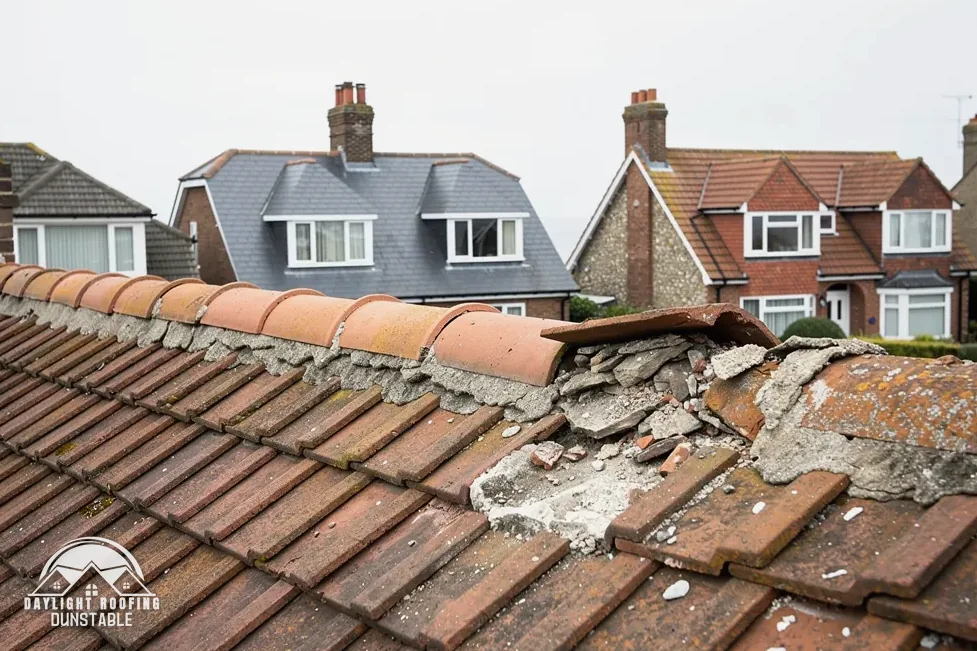
Temporary protection is chosen for the damage in front of the roofer. A tarpaulin is battened down over a missing patch of tiles. A boarded opening closes a hole where a tree limb or a chimney part has come through. Loose tiles are refixed or taken off so they cannot fall, and a flashing that has lifted is pressed back or covered.
These measures are temporary on purpose. A tarpaulin is a cover, not a covering, and it flaps and chafes in wind. Boards across an opening hold until the opening can be repaired properly. A make-safe that stays on the roof for months causes damage of its own, so the permanent repair is planned as soon as the roof is dry enough to survey.
After the roof is safe, the survey looks at what lies behind the visible damage, because water that gets in at one point travels along rafters and battens before it shows. The written price for the permanent repair is one total, given after that survey, and the work done under it is separate from the make-safe.
Weather, access and what the roof needs all shape a make-safe at a particular house, so the useful questions to put to any roofer are what will be done on the roof that day and which work will wait for the permanent repair.
What it costs, from the published guides
No guide can price an emergency at your house, and the roof's height, access and the damage decide the figure. MyJobQuote's page, last updated on 22 October 2026, says "Emergency roofer call-out costs typically range from £150 to £300, while extensive storm damage repairs can cost £1,200 or more." Those are MyJobQuote's own ranges, and no guide can set the price for a single roof.
Which? Trusted Traders give £75 to £400 excluding VAT for a repair of one to six damaged or missing tiles, from a survey of 11 traders in November 2025. That is the permanent side of a small repair. MyJobQuote's average roof repair is around £650 in 2026, a different measure again.
Keep the figures apart, because each comes from a different source and a different job. A guide's figure shows the scale of a problem and not what a particular quote should say, so compare quotes by asking what each one covers. A make-safe sets one expense, the permanent repair another, and the written price after the survey gives one total for the repair work. A guide to roof repair costs on this site explains what moves the figures.
- ask what the make-safe consists of, in words you understand
- ask which work is held back for the permanent repair
- ask whether the quote for the permanent work follows a survey
- keep receipts for the temporary work for the insurer
Your rights on an urgent repair
Consumer law treats urgent work differently from planned work. An agreement made in your own home, following a survey, brings a 14-day cancellation period that starts the day after the agreement is made. For a repair you asked for in an emergency, regulation 28(1)(e) of the Consumer Contracts Regulations removes the right where "the consumer has specifically requested a visit from the trader for the purpose of carrying out urgent repairs or maintenance".
That has a plain consequence. If you phone a roofer because water is coming in and ask them to come, the cancellation period does not apply to that visit, so agree what is being done and what it will cost before work starts. Rights on a planned job run the other way, which is why it matters to know which of the two situations you are in when you agree to the work. If a roofer turns up uninvited and you agree to work, a different position applies and the 14 days may.
The work still has to be done with reasonable care and skill under section 49 of the Consumer Rights Act 2015, whether or not the cancellation right applies. Citizens Advice runs the consumer helpline on 0808 223 1133 for questions about a specific contract. The post on urgent roof repairs and cancellation rights sets out the regulations in more detail.