
What the decision turns on
Whether a repair or a replacement costs less depends on the roof in front of you. Four things carry the decision: the share of the roof involved, the condition of the layers under the covering, the condition of the covering itself, and what the work has to meet once the roof is opened up. The survey checks all four before any figure is written down.
The question also has two halves that are easy to run together. One is the cost of the work now. The other is how long that work is expected to hold. Each of the four things gets its own section below, and published costs then sit side by side to show the scale of each route. A small repair on a sound roof is cheap and holds. The same repair on a roof that is failing across several slopes is cheap and holds for a short time, because the next fault is already a few rows along.
Those figures are third-party ranges with their dates. They describe the market, not your house. The roof repairs hub covers the jobs one at a time, and roof repair costs goes further into what sets a repair price. Neither guide swaps the survey for a formula, because a formula would have to guess at everything hidden under the covering.
What the survey weighs
- The share of the roof involved
- State of the underlay and battens
- Condition of the covering itself
- What the work has to meet
The share of the roof involved
The Planning Portal gives a test for re-roofing and Building Regulations. Under its guidance an application is normally unnecessary when "Less than 25 per cent of the total 'building envelope' (walls, floor, roof, windows, door, roof windows and roof-lights) is affected" and "Less than 50 per cent of the roof is affected." Both limits have to be met, and the word "normally" stays in because the Portal uses it.
The same guidance names two reasons for approval that no area limit removes: a new covering material that "increases the weight of the roof covering by 15 per cent or more", and a new covering whose performance in a fire will be significantly different from the old one's. The Portal's main re-roofing page adds "In most situations, this work will need Building Regulations approval." and recommends asking a structural engineer or surveyor before a heavier covering goes on.
Those tests measure the work, and the work follows the roof's condition. Replacing a handful of tiles sits well inside both limits. Replacing a whole roof goes past the 50 per cent line, so it needs approval. A repair that has to grow because the roof beneath will not take it can drift towards the limits too, which is one reason a survey comes before a price.
Whether a given repair needs an application is for building control to say. The guide to building regulations for roof repairs sets out the route, so the question can be put to the right office before work starts.
Underlay and battens
Under a tile or slate covering sit two layers the eye never meets from the ground. The underlay is a waterproof sheet stretched over the rafters, and the battens are the timber laths the tiles or slates hang from. Both can be reached only when part of the covering comes off, and the condition of both can swing the decision.
Where the battens are sound and the underlay is whole, a repair can reuse them and replace only what has failed. Where battens have gone soft, split or sagged between rafters, new tiles laid over them will not sit true, and fixings can pull out of weakened timber. A torn or perished underlay leaves nothing behind the covering to catch water that gets past a tile.
A roof can look sound from the garden and still need more than it seems, and one with a dozen slipped tiles can need less. A roofer lifting a few courses beside a leak is reading the underlay and battens as much as the tiles themselves.
How a covering is fixed counts too. Marley points out that since the 2015 amendments to BS 5534, mortar "could no longer be relied upon as the only means of securing the roof covering". A covering that depends on old fixings is a different proposition from one that has been fixed to the current code.
The covering itself
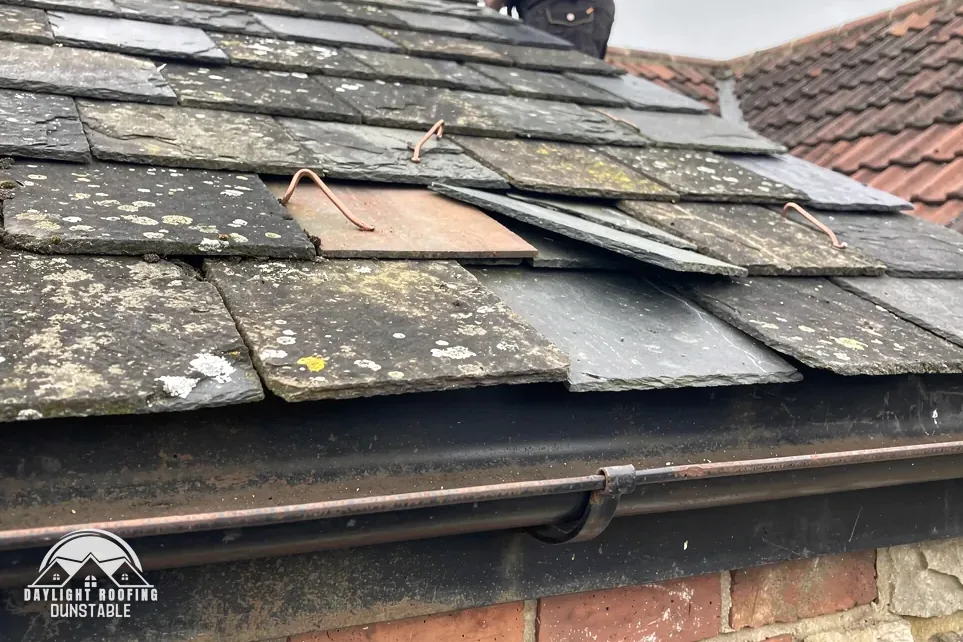
Surface wear and structural failure are different things. A tile with a weathered face can keep shedding water for years. A tile that cracks right through, a slate that slips because its nail has let go, or a run of tiles that have lost their fixings is a covering that has stopped doing its job. A few failures clustered together point to a local repair. The same failures spread over every slope point to a covering that is spent.
A covering's age is not a verdict on its own. HomeBuilding's approximate lifespans are 60-80 years for clay tiles and 40-50 years for plain concrete tiles, and Marley says "Typically, roof tiles are expected to last for around 60 years" and adds "This is not a guarantee or warranty of its longevity." A roof near the end of those figures with sound fixings can still take a repair. A roof well inside them with failing fixings may not.
Flat roofs and metal roofs have their own measures, and laying a new covering on a roof that has failed underneath is a different job from a repair to a covering over a roof that is sound. The survey assesses which of the two the roof is, and the written total follows from that.
A repair can also be the sensible route on a roof with years still in it, simply because the fault is small and well defined. Replacement earns its cost when the roof as a whole has run out of life.
Published costs side by side
Third-party figures show the scale of each route. They come from different sources, different dates and different jobs, so each stands on its own and none gives a repair-to-replacement ratio.
Which? Trusted Traders gathered its prices from a survey of 11 traders in November 2025, and they include labour and materials but exclude VAT. HomeBuilding's page was last updated on 30 September 2025.
| Source | Job | Published figure |
|---|---|---|
| Which? | One to six broken or missing standard roof tiles | £75 to £400 |
| Which? | Whole-roof replacement on an average three-bedroom house | £7,000 to £21,000 |
| HomeBuilding | Replacing a plain concrete tile roof, three-bedroom semi, 65m² | may cost between £10,000 and £15,000 |
MyJobQuote's pages, last updated on 6 October 2026, put the average roof repair at around £650 and replacing roof tiles at an average of around £215. Its page last updated on 3 November 2026 gives around £5,250 as the average new roof. Like the table, these are published averages and ranges. They help in judging whether a quote sits in a sensible region, and they never stand in for a price built from your own roof. Size, access, the covering chosen and whatever the survey finds under it all move the final figure, which is why a published average is a starting point for a conversation rather than an answer.
When a repair stops holding
Some patterns suggest a repair will chase the problem rather than end it. They are worth raising with whoever surveys the roof:
- faults on several slopes, not one area
- a leak that returns after a repair beside it
- a ridge or roof line that sags or dips
- battens or rafters that are soft when the covering is lifted
- underlay that is torn or perished across a wide area
None of these is a verdict on its own. A leak that returns can be a second fault close to the first, and a sagging line can come from the structure rather than the covering. What the pattern does is raise a question the survey has to answer: is the roof worth repairing again, or has the cost of repeated visits overtaken the cost of a new covering?
The same question applies from the other side. A roof that has run out of life but is patched again and again can cost more over a few years than a single replacement, because every visit pays for access and for the fault. The survey weighs the roof's condition against the likely length of repairs still to come, and the finding is put plainly.
You might hear
Patching a roof is the cheaper route, whatever its state.
Plain as day
A patch can leave the underlying fault in place, so the survey decides which route fits.
Getting a written price for the right job
Photos sent on WhatsApp are looked at and help to describe what you can see, but the underlay, battens and fixings can only be judged on the roof itself. After the survey the quote arrives as one written total price. Anything else the survey turns up on the roof is reported in plain words, and a repair that would not hold is described the same way, so the decision rests on what is actually up there.
When you are weighing a price from another firm, check what it covers: which slopes, whether the battens and underlay are inside it, and what the work does if it uncovers more than the visit expected. Two prices that look far apart can describe different jobs, and two that look close can leave different amounts of the roof untouched. Asking each firm to name the slopes, the layers and the fixings that its price covers puts the two on the same footing.
For a fault that is local, the guide to repairing part of a roof explains where a repair can stop and what it leaves as it was. Where a roof is leaking now, noting where the water shows inside and which slope it sits under helps describe the problem accurately before anyone climbs up.