
Signs inside the house
The inside of a house shows a leak once the roof has already let water through, because a ceiling or wall marks where it arrives. A stain is the clearest mark. It can be a brown or yellowish ring on a ceiling, sometimes with a darker edge where the water has dried in stages, and it can spread each time more rain arrives.
Other marks point the same way. Paint that bubbles or peels, plaster that feels soft or crumbles, wallpaper that lifts at a seam and a musty smell in a bedroom or on the landing can all follow a slow ingress. A drip that falls during rain is the most direct evidence of all, and a drip that carries on after the rain has stopped can mean water is still working its way through the structure above.
| Sign indoors | Possible cause |
|---|---|
| Brown ring on a ceiling | Water passing through, then drying |
| Bubbling or peeling paint | Moisture behind the surface |
| Damp patch on a chimney breast | A fault at the stack or its flashing |
| Musty smell, no visible stain | Damp in a void or in the loft |
Each of these can have another cause, and the section on misleading signs below covers them. Note where the mark sits and which way the roof runs above it, because that detail helps whoever looks at the roof later.
What the loft shows
The loft sits directly under the roof, so it can carry the evidence before the ceilings below do. Look with a torch on a dry day, and look again soon after rain, from the hatch or from boards laid for walking. Put your feet on the joists or on laid boards, because the plasterboard ceiling between them will not carry a person.
Dark, damp-looking patches on the roof timbers can mean water has reached them. Boards or stored boxes with a tide mark, insulation that is wet or flattened, and rafters or battens stained in lines that run downhill all suggest a path for water. Specks of daylight showing through the covering mark a place where a tile or slate has slipped or where the underlay has failed.
Droplets beneath the covering are a more ambiguous sign. They can come from a leak, and they can also come from condensation, which forms when water vapour from cooking, bathing and breathing settles on cold timber and underlay. A wet patch that appears after rain and nowhere else points to a leak, while moisture spread across a broad area in cold weather points to condensation.
Photographs help here. A picture taken from the same spot after each shower shows whether a mark has grown, and a note of the date turns it into a record that a roofer or an insurer can read.
Signs on the slopes and ridge
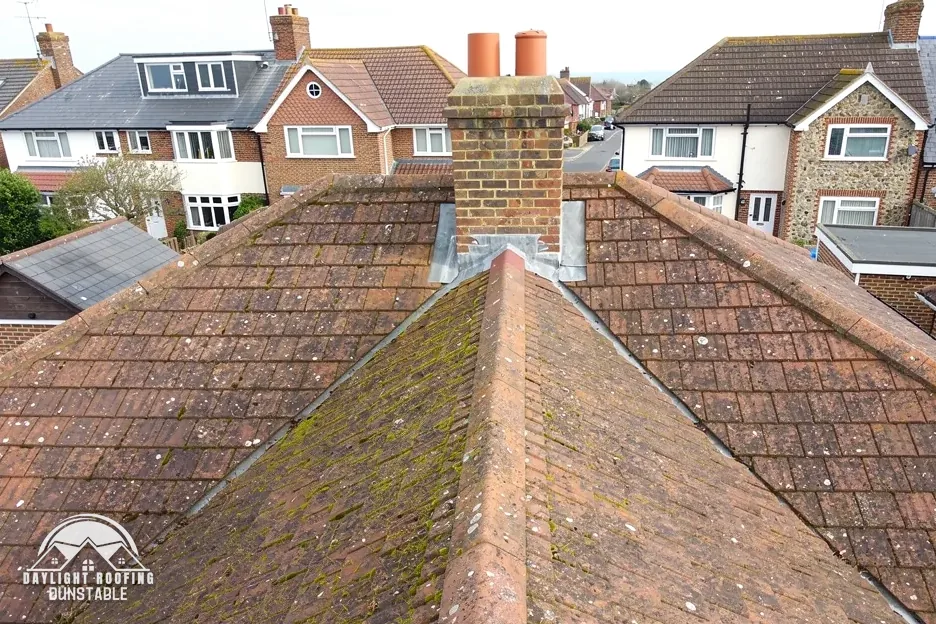
Seen from the garden, a slope reads as rows, and binoculars or a phone's zoom lens bring the detail closer. A sound slope looks even. Faults break the pattern, and each can let rain in.
- a tile or slate hanging below its row
- a cracked tile showing a dark line across its face
- a gap in a course where a tile has gone
- a ridge that dips or has lost bedding at its joints
- a lifted or displaced hip tile
A slipped tile leaves the underlay exposed to the weather, and a cracked one lets water run through the crack. The underlay is built to shed some water, but it is a second line of defence and not a covering, so a gap that stays open is a gap that can leak.
The ridge is the line where two slopes meet at the apex. Marley notes that since the 2015 amendments to BS 5534 mortar "could no longer be relied upon as the only means of securing the roof covering". A ridge whose mortar has cracked, crumbled or fallen away can let rain in at the joints, and it can leave tiles loose in wind.
Standing back far enough to take in a whole slope at once makes uneven rows easier to spot. Nothing here needs a ladder, which adds a fall risk without improving the view.
Lead, valleys and chimneys
Some leaks start without a single tile out of place. The trouble sits at a joint, where the roof butts up against a chimney, a masonry wall standing taller than the slope, a dormer or a roof window. Flashings seal those joints, and they carry more strain than a plain run of tiles, because each is a point where the building moves a little and rain runs hard against the seam.
Check the junction for a strip of metal standing proud of the brickwork, a crack across a fold, sealant that has split or dried out, and a streak of staining on the wall beside it. Lead has a long working life when it is correctly installed: MyJobQuote says correctly installed lead flashing "can last for over 80 years". A failed flashing does not mean poor metal, because fixings, movement and the mortar behind it also play a part.
A valley is the internal angle between two slopes, and it takes the run-off of both. A sagging line, a stain or a heap of debris in a valley can mean water is backing up or has found a gap. Chimneys call for a careful look too. Crumbling mortar, a leaning outline, cracked render and damp marks on the room-side breast can all point at the stack.
A defect high on a stack grows once water is in, because brickwork holds moisture and the effects can turn up lower down the house, some distance from the fault itself.
Where rainwater leaves the roof
Rainwater leaves the roof through the gutters, and a fault in one can pass for a roof leak. In wet weather, watch for water spilling over the lip, dark or green staining on the brickwork beneath the eaves, a dry downpipe beside a wall that runs wet, and weeds growing out of the channel.
A gutter works by slope. Brett Martin gives "1mm for every 600mm" towards the outlet, which is a very small gradient. One dropped bracket or one sagging length can cancel it, and the channel then holds a pool that spills at the front. A tide line along the inside of the run, with standing water, shows the fall has gone.
- a drip under a seam points to a joint that has failed
- overflow at a single point with the rest full points to a blocked outlet
- a wet wall below a corner points to a gutter that no longer reaches the downpipe
None of those is a roof fault, yet each can send water down a wall and into a window reveal or a soffit, where it looks like a roof problem from indoors. Fascia boards sit behind the gutter and share the same wetting, so a board that is soft, stained or pulling away at its end deserves a look.
The guide to finding a roof leak sets out how to trace a mark from inside back to the point where the water came in.
When the signs mislead
A stain on a ceiling does not always sit under the place where the water got in. Water can run along an underlay, a batten or a rafter and drop some distance from its entry point, so a mark in one corner can come from a fault some way up the slope.
Other causes can produce the same marks. Condensation can leave damp patches and mould on a ceiling or wall without any water coming through the roof. A leaking pipe, a loose tank or an overflowing cistern can stain the ceiling below. Damp from a wall soaking up ground water can mark plaster at skirting level, and that is not a roof matter at all.
The test is the pattern. Marks that appear after rain and grow worse after a long wet spell point to the roof. Marks that arrive with cold weather, across wide areas or in corners with little air movement, point to condensation. Marks that turn up whatever the weather point to plumbing or to a source in the structure.
Where the cause is unclear, a few photographs and a short description sent over WhatsApp can narrow the possibilities before anyone visits, and the survey settles what is left.
You might hear
A ceiling stain sits directly under the leak.
Plain as day
Water can travel along timber and underlay and drop some distance from where it came in.
Before you call anyone
Stay off the roof. A tile that looks sound can slip, a wet slope is slippery and a fall from a roof is serious. HSE says "AC roofs are always fragile", and a garage or outbuilding roof of asbestos cement sheeting may collapse beneath someone standing on it. HSE also advises: "If the building was built or refurbished before 2000, assume that there is asbestos in it." Look from the ground and from the loft, and let a roofer do the climbing.
Indoors, move belongings from beneath a drip and put a container under it. A folded towel in the container stops splashing. Take dated pictures of the stain, of the drip and of the loft above them. They show how the leak develops, and they matter if damage has to be demonstrated to an insurer later.
For a leak happening now, the guide on what to do if your roof is leaking gives the steps in order, and making a roof safe explains what a temporary cover achieves. The roof repairs hub covers the repair itself.
Send photos on WhatsApp if they help to describe what you have seen. The survey follows, and after it the price arrives in writing as a single total.