
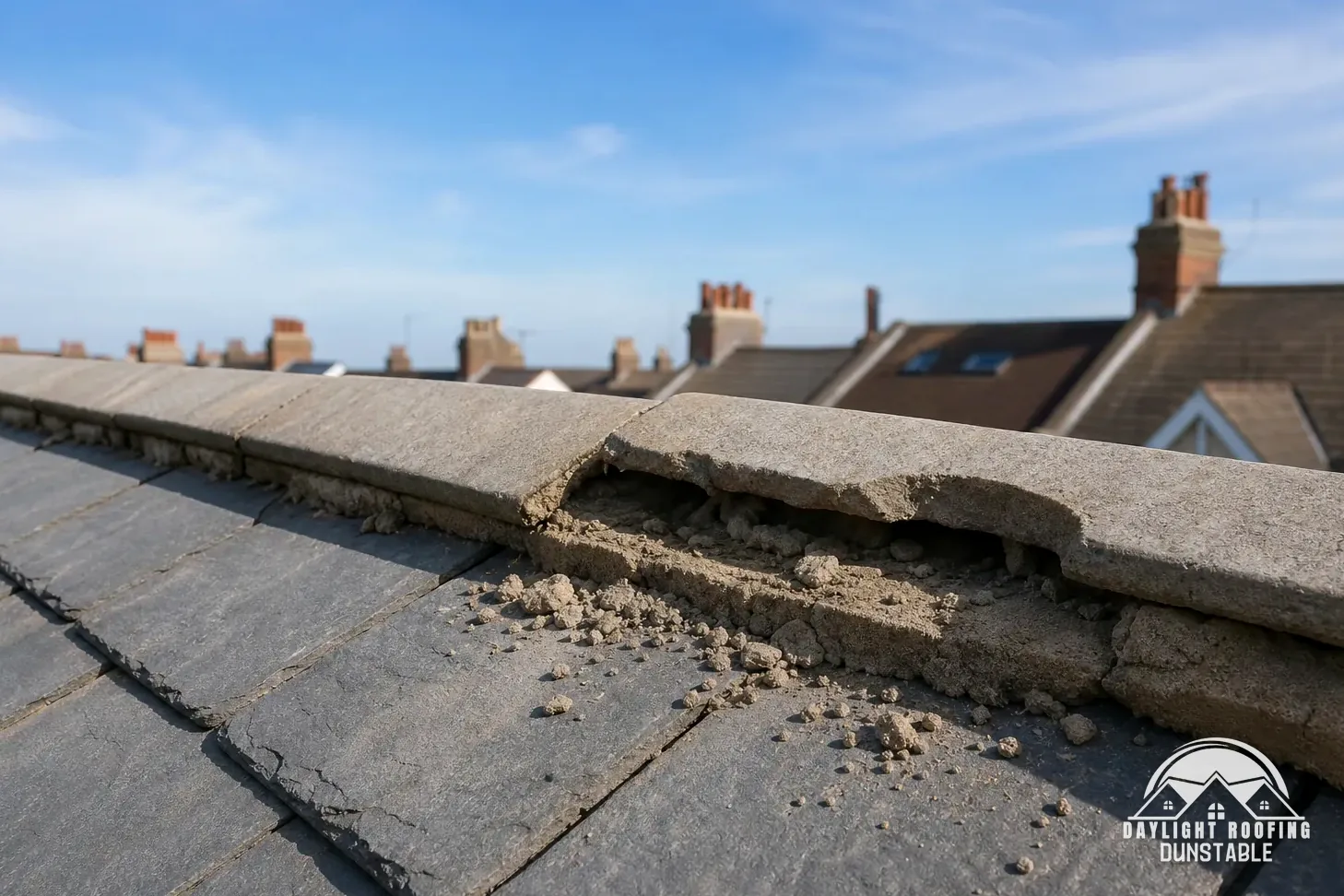
What moves a repair price
Two repairs that sound alike can cost very different amounts. The size of the area involved counts, and so does the number of separate faults, because each is a place the roofer has to reach and make good. Reaching the fault counts as well: a low rear slope with a clear path to it is a different job from a high gable end above a conservatory.
The covering sets the materials. Plain clay tiles, concrete tiles, natural slate and a lead flashing are not interchangeable, and finding a tile that sits well beside the existing ones can mean sourcing a particular make. What lies beneath the covering matters too. Once a few tiles come off, the battens and underlay beneath are in view, and a repair that began as three tiles can grow if the timber behind them has softened.
None of this can be read from a distance. A photo sent over WhatsApp is looked at and shows what the camera caught. The survey shows the extent of the fault and the state of what surrounds it, and the price is then written down as one total for the work. It is not a stack of separate charges.
Published figures for repair jobs carry their own source and date. They give the scale of the market, not a quote for your house. The roof repairs hub explains each repair in more depth.
What moves a repair price
- Area and number of faults
- Access to the slope
- The covering and its match
- Condition of timber beneath
- What the survey finds
Tiles, ridges and gutters: the Which? ranges
Which? Trusted Traders publish a cost guide drawn from a survey of 11 Which? Trusted Traders, gathered in November 2025. The prices cover labour and materials, and VAT is left out. Three of its lines bear on repairs.
| Job | Published range | VAT |
|---|---|---|
| Swapping one to six standard tiles | £75 to £400 | excluded |
| A new ridge tile along the top of the roof | £80 to £300 | excluded |
| Clearing out all gutters, front and back | £75 to £350 | excluded |
The ranges are wide because each job in them is small and its price turns on the factors listed above. A ridge tile at the low end of its range sits on a roof that can be reached easily. One at the high end may need a longer reach, or a run of ridge to be bedded and fixed again beside it. The guttering line covers clearing out only, not replacement.
Every range stands on its own. A tile line and a ridge line are not added together to price a roof, because a survey, not a sum of ranges, decides what the roof needs. Hips are outside these ranges, and a ridge figure is never a hip figure. For a hip, the figure waits for the survey.
Averages from MyJobQuote
MyJobQuote publishes averages as well as ranges for several repair jobs, each on a page with its own last-updated date.
| Job | Published figure | Page date |
|---|---|---|
| Average roof repair | around £650 | 6 October 2026 |
| Replacing roof tiles | average around £215 | 6 October 2026 |
| Replacing ridge tiles | £225 to £550 | 1 October 2026 |
The first line is a single average for roof repair as a whole, which is why it sits above the small tile jobs. The second is an average for tile replacement and the third is a range for ridge work. Each is a market figure from one source, on one date, for one kind of job.
A reader holding a quote can use these numbers to put a sensible question to any firm: what does this price cover, and what is left out? The answer matters more than the distance from an average.
Averages also hide spread. A repair priced at half the published average is not necessarily a bargain, and one at double it is not necessarily poor value. Either can describe a roof that is easy or hard to work on, a fault that is small or a fault with something worse underneath it.
Emergency call-outs and storm damage
When water is coming in, the first visit is about stopping the damage. MyJobQuote's page dated 22 October 2026 says "Emergency roofer call-out costs typically range from £150 to £300, while extensive storm damage repairs can cost £1,200 or more." The two halves describe different jobs.
A call-out figure covers coming out and making the roof safe. It does not cover the permanent repair that follows. A tarpaulin or a temporary cover stops the rain, and the lasting work can then be planned on its own terms. The guide to making a roof safe explains the two stages.
The storm half reads "extensive storm damage repairs can cost £1,200 or more". It describes extensive damage, and it says nothing about a few displaced tiles, which belong with the smaller ranges above. A storm that strips one slope and leaves another untouched gets a price that follows what the survey finds.
- Take pictures of the damage while it is untouched.
- Leave fallen pieces where they landed, if that is safe.
- Tell the insurer, then arrange the make-safe visit.
The guide to storm damage and insurance covers what the Financial Ombudsman Service looks at. One consumer point belongs here as well: the regulations exclude from the 14-day cancellation right a case where "the consumer has specifically requested a visit from the trader for the purpose of carrying out urgent repairs or maintenance".
Chimney leadwork, and jobs priced after a survey
One published set of figures covers chimney leadwork specifically. MyJobQuote's page last updated on 22 September 2026 puts a chimney lead flashing patch at around £200 and a full replacement at around £570, and gives £350 to £920 for replacing chimney leadwork in full. These numbers describe chimney leadwork alone. They do not stretch to a flat roof, a bay, a valley or any other lead on the house, and a chimney job is read the same way: the survey looks at the stack, its flashing and the brickwork before the written total is set.
Other repair jobs have no figure to quote. They are priced after a survey:
- chimney repointing
- hips
- commercial roof repairs
Chimney repointing is on that list because the pages that price it contradict each other. Hips are on it because published ridge figures are not hip figures. For a commercial roof the size, the covering and the access vary too much for a published average to mean anything, so the figure comes from the survey.
On a house, where a job needs scaffolding the cost sits inside the one total on the quote. Where the scaffold stands on a pavement or road, the Highways Act 1980 s169 requires a scaffold licence from the highway authority. We arrange the licence with our scaffolder.
One written total
What sets the price of a repair
The size of the fault, how the roof is reached, the covering and its condition, and what the survey finds beneath all shape the figure. The survey turns those into one total, written down before work starts.
Reading a repair quote
A figure means more when it reads as a description of work. These are the questions to put to any firm:
- Which slope or slopes does the price cover?
- Are battens and underlay included if the timber behind the tiles has failed?
- What happens if the work uncovers more than expected?
- Does the new covering sit well with what is already on the roof?
Two quotes can be far apart because they describe different jobs, so the useful comparison is of the work, not the total. A low price covering three tiles and a higher one covering the tiles, the ridge beside them and the flashing that let the water in are not the same offer.
The same applies to published averages. An average repair of around £650 on MyJobQuote's page is a middle point across a range of jobs, so a particular repair can fall well on either side of it without anything being wrong. The survey is what places your roof in the range.
Caution is reasonable over a very low figure, and over a figure given on the phone for a roof that nobody has looked at. A repair priced without a survey is a guess about what lies under the covering, and the guess can go either way.
Asking for the answers in writing, on the quote itself, keeps the conversation tied to the job. Where the slopes and the work are named, a later disagreement has little to feed on.
Getting a figure for your roof
The route to a figure is short. Send a photo over WhatsApp if one helps to show the fault, or ring, and a survey follows. After the survey the price arrives written down as one total, and any other fault spotted on the roof is described in ordinary words so that you can weigh it.
An agreement made at home after the survey comes with a cancellation right. Under the Consumer Contracts Regulations "the cancellation period ends at the end of 14 days after the day on which the contract is entered into". Starting inside that period needs a written request from you. Making the request does not take the right away, although payment can fall due for what has been done in the meantime.
An urgent repair that you asked a trader to visit for sits outside that right, as the section on call-outs explains. The Citizens Advice consumer helpline, 0808 223 1133, gives advice on both situations.
For a roof that has failed more than once, the guide to repairing or replacing a roof goes through how that choice is weighed. Published figures help to frame the choice, but they cannot make it for you: the roof has to be looked at, and the figure follows.