
The short answer
Compare the damage with the weather. The Financial Ombudsman Service's test is that "a storm usually involves violent winds, usually with rain, hail or snow". Sudden, fresh damage after rough weather points to a storm, gradual deterioration to wear, and dated pictures with a surveyor's report show which it was.
What counts as a storm to the Ombudsman
A home insurance policy can cover storm damage and can exclude wear and tear, so what counts as a storm matters. The Financial Ombudsman Service, which settles disputes between insurers and their customers, sets out its approach on its website. It puts the test this way: "We say that a storm usually involves violent winds, usually with rain, hail or snow."
The same page adds that "Rain, hail or snowfall by itself can constitute a storm". A spell of very heavy rain or hail can therefore qualify without a gale. The Ombudsman also states: "We take into account the Beaufort Scale". That is a standard measure of wind force, so the weather on the day, and how severe it was at your address, is part of the picture.
That wording describes how complaints are assessed, and it is not a promise that a claim will succeed. Each case turns on the policy terms, the evidence and what the insurer finds, and the cause of the damage is for the insurer to establish.
Our page on storm-damaged roofs and insurance covers the claims steps in more detail, including what to tell the insurer.
Signs that point to a storm or to wear
The roof carries clues about what happened. Neither column proves a cause by itself, but together they show which story fits better.
| Points to a storm | Points to wear |
|---|---|
| Tiles missing after one event | Tiles flaking or crumbling |
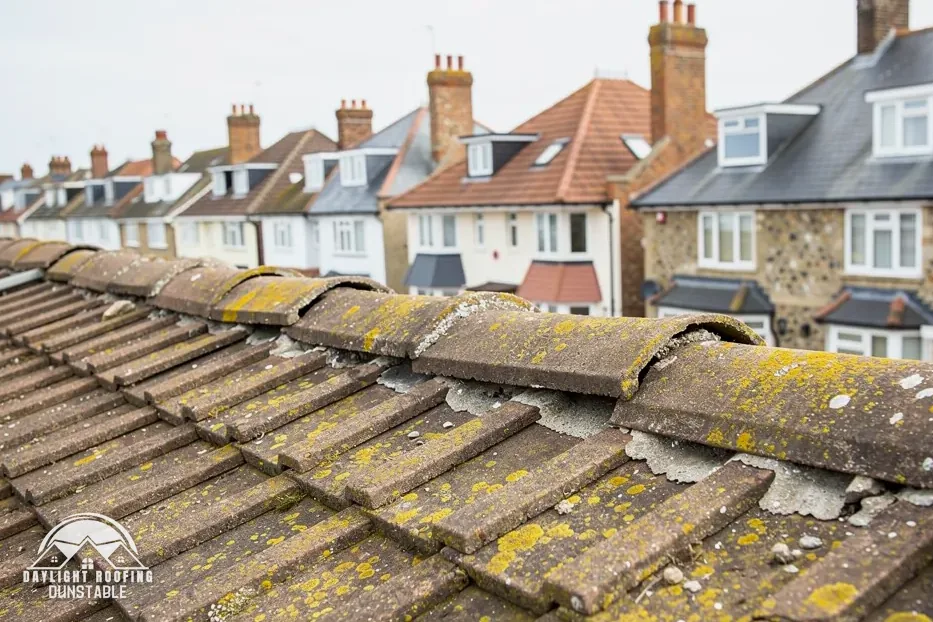
| Fresh breaks and clean edges | Weathered, stained fracture lines |
| Debris from a tree or a neighbour | Moss and slow-growing staining |
| Damage on the exposed side only | Damage spread across the roof |
A weathered tile that lifts in a gale is a grey area, because the wind was the trigger and age was the weakness. An insurer may argue either way, and a surveyor's findings can help settle it.
A look from the ground gives a first idea, and the guide to the signs of a leaking roof shows what to check indoors. Stay off the roof itself, because a storm can loosen more than is visible from below, and a wet slope is dangerous.
Debris matters as well. A branch lying across the slope, a neighbour's fence panel in the garden or a ridge tile found on the path all point to a dated event, which a slow decline does not. Ask neighbours whether their roofs or fences lost tiles or fence panels in the same gale, because damage along a whole street supports a storm.
Evidence that supports a claim
Good evidence is gathered early. The Ombudsman says it will "usually look at expert reports and photos", and that your insurer will usually want a surveyor's written report. On exclusions it is direct: "The insurer has to prove that the exclusion applies - for example, with an inspection report."
Photograph the damage as it fell, before anything is cleared away: wide shots to show the surroundings, close ones of each break, and one of the gutter and the ground below for any fallen pieces. Note the date of the weather, any warnings you saw and the day the problem came to light. Keep any broken pieces, bag them with a dated label, and tell the insurer promptly, because a delay gives room to argue that the damage grew afterwards.
If a claim is refused and you disagree, there are time limits. The Ombudsman says "For most complaints, a business has up to 8 weeks to consider a complaint." A separate period applies afterwards: "You have 6 months from the date on the final response".
A temporary make-safe holds back further damage during the claim, and our page on making a roof safe in an emergency explains it. The roof repairs page describes the repair side.