
The short answer
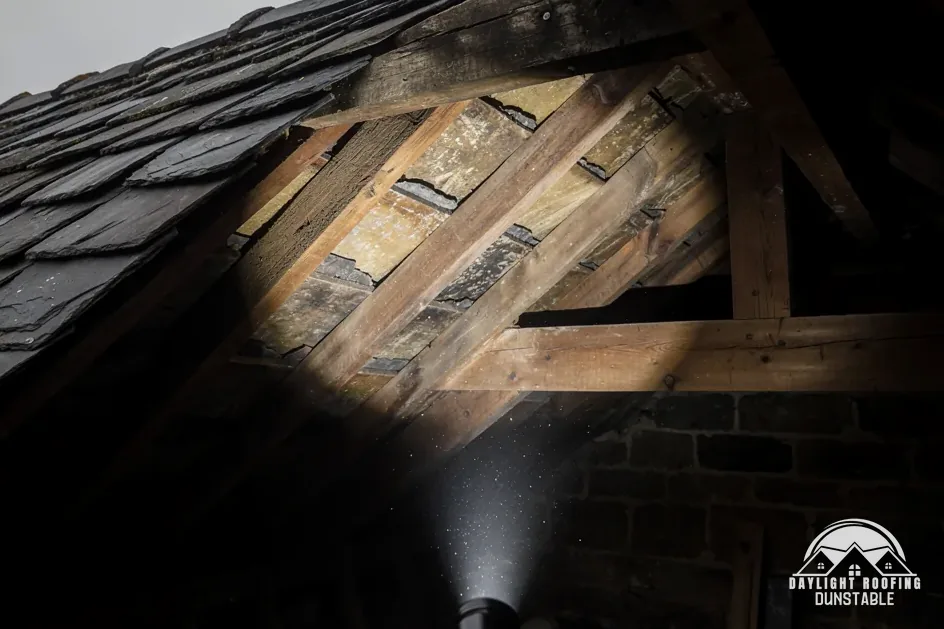
A roof survey is a close inspection of the whole roof: the covering, ridge and hips, flashings, valleys, gutters and fascias, plus any signs of water getting in. It establishes the cause of a fault and what else needs attention, so that a price for the repair rests on what was found rather than a guess.
The parts a survey reads
A survey treats the roof as one system, because a fault showing in one place can start in another. A gutter that has dropped can soak a fascia, and a lifted flashing can feed water into a wall far below it. The covering, the ridge and hips, flashings, valleys, gutters and fascias are each read for a different reason.
| Part | What is looked for |
|---|---|
| Covering | Slipped, cracked or missing tiles and slates |
| Ridge and hips | Loose caps, failed bedding, open joints |
| Flashings | Lifted or split lead, failed seals at walls and chimneys |
| Valleys | Worn lining, blockages, cracked edges |
| Gutters and fascias | Sagging runs, leaking joints, rot in timber |
Clues from inside the building help the reading. Ceiling stains, damp patches on walls and wet insulation point a surveyor towards the part of the roof to study first, so a note of where and when marks appear is worth having ready. A stain that grows during rain and dries in between tells a different story from one that never dries, and the difference is worth telling the surveyor.
How a survey leads to a price
The purpose of the survey is to settle two questions: what has gone wrong, and what is the sensible way to deal with it. A roof can have one local fault or several linked ones, and the answer decides whether a small repair, a larger one or a replacement makes sense. The page on repairing or replacing a roof shows how that decision is reached. The survey is also the moment to ask about anything that looks odd.
Here the roof is surveyed first, whatever turns up is reported in plain language, and the work is then priced with one total in writing. The price follows the findings instead of a phone description. A photo sent to 07880 284133 on WhatsApp can be viewed ahead of time, which helps to judge how much ground the survey needs to cover.
A survey is a visual reading of what can be seen and reached. It cannot show a fault hidden beneath a covering that has not been lifted, and it cannot measure how long any part has left. A roof that is sound today can still develop a fault by next winter, so a clean result describes the roof on the day it was read and no further. Booking a fresh look after a storm or a long wet spell is a reasonable habit for the same reason.
What a survey costs elsewhere
Prices for a stand-alone roof survey vary, and no single figure applies to every roof. MyJobQuote's roof survey page, last updated 12 October 2026, quotes an average of around £300 for a roof survey. That is the site's own average across the surveys it prices, and it says nothing about what one particular roof needs or what one particular firm will charge.
When a survey is the first stage of a repair job, the reading becomes part of the work being quoted. When a survey is wanted on its own, for example before buying a house, check what the report will contain, because format and detail differ from one provider to the next. The page on roof repair costs explains what moves the price once the findings are in.
Whatever the route, a survey should name the part, the fault and the likely consequence if it is left alone. A line such as 'roof in fair condition' tells a reader almost nothing. Questions about any survey, ours included, are worth raising before the work starts, and the roof repairs hub explains the wider repair options. A fair report also separates faults that need attention now from wear that can be watched.