
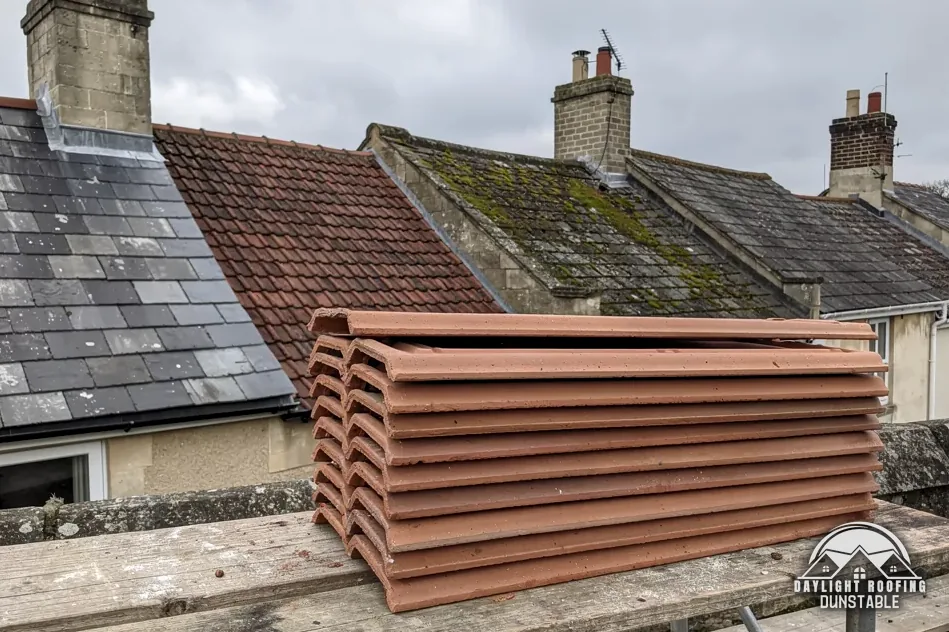
Slipped, cracked and missing tiles across the slopes
A single tile that has slid down or cracked is a small job, and published prices reflect that. In its November 2025 survey, Which? Trusted Traders listed "Replace one to six broken or missing standard roof tiles" at £75 to £400, excluding VAT. The picture changes when gaps are spread over several slopes, because each gap exposes the lining beneath and gives wind and water a way in to the next row. Tiles can also be loose without having moved, so lifting a few along an edge with a pole is a job for a roofer, not the owner.
Circle the house in daylight and look up at each slope in turn. Binoculars help, and so does a phone's zoom. Note where the gaps sit, whether tile pieces lie in the gutter, and whether the courses have drifted out of line. A pattern across the roof says something different from a cluster beside one chimney.
- gaps on more than one slope, not a cluster in one spot
- tile fragments in the gutters or on the ground below
- courses that have shifted so the lines no longer run straight
- cracks that run through a whole run of tiles, not a few
Never climb up for a closer look. A photo taken from the ground gives a roofer enough to start with, and it can be sent on WhatsApp to 07880 284133. Whether the gaps point to repair or replacement is a judgement that needs the roof in view, together with what lies beneath the tiles, so it waits for the survey.
A sagging ridge or dipping slope
A roof that should run in straight lines but dips between supports deserves attention. A ridge that curves, a slope that bows inward or a line of tiles that waves can mean that the timbers beneath are moving or that the weight on them has altered. It can also be an old build that has simply settled, so the sign is a reason to look and never a verdict.
Walk to the far pavement and squint along the ridge, then along the eaves. If the house is half of a pair, compare it with its partner. A difference between the two sides of a semi deserves a dated photo.
Sagging is a matter of structure, so a structural engineer or surveyor can answer it. A new covering laid on a roof that has already moved can add weight to a frame that is struggling, which is why the Planning Portal advises taking that advice before work with a heavier covering.
- a dip between two walls or along the ridge
- a slope that bows inward
- cracks in the ceiling below that follow the line of the rafters
- doors or windows on the top floor that have started to stick
None of these proves a failed roof when taken alone. Alongside a worn covering they can make replacement the sensible route.
Light and damp in the loft
What the tiles hide, the loft shows. After a spell of rain, open the hatch, aim a torch at the rafters and boards and look for dark stains, drips, wet insulation or a musty smell. A patch of daylight where none belongs marks a gap in the covering, and a brown ring on a rafter or board shows that water has been there before.
Step onto the joists only if they are boarded, and never onto a bare ceiling. Staying at the hatch is enough. Take pictures, date them and jot down the weather, since a roofer can read the pattern better with that detail to hand.
- dark stains on rafters, boards or the lining
- damp or flattened insulation
- daylight showing where there should be none
- a musty smell that arrives with wet weather
One stain beside a chimney can come from a flashing, which is a repair. Stains in several places, or a lining that is torn or hanging, point to a roof that has stopped working as a whole.
Do not touch old sheeting or soffit boards that may contain asbestos. HSE says: "If the building was built or refurbished before 2000, assume that there is asbestos in it."
A failed underlay and tired battens
Under the tiles lie the underlay and the timber battens that carry them. The underlay is the second barrier: it carries water that gets past the tiles down to the gutter. When it tears, turns brittle or sags between the rafters, the roof can leak even where every tile looks sound from the street.
From the hatch you can spot an underlay that hangs in folds, has holes, or lets light through at its overlaps. Battens that are soft, dark or snapped show from outside as tiles sagging in lines. Neither can be mended without lifting tiles, so the question is how far the trouble spreads across the roof.
Where it is confined to one area, lifting the tiles there and renewing the lining can answer it. Where it runs across the whole roof, replacing the covering and the lining together makes more sense, because the tiles are then laid on sound timber with a sound lining beneath.
- lining that hangs in folds or has holes
- light at the overlaps
- battens that look dark or soft
- tiles sagging in lines
Replacing a covering is also the point where the rules arrive. A whole new covering exceeds the Planning Portal's limits, so Building Regulations approval is needed. What happens during a roof replacement describes the work in order, from the first tile off to the ridge.
Where the battens are rotten, they are replaced as part of the work. Rot is one of the things that a survey can confirm only once part of the covering is lifted, and a roofer who has seen a sample section can say more about what the rest is likely to need than one who has looked from the road.
Repeated leaks and patch repairs
A leak that is mended and then returns is a sign worth weighing. Each repair adds to the bill, and a roof needing a fresh patch each season is spending money on a covering that has run out its years, or on a fault nobody has traced.
| Repair | Wording on the page | Dated |
|---|---|---|
| Roof repair | "around £650 in 2026" | 6 October 2026 |
| Replacing roof tiles | "around £215" | 6 October 2026 |
Set those repair figures beside the figures for replacement before deciding. MyJobQuote's page of 3 November 2026 says "The average new roof costs around £5,250 in the UK."
Which? Trusted Traders priced "Replacing entire roof on an average three-bedroom house" at £7,000 to £21,000, excluding VAT. Neither guide is a quote for your roof, and new roof costs and what sets the price sets the figures out with their dates.
A written record helps. Note each leak with its date and where the water showed inside, because the pattern shows whether one fault or several are at work. Three leaks from one valley is a valley repair. Leaks from all over the roof is a roof problem. A tidy list kept over a winter also gives a surveyor something concrete, which a memory of last year's drip does not.
Flashings, ridge and chimney joints
Some failures sit at the joints and not in the field of tiles. Flashings are the strips of lead or similar metal that seal the roof where it meets a chimney, a wall or a roof window. Ridge tiles run along the top, over the meeting line of two slopes. Both can fail while the tiles beside them stay sound.
Lead lasts a long time when it is correctly installed. MyJobQuote says correctly installed lead flashing "can last for over 80 years". When a flashing fails, the cause is a specific fault such as a lifted edge or a split, and mending it is a repair.
For ridge work, the Which? Trusted Traders survey of November 2025 priced a new ridge tile at £80 to £300, excluding VAT. A gap in the ridge, tiles that rock when touched, or crumbling mortar are each a reason for a closer look.
- lead lifting or splitting at a chimney, wall or window
- ridge tiles that move under a gentle push from a ladder held steady by someone else
- crumbling mortar along ridge or verge edges
- moss or soil banked up in a valley
A roof with sound tiles and failing flashings is repaired. A roof whose tiles and flashings are both failing points toward replacement.
Why age alone is a poor test
A roof's age is the figure everybody reaches for, and the published ranges show why it settles little. HomeBuilding gives approximate lifespans of 100+ years for Welsh slate, 60-80 years for clay tiles and 40-50 years for plain concrete tiles. Marley, a tile maker, says "Typically, roof tiles are expected to last for around 60 years", adding "This is not a guarantee or warranty of its longevity."
The ranges are wide, and a given roof can fall inside or outside them. The state of the covering, the lining and the timbers tells you more than the build date. Treat the figures as a background to the evidence on your own roof, not a deadline, and remember that a roof that fell short of the range and one that outlived it are both on record.
- photograph each slope from the ground
- photograph any loft stain, with the date
- list the leaks and when each appeared
- send the photos on WhatsApp, or email info@daylightroofingdunstable.co.uk
After that, the survey and the written quote do the rest. If the roof needs only a repair, we tell you so plainly. If it needs replacing, choosing a covering for a new roof is the next step, within the wider roof replacement work we do.