
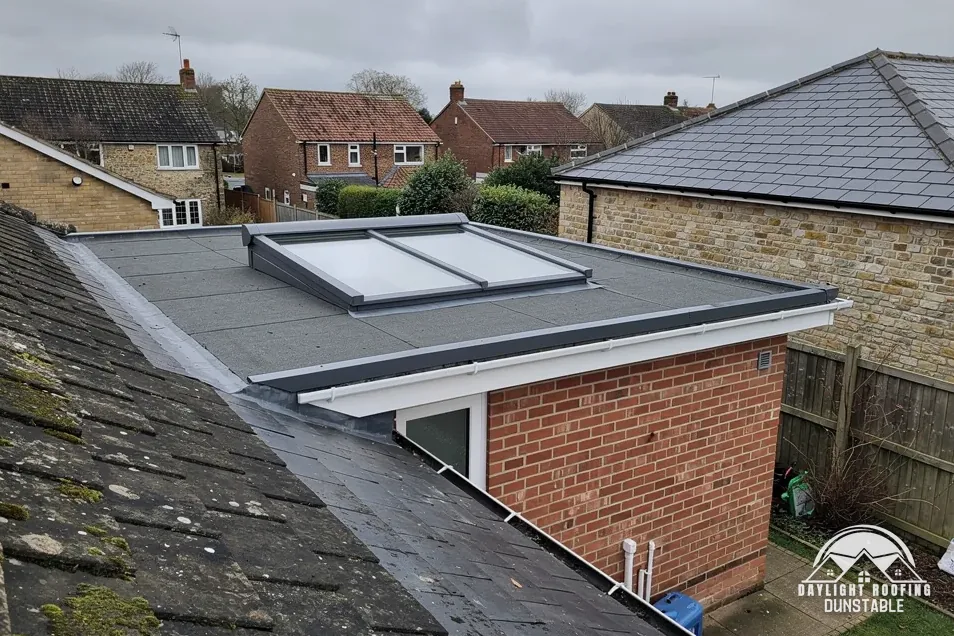
A roof window has no single age
Velux is a brand name, and the same parts are found in roof windows of any make. The question has no one answer, because a roof window is not one thing. It is a glazed sash, a frame, seals, a flashing set into the roof covering and the gear that opens and closes it, and each of those parts wears at its own speed.
For the same reason a single number of years would mislead. It would have to treat a window shaded by a tree and one in open sun as the same, a window fitted with care and one fitted badly as the same, and a window that has been kept clear of leaves and one that has been left as the same. None of those comparisons is fair to the window in front of you.
What can be said is which parts wear, what the signs look like and how a worn part is weighed against replacing the whole window. The guide on repairing or replacing a roof window deals with the decision itself. The sash, the frame, the seals, the flashing and the opening gear each wear in their own way and show it with their own signs.
The five parts that wear
Five parts decide how a roof window ages. Looking at them separately is more useful than asking about the window as a whole, because a repair can touch one part and leave the others alone.
| Part | What it does | How it can wear |
|---|---|---|
| Seals | Close the joint between sash and frame | Harden or crack, then let air and water past |
| Glazed unit | Holds two or more panes apart | The edge seal fails and moisture shows between panes |
| Flashing | Laps the frame into the roof covering | Lifts, splits or packs with debris |
| Frame and sash | Carry the glass and the gear | Corrode, swell or drop out of square |
| Opening gear | Handle, hinges and stays | Stiffen, stick or work loose |
The table is a map and not a prediction. A part that can wear has not necessarily done so, and a window with one tired part is not a window at the end of its life. The next sections take the sealed unit and the seals, then the flashing, then the frame and the gear, because each calls for a different kind of look and a different kind of repair. Some of the parts can be reached from inside the room, such as the sash, the handle and the glass. Others sit on the roof and are seen only from outside, such as the flashing and the covering round it, which is why a survey covers both sides of the window.
Seals and the glazed unit
A roof window's glass is a sealed unit: two or more panes held apart by a gap and closed at the edge. When the edge seal fails, moisture can get into the gap and show as mist or droplets between the panes that no amount of wiping will remove. That is a different thing from condensation on the inside face of the glass, which wipes away and has its own cause.
When a unit has failed, the fault lies in the glazing and not in the roof. Depending on the make and the age of the frame, the unit may be replaced on its own, or the whole window may be replaced. Which route suits a window depends on the product, and that is settled at the survey, one window at a time.
The rubber or foam seals between sash and frame have another job: they close the joint when the window is shut. They can harden, crack or flatten, and a window that looks sound from inside can then admit a draught or a drip at the joint. A seal is a small part, and where the maker supplies it, a worn one can be replaced without replacing the window.
Because a drip at the joint can look like a failed unit from below, we look at the unit, the seals and the frame together before saying which is at fault. A leaking window is judged on every part that could account for the leak.
The flashing round the frame
A roof window sits in an opening in the roof, and a flashing laps the frame into the surrounding covering so that rain runs across the frame and carries on down the slope. Where the covering is tile or slate, the flashing has to suit its profile. When it fails, water reaches the opening around the frame, not the glass, and the stain appears on the ceiling beside the window.
Flashing material is a separate question from the window. MyJobQuote, writing about chimney leadwork, says that correctly installed lead flashing can last for over 80 years. That is a statement about lead flashing on a chimney. It is not a lifespan for a roof window or for a flashing kit, and it is quoted only to show that the flashing and the window are judged apart.
What shortens a flashing's useful life is easier to see than its age. Leaves and moss packed against the upper edge of the frame, a gap where the covering has slipped and a split or lifted edge can each hold water where it should run off. A leak at the top of the frame can point to the flashing before it points to the glass.
Because the flashing is part of the roof and not part of the glass, it is judged from the roof itself, with the covering beside it. A window that is sound in every other respect can still leak for this reason alone.
Frames, sashes and opening gear
The frame and sash carry the glass and take the weather on their outer face. Each maker publishes care instructions for its own frames, and those are the place to look for how a particular finish should be treated; this guide does not try to replace them.
Signs that a frame is wearing include a finish that has flaked, swelling or softening at the lower corners where water sits, corrosion on metal parts and a sash that no longer closes square. A sash that has dropped can be seen from inside as an uneven gap around the edge of the closed window.
The handle, hinges and stays work every time the window opens. A stiff handle, a sash that will not stay where it is set or a catch that no longer pulls the sash tight can each be a worn part, and each should be pointed out to the surveyor, since the cause may be the part itself or the frame that holds it. A hinge that binds because the frame has moved needs a different answer from a hinge that has simply worn, and the two look alike from inside the room.
A loft room that relies on its roof window as an escape window needs that window to open fully when it is called on, so a sticking sash there deserves attention sooner. Escape windows serve storeys up to 4.5 m above ground, and the wider rules for loft rooms are in our guides to roof windows and Building Regulations.
What can shorten a window's life
Age on its own is a poor guide. The conditions around a window can add to its wear, and several are visible from the ground or from inside the room.
- Debris packed against the top of the frame, which holds water where the flashing laps over.
- A leak left alone, so that water reaches the timber round the opening and the insulation beside it.
- A sealed unit that has failed and been left, so the window mists and can insulate less well.
- A sash that has dropped and is forced shut, which strains the hinges and the seals.
- Moss or lifted covering beside the window, which sends water towards the frame instead of past it.
None of these is a count of years, and none depends on how old the window is. Each is a condition that can be seen, and each is cheaper to deal with early than late, because a leak that reaches the timber is a bigger job than a flashing that has been cleared in good time.
Clearing debris means getting onto a roof, which carries a risk of a fall. From the pavement, the garden or a window, look for packed leaves above the frame and for staining below it, and ask for a survey if either is there.
When age calls for a survey
A window's age is a prompt to look and not a verdict. A window with a worn seal and a sound frame may need a part. One with a corroded frame, a failed unit and a lifting flashing is a different case. The questions are what the window is, when it was fitted, what has been done to it, and what the survey turns up in the frame, the flashing, the unit and the timber round the opening.
| What shows | What it can mean |
|---|---|
| Mist between the panes | The glazed unit's edge seal has failed |
| A drip at the top of the frame | The flashing or the covering above it |
| A draught round the closed sash | Worn seals or a sash out of square |
| A sash that sticks | The gear or the frame |
If a window is replaced, the new window falls under the energy rules for new fabric. Approved Document L, in Table 4.2, sets a roof window at 1.4 or Window Energy Rating Band B minimum, and our guide to roof windows and Building Regulations sets out the rooflight figure and the planning side.
The quote after a survey arrives as a single written total, and the page on roof window and skylight costs gives dated third-party figures to read it against.