
Mist trapped between the panes
A double-glazed roof window has two sheets of glass held apart by a spacer, with a sealed gap between them. If that seal fails, damp air gets into the gap and condenses on the glass faces you cannot reach with a cloth. The mist can clear on a warm afternoon and return on a cold morning, so the unit can look fine at noon and cloudy at breakfast.
Run a fingertip over each face of the glass to find out where the moisture sits. Mist that wipes off is on the room-side surface and is a matter of humidity and ventilation in the room, which our guide to condensation on roof windows covers. Mist that stays put when you wipe is inside the sealed unit. A rim of grey or brown staining at the edge of the glass points the same way.
| Pattern | Possible cause | Next step |
|---|---|---|
| Droplets that wipe away | Moist room air meeting cold glass | Ventilate the room and watch the pattern |
| Haze that will not wipe off | Seal gone in the glass unit | Photograph it and note the time of day |
| Haze plus a wet frame edge | A leak as well as a seal fault | Check the lining and the flashing |
A misted sealed unit is a fault in the glass, not in the roof around it. Take a photograph in the morning and another in the afternoon, and send both on WhatsApp to 07880 284133 so the unit can be looked at before anyone orders glass.
A drip at the edge: the flashing and the covering
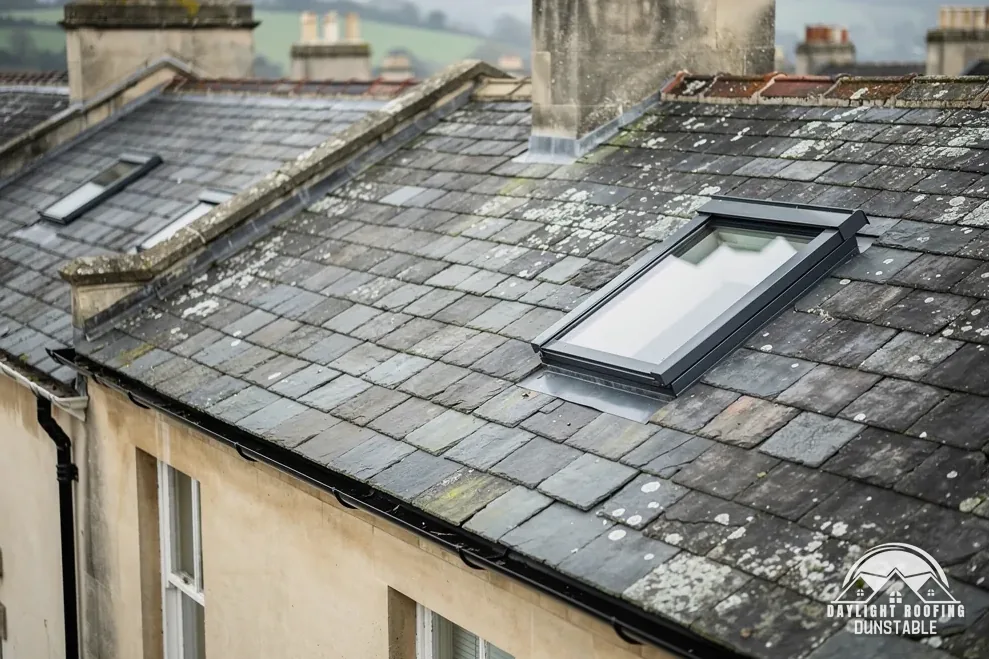
The frame is set into an opening cut through the roof covering. The gap between frame and tiles or slates is closed by a flashing, a set of metal pieces that overlap the frame on one side and tuck under the covering on the other. Every edge of that kit has to shed water onto the covering below it, so a lifted flashing or a slipped tile beside the frame lets rain in.
Look at the lining on the inside first. A stain that begins at a corner of the frame and runs down the reveal says water is arriving at the top or side of the opening. A stain across the bottom of the frame may be the lower edge of the flashing, or water running down the glass and over the sill. Where the flashing is lead, MyJobQuote says correctly installed lead flashing can last for over 80 years. That figure assumes correct installation, so a lifted lead apron is a fault whatever its age.
A ceiling stain shows less than a torch beam does. Climb into the loft in rain or soon after it, look at the timber around the opening and feel the insulation near it with the back of a hand. Damp felt, dark timber or a wet patch on the insulation places the problem at the window, not somewhere along the roof.
Do not smear mastic around the outside of a flashing. Sealant can hold a loose edge for a little while, and it hides the very gap that needs looking at.
Hinges that stick, sashes that will not stay open
A roof window should open smoothly, hold at the angle you set and close tight. A handle that has stiffened, a sash that drags on one side or a window that drifts shut on its own is telling you that the hardware, the frame or the seals have changed. A frame that has been pushed slightly out of square by movement in the roof can make a sash bind, and a seal that has swollen with damp can press against the frame.
Open the window slowly and watch the gap around the sash. An even gap means the hardware is probably sound and the stiffness is in the handle or the friction setting. An uneven gap, wider at one corner, points to a frame that has moved. Do not force a stuck sash, because glass in a pivot or top-hung frame is held at its edges and a hard pull can crack it.
- a handle that needs two hands to move
- a sash that scrapes the frame on one side
- a window that will not hold at a set angle
- a gap at one corner that lets in daylight when closed
The opening matters more where a roof window serves a loft room as its escape route. Approved Document B gives an emergency escape window a minimum area of 0.33m2, a minimum height and width of 450mm, and an openable area whose bottom edge is a maximum of 1100mm above the floor. Storeys up to 4.5 m above ground rely on such windows. A sash that sticks is a safety fault in that room as well as a nuisance.
Linings, reveals and the timber around the opening
The lining is the finished surface that runs from the window frame to the ceiling and wall, in timber, plasterboard or a plastic trim. It is the part of a roof window you see every day, and it records what water has been doing behind it. Paint that has bubbled, a lining that has darkened, a ring of mould at the top corners and plaster that has gone soft are all marks of moisture that has been present for some time.
Two sources of wet are possible and they leave different patterns. A leak at the flashing stains the lining at set points and can appear after rain. Condensation on the room-side glass drips onto the sill and the lower lining, which shows as a band of damp along the bottom edge. A lining that is damp at the top and the sides after a downpour points up and out, while one that is damp along the bottom after a cold night points to the room air.
Press the timber gently with a screwdriver handle or a thumb at a few points around the frame. Timber that gives under light pressure has taken in water for long enough to soften, and that is a reason to have the opening opened up and looked at, since the window frame and the roof timbers beside it may be affected as well.
Wipe away surface mould with a damp cloth only if the area is small and dry, and do not paint over a damp lining. Paint hides the colour change and keeps the moisture in.
Draughts, cracked glass and what a replacement has to meet
Cold air around the edge of a closed sash means the seals have lost their grip or the sash no longer closes square. A whistle in wind, a cold patch on the floor below the window or a curtain that moves with the window shut are all worth noting. A cracked pane is a different matter: it needs attention soon, because a crack can run, and a crack in the outer pane lets water into a sealed unit.
When a roof window is replaced as a whole, Approved Document L (2021) applies. Table 4.2 has a row for each: WER Band B minimum or 1.4 W/m²K for the roof window going in, 2.2 W/m²K for the rooflight. Roof window and rooflight name two different units there. Appendix A calls a glazed unit installed "out of plane with the surface of the roof on a kerb or upstand" a rooflight, and a window installed "in the same orientation as, and in plane with, the surrounding roof" a roof window. Our guide to rooflight against roof window explains the difference.
| Unit | Figure |
|---|---|
| Roof window | 1.4 W/m²K or Band B minimum |
| Rooflight on a kerb | 2.2 W/m²K |
Check the glass for a crack by tilting your head so that daylight crosses the pane. A hairline can be hard to see face on. Do not use the window if a pane is cracked in a way that could drop glass into the room.
Which signs point to a repair and which to a new window
Some of these faults sit in one part and can be put right there. A misted sealed unit is a glass fault, and a leak at the flashing is a fault in the weathering around the frame. A stiff handle or worn hinge can be a hardware fault. Others run through the whole window: a frame that has moved, linings that have rotted and timber that has softened mean the opening itself needs rebuilding.
A survey looks at all of it together before anything is priced, so that a window is not replaced for a fault that sits in the flashing, and a flashing is not redone around a frame that has failed. Our guide to repairing or replacing a roof window sets out the decision in more detail.
On MyJobQuote's figures a standard mid-range Velux averages £1,100, and swapping one into an existing opening costs around £100 less (22 September 2026). That is a single platform's average for a single make of window. We quote once the survey is complete, as one total on paper.
| Sign | Likely part |
|---|---|
| Haze inside the glass | Sealed unit |
| Stain from a frame corner | Flashing or covering |
| Sash binds on one side | Hardware or frame |
| Soft timber at the lining | Opening and frame |
Checks you can make safely and what to send
Everything above can be checked from inside the house, from the garden or from a loft with a torch. None of it needs a ladder on the roof or a foot on the slope, and none of it should have one. A roof window sits in a pitched slope where a slip can be serious, so keep off the roof and use binoculars from the ground to study the metalwork and the covering around the frame.
- glass: mist between panes, cracks, edge staining
- seals: draughts, gaps, swollen or split rubber
- sash: how it opens, holds and closes
- lining: stains, soft timber, mould, bubbled paint
- loft side: damp timber or insulation near the opening
Photograph each fault in daylight, with a coin or tape beside it for scale, and note when it appears: after rain, on cold mornings or all the time. Send the pictures on WhatsApp to 07880 284133, or ring 01582 935272, and we will look at them.
Where the window sits in a conservation area or on a listed home, rules on replacing it can differ from a house with none, so check the position with the council before ordering. Once the survey is done, one written figure covers the work.