
Call 01582 935272

Aston · 22 road miles east

Roofers in Aston

Aston is a Hertfordshire village 21.9 road miles east of Dunstable, with a Grade I manor, a Grade II* church and a conservation area; flat roofs, soffits and eaves are priced after a survey as one written total.

Get a written quote

Call 01582 935272WhatsApp us

Council
East Herts
Road miles
22
Conservation area
Aston
Building control
Hertfordshire BC Ltd

Roofs near Aston Bury Manor and Benington Road

Aston's Parish Church of St Mary the Virgin (Church of England) is listed Grade II*, entry 1101433, first listed on 24 November 1966. Aston Bury Manor stands higher at Grade I (entry 1174988, listed 20 October 1952), numbers 43 and 45 Benington Road are Grade II* (entry 1175062, listed 31 May 1984) and Grade II is the listing of the Rose and Crown Public House (entry 1295481). East Hertfordshire District Council has designated an Aston conservation area, and the Article 4 directions recorded close by are Stevenage Borough Council's, for its own area, so the step for any Aston address is to check with East Herts Council whether an Article 4 direction applies.

Aston parish had 839 usual residents at the 2021 Census. Planning applications for the village go before East Herts Council, and building control is the work of Hertfordshire Building Control Ltd, which East Herts Council owns jointly with other Hertfordshire local authorities (operations team 01438 879990). The planning guide deals with permitted development, flat roofing with membrane roofs, and guttering, soffits and fascias with the roofline.

  1. 01St Mary's churchGrade II* (entry 1101433), Church of England. Roof matters run through the faculty system, with planning a separate question for outside work.
  2. 02Aston Bury ManorGrade I (entry 1174988). Consent follows the character of the building, and the council is the first call for any roof change.
  3. 0343 and 45, Benington RoadEntry 1175062, Grade II*. Any new covering for these houses should be raised with the council before it is planned.
  4. 04Rose and CrownEntry 1295481, Grade II. A listed pub roof is a commercial job, and its price follows a survey.
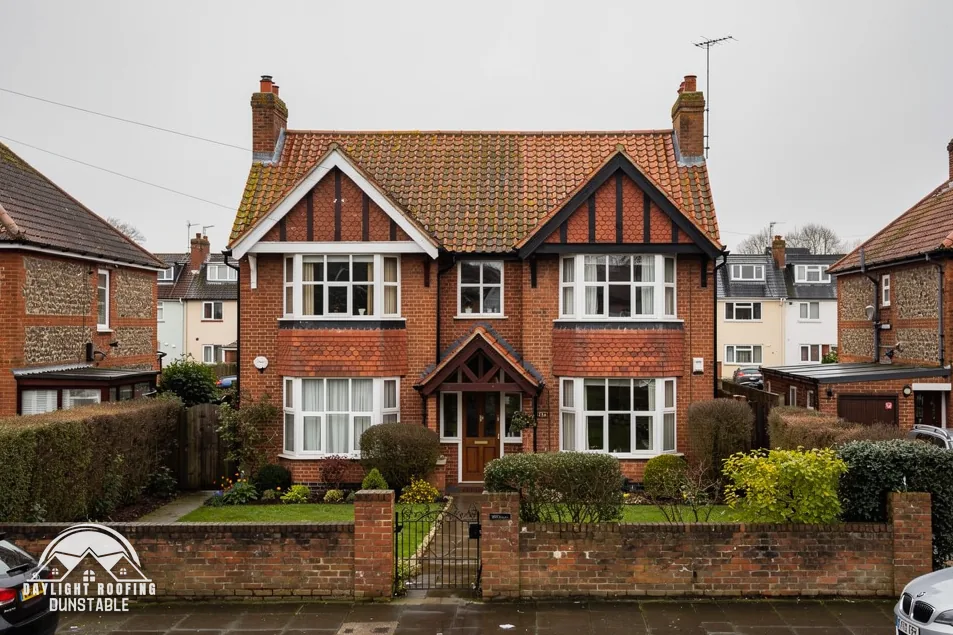
A detached Edwardian brick house with a clay tiled roof and gables

The roof, in plain words

Fall
The gentle slope that lets water run off a flat roof.
Soffit
The board closing the underside of the eaves, between wall and fascia.
Membrane
The waterproof sheet, such as EPDM, that covers a flat roof.
Cold roof
Insulation sits at ceiling level, with air passing through the void above it.

The plain-as-day roof check

Eaves, falls and soffits at Aston

4 checks about 3 minutes to read

  1. Falls on an extension roof
  2. Ventilation at the eaves
  3. Soffit boards and asbestos
  4. Listings and Article 4 nearby

01 Falls on an extension roof

A flat roof is never meant to be quite flat. BS 6229:2025 is the code for flat roofs with continuously supported flexible waterproof coverings; it is current, the 2018 edition is withdrawn, and it covers membranes, not lead. NFRC reads it as setting "a minimum 1:80 finished fall for general roof areas and internal gutters", and IKO reports that the code says to design for 1:40 so that 1:80 is achieved once the roof is built. Water that cannot leave the surface sits on the covering, adds load to the deck and stresses every seam.

HomeBuilding and Less each state covering lifespans, and the figures differ. HomeBuilding puts EPDM at 25-30 years, GRP at 25-30 and felt at 10-15. Less says EPDM "typically lasts 30 to 50 years", GRP "lasts 25 to 40 years with minimal maintenance" and torch-on felt "lasts 10 to 20 years depending on quality and installation". Water lying on an Aston extension roof after rain is a reason to have the fall looked at, and the flat roofing page lays the three coverings out next to each other.

02 Ventilation at the eaves

Ventilation is about moisture in the roof void: air moving through carries damp out before it condenses on cold timber. Marley's guidance, based on BS 5250, covers the case where a high-resistance underlay lines a cold roof: the eaves then need a gap of 25mm along their length for pitches of 15° or less, and 10mm for pitches above 15°. An HR underlay does not let vapour through, so the air has to come through the eaves gap, not through the underlay.

From outside, look for paint or debris choking the gap behind the fascia. In the loft, look for damp rafter ends, a musty smell or a stained underlay close to the eaves. A warm roof is a different build-up, and its ventilation rules differ, so the survey establishes which kind of roof an Aston house has before any figure is applied. The pitched roofing page covers the build-ups in more detail.

03 Soffit boards and asbestos

The soffit is the board that closes the gap under the eaves, and one with vent strips or perforations is doing the ventilation job from the previous check. HSE names "AIB white soffit panels to underside of roof eaves" in its list of where asbestos insulating board turns up, and its guidance reads "If the building was built or refurbished before 2000, assume that there is asbestos in it." Work on AIB is licensed where the risk assessment indicates that it will not be of short duration, so have a soffit that might be AIB identified by an asbestos specialist, which is separate specialist work, before anyone drills, cuts or pulls it.

White uPVC boards are the modern alternative. A retailer says that, fitted correctly, its fascia boards "can typically maintain reliable performance for between 20 and 40 years". A cracked, bowed or discoloured board marks a roofline that is failing, and a gutter pulling away from a fascia shows the same thing from a different angle. A replacement board has to keep the air path open. Replacement is covered under guttering, soffits and fascias.

04 Listings and Article 4 nearby

GOV.UK explains that "An article 4 direction is a direction under article 4 of the General Permitted Development Order which enables the Secretary of State or the local planning authority to withdraw specified permitted development rights across a defined area." Stevenage Borough Council's directions, close to Aston, apply within its own area and decide nothing by themselves about an Aston roof. For an Aston address the question goes to East Herts Council, and the reply is worth keeping in writing, since it settles the route for the whole job.

The listed buildings give the practical test: Aston Bury Manor, the parish church, 43 and 45 Benington Road and the Rose and Crown each have a list entry number, and a roof job on any of them starts from the entry. Work that would affect the character of a listed building needs consent, whatever the covering, so a like-for-like repair and a change of material are not treated the same way, and the council is asked about the difference. Each listed building is asked about on its own, and one reply does not cover all of them.

The dashed ring takes in the nearest towns and villages we cover around Aston. Map tiles © Esri; map data © OpenStreetMap contributors.

Aston roof questions, from listings to soffits

01What shortens the life of a flat roof on an Aston extension?

Standing water after rain points to a fall that is too shallow, and a membrane lifting at an upstand or splitting at a seam lets water in at a joint. Sources disagree about lifespans: for EPDM, HomeBuilding says 25-30 years and Less says 30 to 50 years; for felt, 10-15 against 10 to 20 years depending on quality and installation. A survey reads the actual covering and the deck beneath it, because an old felt covering and a newer EPDM sheet can look alike from the ground but age differently, and the written total covers whatever the survey finds, with flat roofing explaining the options for the covering.

02Could the soffit boards on an Aston house contain asbestos?

HSE says "If the building was built or refurbished before 2000, assume that there is asbestos in it." It names asbestos insulating board white soffit panels at the underside of roof eaves as one place to look, and it describes damaged AIB soffits as well. A board that is intact can stay put until it is identified; a board that is broken, drilled or cut changes the risk, and the handling rules change with it. A soffit that might be AIB is identified first, and only then is the roofline work priced. Paint flaking from a soffit, a stain below it or a board that has dropped at one end are all worth noticing from the ground.

03How does an owner near Aston Bury Manor find out whether a house is listed?

The National Heritage List for England carries one entry per listed building, each with its own number: Aston Bury Manor is entry 1174988, 43 and 45 Benington Road entry 1175062 and the Rose and Crown entry 1295481. Looking an address up there shows whether it has an entry. A house with no entry can still sit inside the Aston conservation area designated by East Hertfordshire District Council, and East Herts Council can confirm both points for one address in a single reply. The entry itself is worth reading before a roof change is planned.

04What route does roof work on Aston's parish church follow?

The Parish Church of St Mary the Virgin is a Church of England church, listed Grade II* (entry 1101433). A church in use sits within the faculty jurisdiction of the Church of England, so a faculty replaces listed building consent for it. The exemption stops there: exterior work can still need planning permission under the ordinary tests, and that planning question is for East Herts Council. A private house in the village follows the listed-building route, not the faculty route.

05Is there an Article 4 direction on roofs in Aston?

The directions recorded near Aston are Stevenage Borough Council's, for its own area, and an Aston address answers to East Herts Council. The route for any Aston house is to check with East Herts Council whether an Article 4 direction applies. GOV.UK's wording is that a direction withdraws specified permitted development rights across a defined area, so for work that would otherwise need no application it settles whether one is needed after all. Directions covering a change of use say nothing about a roof.

06Who licenses scaffolding on an Aston lane or pavement?

Hertfordshire County Council licenses scaffolding on Aston's highways, not East Herts Council. The licence from Hertfordshire County Council costs £134 for 14 days, and each week after costs £59. Hertfordshire County Council quotes "It usually takes 3 weeks to process an application", and it requires a 1.2 m clear walkway on the footway at all times. We arrange it with our scaffolder. Where the scaffold can stand entirely on the property, no highway licence arises, and the survey shows which case an Aston house falls into.

07Does recovering a flat roof in Aston bring in Part L energy rules?

Renovation, in Approved Document L's terms, includes replacing a flat roof's waterproof membrane. Where more than 50% of a roof's surface is renovated, AD L expects the whole roof to be brought up to its Table 4.3 standard where that is feasible: 0.35 is the threshold and 0.16 the improved value. Where a full upgrade is not feasible, or would fall short of a simple payback of 15 years or less, the roof goes as far as is feasible within that payback. A survey of the deck shows what the build-up would need.

08What does a loft conversion in Aston need for escape?

Approved Document B says escape windows serve storeys up to 4.5 m above ground. Where a loft conversion creates a storey above 4.5m, paragraph 2.5 calls for either a protected stairway or an alternative escape route, and paragraph 2.23 allows sprinkler protection for open-plan layouts. The edition is the "2019 edition incorporating 2020, 2022, 2025 and 2026 amendments". A conversion is a building control matter first, and East Herts Council's provider is Hertfordshire Building Control Ltd, operations team 01438 879990.

09What does one written total price cover for an Aston roof?

It is a single figure for the whole job, given after the survey, and where a job needs scaffold the scaffold sits inside it. We also tell you plainly what else the survey saw on the roof, for example a ridge tile that has worked loose or a flashing that has lifted. If the job needs a council route, whether planning or building control, the route is checked with the council before work starts, and any scaffold licence is something we arrange with our scaffolder. The figure follows the survey, never a guess from the road.

Get a written price for your roof

10-year workmanship guarantee, in writing

Tell us about your roof

Call WhatsApp Written quote