
Call 01582 935272

Benington · 23 road miles east

Roofers in Benington

Benington, 23.3 road miles east of Dunstable, is a Hertfordshire village with a Grade I church, castle remains and a conservation area; roof work follows a survey and ends in one written total price.

Get a written quote

Call 01582 935272WhatsApp us

Council
East Herts
Road miles
23
Conservation area
Benington
Building control
Hertfordshire BC Ltd

Roofs near Benington Lordship and Church Green

Benington's Parish Church of St Peter holds a Grade I listing (entry 1101403, first listed 24 November 1966) and belongs to the Church of England. The Remains of Benington Castle, in the grounds of the Lordship, are Grade I as well (entry 1175349), while The Bell Public House and Benington Lordship are both Grade II* (entries 1101413 and 1101404). A motte and bailey castle west of Church Green is a scheduled monument (entry 1007844), and East Hertfordshire District Council has designated a Benington conservation area.

Benington parish had 903 usual residents at the 2021 Census. East Herts Council handles planning for the village, and building control is carried out by Hertfordshire Building Control Ltd, which East Herts Council owns jointly with other Hertfordshire local authorities (operations team 01438 879990). Chimneys are covered under chimney repairs, metal roofing under lead roofing and leadwork and a whole new covering under roof replacement, while the permitted development tests sit in the planning guide. Listed and scheduled entries are the first thing to look up for any building near Church Green.

  1. 01St Peter's churchGrade I (entry 1101403) and Church of England, so repairs go through the faculty system, with planning for outside work judged separately.
  2. 02Castle remainsGrade I (entry 1175349) in the Lordship grounds. The scheduled motte and bailey (entry 1007844) near Church Green has its own consent rules.
  3. 03The BellGrade II* (entry 1101413). A pub is a business premises, so its roof is a commercial job, priced once a survey has seen it.
  4. 04Benington LordshipGrade II* (entry 1101404). Consent follows the building's character, so a change of covering is raised with the council early.
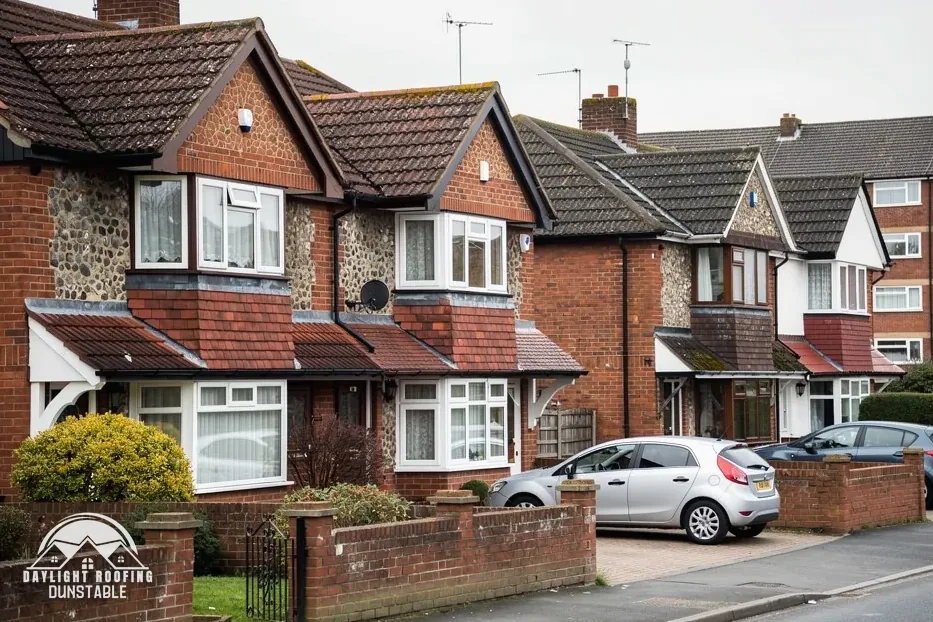
Edwardian brick and flint semi-detached houses with tiled gables

The roof, in plain words

Scheduled
A protected site where works need authorising, not listed building consent.
Flue lining
The inner skin of a chimney stack, guiding smoke up and out.
Standing seam
Metal sheets joined by upturned edges folded together along the slope.
Cooling-off
The 14-day period in which a contract made at home can still be cancelled.

The plain-as-day roof check

Four things to weigh near Benington castle and church

4 checks about 3 minutes to read

  1. Scheduled ground near roofs
  2. Stacks, flashings and pots
  3. Zinc and standing seams
  4. Signing a contract at home

01 Scheduled ground near roofs

A scheduled monument is a site protected by law. Under section 2 of the Ancient Monuments and Archaeological Areas Act 1979 it is an offence to carry out works to one unless the works are authorised. The Secretary of State grants the consent, and Historic England receives the applications. Listed building consent does not apply to a building that is on the schedule. Benington Castle, the motte and bailey west of Church Green, carries entry 1007844, and the Remains of Benington Castle in the Lordship grounds hold a separate Grade I list entry, 1175349.

A house or outbuilding near the castle site is not automatically part of it. The scheduled area is shown in the monument's own list entry, which settles whether roof work could touch protected ground, for instance through where a scaffold stands or a skip is placed. Any request for consent goes to Historic England, quoting the entry number. Entry 1007844 is the reference to quote when asking, and a reply kept in writing saves repeating the question to the next owner or to a buyer's solicitor.

02 Stacks, flashings and pots

A chimney stack meets the roof at its flashings, and that join is one place where an otherwise sound stack can let water in. MyJobQuote says "A chimney lead flashing patch repair typically costs around £200, while a full replacement averages around £570." (page dated 22 September 2026). Its figures are for chimney leadwork alone, not for lead on a porch or a bay, and the same source says correctly installed lead flashing can last for over 80 years.

Taking a breast out beneath a stack is a bigger matter. The Planning Portal says "Building regulations approval will always apply when removing chimney breasts", and a breast built into a party wall brings a notice that has to "be served at least two months before the date on which the proposed work will begin". On a listed building such as Benington Lordship, any change to a stack is also a consent question for East Herts Council. Repointing is priced after a survey, since its cost turns on how much mortar has gone and how high the stack stands.

03 Zinc and standing seams

Zinc roofing is laid in long sheets whose edges turn up and fold together along the slope, forming a standing seam. VMZinc, the maker, says "When correctly designed and installed a zinc roof can last in excess of 100 years." That is a maker's claim with its condition attached: design and installation decide whether the figure applies to a particular roof. Zinc is formed on site to the profile of the roof, so each run is cut to length and the folds are made along the slope.

Lead is the other metal used for small roofs, flashings and porch tops. MyJobQuote says correctly installed lead flashing can last for over 80 years, HomeBuilding gives a lead flat roof 60-100 years and Less says 50 to 100. Which metal suits a Benington extension or bay depends on the shape, the pitch and the neighbouring covering, and the lead roofing page sets out where each is used.

04 Signing a contract at home

A roofing contract signed at the house, after a survey, is an off-premises contract, and the Consumer Contracts Regulations give a right to cancel: "the cancellation period ends at the end of 14 days after the day on which the contract is entered into". Counting starts the day after signing. Work starts sooner only on a request made in writing, which does not take the right away, though the customer may owe for work already done, so a request to start early is a decision worth making deliberately.

Two further points. No cancellation right exists where the customer "has specifically requested a visit from the trader for the purpose of carrying out urgent repairs or maintenance". And under the Consumer Rights Act 2015 a trader owes a "Service to be performed with reasonable care and skill". The Citizens Advice consumer helpline, 0808 223 1133, is the place for anyone unsure of their position, and a signed written quote is the record that settles what was agreed.

The dashed ring takes in the nearest towns and villages we cover around Benington. Map tiles © Esri; map data © OpenStreetMap contributors.

Benington roofs, castle ground and contracts

01What can a Benington owner check on a chimney stack from the ground?

Look at the stack from the ground: pointing that has fallen out, a lean, cracked flaunching or a cap that has shifted. Then look at the base, where lead is dressed against the brick, for a lifted edge or a gap. Indoors, a stain on the chimney breast just below the roof can be a sign that water is getting past it. A photograph of the whole stack and one of its base, sent on WhatsApp to 07880 284133, gives a first view, and chimney repairs describes the work in plain words, step by step.

02Does the scheduled castle site change roof work in Benington?

Scheduled monument consent applies to works to the monument itself; the Secretary of State grants it, and Historic England receives the applications. Benington Castle, the motte and bailey west of Church Green, is entry 1007844. Whether a given house or outbuilding falls within the scheduled area is shown in that list entry, and the question arises whenever scaffold, a skip or any digging would sit on or near the monument. A roof on an ordinary house elsewhere in the village follows the usual routes, listed or not.

03What route do repairs at St Peter's church in Benington follow?

St Peter's holds a Grade I listing (entry 1101403) and is a Church of England church. Within the faculty jurisdiction of the Church of England, a church in use goes through the faculty system and not through listed building consent. The exemption covers listed building consent alone, so outside work may be caught by planning rules in its own right. Ask the parish's advisers and East Herts Council before any roofer prices the roof, and keep the replies, since a faculty and a planning decision are separate documents.

04How long can a zinc roof last on a Benington extension?

VMZinc, the maker, says a zinc roof "can last in excess of 100 years" when correctly designed and installed. That is the maker's figure and it depends on the design and installation, so it cannot be read as a promise about a particular roof. Sheets are folded into standing seams along the slope, and a low-pitched extension or a bay is a place where the metal is used. A written total for a zinc or lead covering follows a survey of the structure, the falls and every junction where the metal meets a wall or another roof.

05Does a Benington homeowner pay the VAT reverse charge on a roof job?

The construction reverse charge applies to supplies reported within the Construction Industry Scheme, between VAT-registered businesses. HMRC's guidance says it "does not apply for supplies to end users" once an end user has confirmed that status to the supplier in writing. The same guide answers the Benington homeowner's question directly: "if services are provided to a private domestic customer, the reverse charge does not apply because the customer will not be VAT registered", so a household has nothing to send. The written total for a Benington roof is one figure, and the quote is the document to read for what it covers. A landlord or a business owner with a property in Benington can ask about their own VAT position.

06Is a Benington homeowner responsible for safety on a roofing job?

CDM 2015, the construction safety regulations, treats a homeowner as a domestic client, and the duties are carried out by "the contractor for a project where there is only one contractor" or by the principal contractor on a job with several contractors. The contractor also draws up "a construction phase plan". The homeowner is not asked to write one. What a Benington homeowner can do is point out where the loft hatch is, how the roof is reached and any fragile sheeting on an outbuilding or garage, and tell the contractor about anything underneath such as a conservatory or a lean-to.

07What does a scaffold licence cost for a roof in Benington?

Hertfordshire County Council is the highway authority for Benington, and its scaffold licence costs £134 for 14 days, plus £59 for every week after. Hertfordshire County Council reports that "It usually takes 3 weeks to process an application", and a clear walkway of 1.2 m must remain on the footway. We arrange the licence with our scaffolder. Where the scaffold stays within the property boundary, no highway licence applies, and the survey of a Benington house shows which case it is.

08Does the Benington conservation area change how a roof is re-covered?

East Hertfordshire District Council has designated a Benington conservation area, and whether a given address lies inside it is for the council to confirm. Planning rules for ordinary re-roofing are set out in the planning guide. An Article 4 direction can remove further permitted development rights, so we check with the council first, and for a listed building the test is whether the work would affect its character. Keep the council's reply on file, since a later buyer's solicitor may ask for it, and send it with any photographs.

09Who can a Benington homeowner ask about a roofing dispute?

The Citizens Advice consumer helpline, 0808 223 1133, advises individuals on consumer problems; Trading Standards does not advise individuals. For work that has gone wrong, the standard is the Consumer Rights Act's requirement that a service be carried out with reasonable care and skill. Where an insurance claim is involved, the Financial Ombudsman Service is the next step after the insurer's own complaints process. Photographs taken before and after a repair, and the written quote, are the records that count in any dispute, so keep them together in one folder or one email thread.

Get a written price for your roof

10-year workmanship guarantee, in writing

Tell us about your roof

Call WhatsApp Written quote