
Call 01582 935272

Tylers Green · 26 road miles south-west

Roofers in Tylers Green

Re-roofs, repairs, chimney leadwork and gutters for houses in Tylers Green, each ending in a single written total, with the Penn and Tylers Green conservation area checked before any covering is chosen.

Get a written quote

Call 01582 935272WhatsApp us

Council
Buckinghamshire
Road miles
26
Conservation area
Penn and Tylers Green
Building control
Buckinghamshire Council

Roofs round St Margaret's and Rays Yard

Tylers Green is a Buckinghamshire village lying south-west of Dunstable, 25.6 road miles away and about 45 minutes by road. The village falls within Chepping Wycombe parish, which had 14,537 usual residents at the 2021 Census. The Church of St Margaret is listed Grade II (entry 1125628, first listed 8 January 1987), and so are Rays Yard (entry 1158974) and Greycot (entry 1332131), both from that same date. Older roofs in a place like this can raise a heritage question before they raise a repair one, and the answer shapes which covering is even on the table.

The conservation area carrying the Penn and Tylers Green name was created by Buckinghamshire Council, which also handles planning applications here. Round the green, the council's answer for a house is worth having before any covering is picked, because a rule that surfaces halfway through a job costs far more than one learnt on day one. Surveying comes ahead of pricing, and what the survey finds, other faults included, is told to you plainly before the written total. That includes sheltered corners hidden from the lane, such as the back slope above an extension.

  1. 01Rays Yard and GreycotBoth are listed Grade II, so work to their roofs is read against the list entry before any covering is chosen.
  2. 02Yonder LodgeListed Grade II (entry 1309723), so an altered roofline is tested against what the listing is there to protect.
  3. 03Church of St MargaretA Grade II Church of England church, so work to its roof follows the faculty system, not listed building consent.
  4. 04Houses near the greenWhether an Article 4 direction applies to a given house is something to check with Buckinghamshire Council, ahead of planning the work.
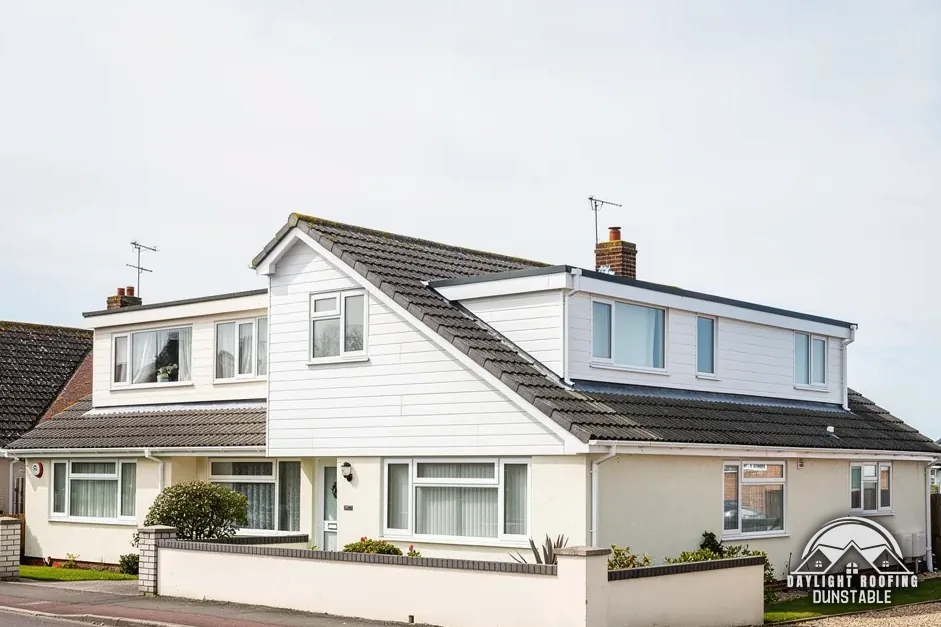
A pair of chalet bungalows with flat-roofed box dormers

The roof, in plain words

Underlay
Sheet fixed beneath the battens that carries away water slipping past the tiles.
Batten
A slim length of timber fixed over the rafters, holding each course of tiles.
Flashing
Lead or another metal weatherproofing the joint at a wall or chimney stack.
Article 4 direction
A council order withdrawing specified permitted development rights across a defined area.

The plain-as-day roof check

Four things to read from Tylers Green gardens and lanes

4 checks about 3 minutes to read

  1. Ridge and hip tiles
  2. Lead beside the stack
  3. Gutter fall at the eaves
  4. The roof space under the slope

01 Ridge and hip tiles

Ridge tiles cap the apex of a roof and hip tiles cap each sloping corner. They sit along the top lines of the roof, so a survey looks at the fixing as well as the finish. BS 8612:2018 covers dry-fixed systems for ridge, hip and verge, and Marley's guidance says ridge or hip tiles "should be mechanically fixed to resist the calculated wind uplift force". Standing in a garden or on the green, run an eye along the line for one tile sitting proud, a crack in the bedding, or a dip in an otherwise straight ridge.

Mortar bedding alone is the older method. Marley records that since the 2015 amendments mortar "could no longer be relied upon as the only means of securing the roof covering", which is why a survey asks what is holding a ridge down. On cost, a new ridge tile comes in at £80 to £300 in the Which? Trusted Traders survey (11 traders, November 2025, VAT excluded); the figure is for one tile and not for a length of ridge.

02 Lead beside the stack

A chimney stack is brickwork standing up through the roof, and strips of lead called flashings bridge the joint between the two. MyJobQuote says lead flashing that is correctly installed "can last for over 80 years". For chimney leadwork alone, it says a patch repair "typically costs around £200, while a full replacement averages around £570" (page last updated 22 September 2026). From the lane, check the lead for a curling edge, a crack running along a fold, and then look indoors for brown marking on the chimney breast.

Lead comes as rolled sheet made to BS EN 12588 in codes 3 to 8, and code 4 is 1.80 mm thick. Which code suits each detail is a matter for the specification. Not every joint round a stack is lead, since some are sealed with a cement fillet, and a survey separates the two. Chimney work more widely is set out under chimney repairs, and the lead itself is covered in lead roofing and leadwork.

03 Gutter fall at the eaves

Rain leaves the roof through the gutter, so the run has to fall gently toward its outlet. Brett Martin gives the slope as "1mm for every 600mm". A line of standing water, dripping from a joint, or a green tidemark staining the wall below each point to a fall or a joint that has shifted. A sagging bracket and a clogged outlet are separate faults: one needs refixing and the other needs clearing, which is why the two are told apart before anything is priced.

For a sense of scale, Which? Trusted Traders give £75 to £350 for a gutter clear-out on both the front and the rear of a house, excluding VAT (November 2025). If a bracket has failed because the fascia behind it has softened, the board is the real repair and the bracket is only the symptom. Replacement runs, fascias and soffits are covered at guttering, soffits and fascias.

04 The roof space under the slope

Damp in a loft stays a mystery until its cause is separated. For a cold loft under high-resistance underlay, Marley's eaves figures are 25 mm of ventilation at a pitch of 15° or less and 10 mm above that. Vapour cannot pass such an underlay, so those eaves openings carry the whole burden. BS 5250:2021 is the code that deals with moisture in buildings generally.

Up in the loft, play a torch beam over the rafters. Pinpoints of daylight, or a damp smell, suggest a gap in the covering; dark spotting across the whole underside suggests the house is sending moisture upward. Check too that insulation has not been stuffed into the eaves, because that closes the very gap the ventilation figures rely on. Where the loft has been boarded or converted, the same questions apply to the space between the insulation and the underlay.

The dashed ring takes in the nearest towns and villages we cover around Tylers Green. Map tiles © Esri; map data © OpenStreetMap contributors.

Tylers Green roof questions, one at a time

01Standing on the pavement or in the garden, what can be read from a Tylers Green roof?

In good light, start at the ridge and its row of tiles, then the chimney for lead lifting or mortar crumbling, and along the eaves for a sagging gutter or a stain running down the brickwork. Indoors, a torch in the loft will pick out daylight where the covering has gaps and dark patches on the timbers. Mark where each sign is, and note whether it is above a bedroom, a landing or a bathroom, since that places it on the roof. A WhatsApp picture from you can be looked over before any visit is arranged, and the survey then checks from the roof itself whatever the view from the ground suggested. Smaller faults like these sit under roof repairs.

02Does work on the Church of St Margaret's roof go through the council?

The church is listed Grade II (entry 1125628) and is a Church of England church, so its roof sits within "the faculty jurisdiction of the Church of England" and not under listed building consent. That exemption stands in for listed building consent and nothing wider, so alterations to the outside of the church may still have a planning dimension of their own. Nobody living in an ordinary house takes part in the church's process. A listed house such as Rays Yard or Greycot is different, because it uses listed building consent when work would affect its character.

03What counts as affecting character on a listed roof such as Greycot?

If work would be carried out "in any manner which would affect its character as a building of special architectural or historic interest", listed building consent is the requirement; a listed home still keeps its permitted development rights. Greycot (entry 1332131), Rays Yard (entry 1158974) and Yonder Lodge (entry 1309723) are each listed Grade II. Matching the old covering and moving to a new material are separate questions, and the answer for one job rests with Buckinghamshire Council, who should be asked while the covering is still undecided.

04How does the conservation area change the order of work on a Tylers Green re-roof?

It puts one more question at the front. The Penn and Tylers Green conservation area is Buckinghamshire Council's designation, and an Article 4 direction can remove further permitted development rights, so we check with the council first. Establishing whether a direction reaches an address takes a short enquiry, whereas learning of one later can halt a job midway. Planning in general is dealt with in the planning guide, though for a named property it is the council's reply that counts.

05Which authority licenses scaffolding at a Tylers Green house, and what does it charge?

We arrange the licence with our scaffolder. Scaffolding across a footway or carriageway is caught by section 169 of the Highways Act 1980, and Tylers Green's highway authority, Buckinghamshire Council, sets its charge at £402.78 for 28 days, with £69.09 for renewal and £777.63 for a licence applied for retrospectively; its rule on applicants is "You must be a registered scaffolding company to apply for a licence." Scaffold that a job needs goes into the one written figure, and a renewal fee stretches the licence if the work outlasts the first 28 days.

06When does a heavier replacement covering need a check at Tylers Green?

The Planning Portal sets the trigger where a new covering material makes the roof covering heavier by "15 per cent or more", and it advises asking a structural engineer or surveyor before work starts. Approved Document A defines a significant change in roof loading as one where "the loading upon the roof is increased by more than 15%". The building control body for Tylers Green is the council's in-house team; Buckinghamshire Council's building control page carries the contact details. Because a complete re-roof touches more than 50 per cent of the roof, it lies beyond the Planning Portal's limit and brings Building Regulations approval with it, covering or no covering.

07What range do outside sources give for replacing the whole roof of a house here?

What a customer is given is one written figure, given after the survey. For outside context, Which? Trusted Traders put the cost of re-roofing an average three-bedroom house in full at £7,000 to £21,000 excluding VAT, from a survey of 11 traders in November 2025. HomeBuilding (last updated 30 September 2025) says "a standard three-bedroom semi with a 65m² roof and plain concrete tiles may cost between £10,000 and £15,000". Access, covering and roof size push a real quote up or down, so the ranges are a loose guide only.

08What evidence helps a storm-damage claim on a Tylers Green roof?

Photographs of the damage, dated and taken before anything is cleared. The Financial Ombudsman Service says it will "usually look at expert reports and photos", and that "Rain, hail or snowfall by itself can constitute a storm". Should a claim be refused, "For most complaints, a business has up to 8 weeks to consider a complaint" before it can be brought to the Ombudsman. A fallen tile should be kept for the insurer to inspect, and the climbing should be left to a roofer.

09What if the garage roof or eaves boarding at a Tylers Green house is asbestos?

HSE's advice is "If the building was built or refurbished before 2000, assume that there is asbestos in it." Cement roof sheeting taken off carefully and whole counts as non-licensed work, yet "AC roofs are always fragile", so nobody should put weight on one. HSE also lists "AIB white soffit panels to underside of roof eaves", and most work on asbestos insulating board is licensed. Any asbestos waste belongs in a lockable skip, never an open one, so a suspect board is left whole, with no drilling, sanding or breaking, until it has been identified, and any broken sheet is kept away from children and pets.

Get a written price for your roof

10-year workmanship guarantee, in writing

Tell us about your roof

Call WhatsApp Written quote