
Call 01582 935272

Halton · 14 road miles south-west

Roofers in Halton

Halton roof repairs, re-roofs, chimneys and gutters, with a conservation area and listed buildings in the village, so the planning route is checked first and one written total follows.

Get a written quote

Call 01582 935272WhatsApp us

Council
Buckinghamshire
Road miles
14
Conservation area
Halton
Building control
Buckinghamshire Council

Roofing around Halton House and the parish church

At the 2021 Census, Halton parish had 1,417 usual residents. Dunstable is 13.5 road miles away and the village lies to its south-west, about 24 minutes by car, and its roofing questions turn less on size than on status. Halton House is listed Grade II*, the Church of St Michael and All Angels is listed Grade II, and Ivy Cottage and the Post Office are both listed Grade II. So the roof of any of these is read as part of a protected building first, and as a repair second.

Beyond the listed buildings, the village has a conservation area designated by Buckinghamshire Council, which also handles planning applications for every Halton address. Whether a house is listed, inside the conservation area or neither, the order is fixed: a survey of the roof, a straightforward report of what the survey found plus anything else we noticed, then one written total price. Where the council's permission could come into it, we check the route with the council before work starts.

  1. 01Listed house roofsHalton House and Ivy Cottage are listed, so a change touching a roof's character needs listed building consent first.
  2. 02Church roof workSt Michael and All Angels is a Church of England church, so its roof follows the faculty system rather than listed building consent.
  3. 03Conservation area homesInside the Halton conservation area, an address is checked with Buckinghamshire Council before roof work begins.
  4. 04Stacks and flashingsA chimney stack and the lead round its base are read together, because a failed joint shows as damp on the breast indoors.
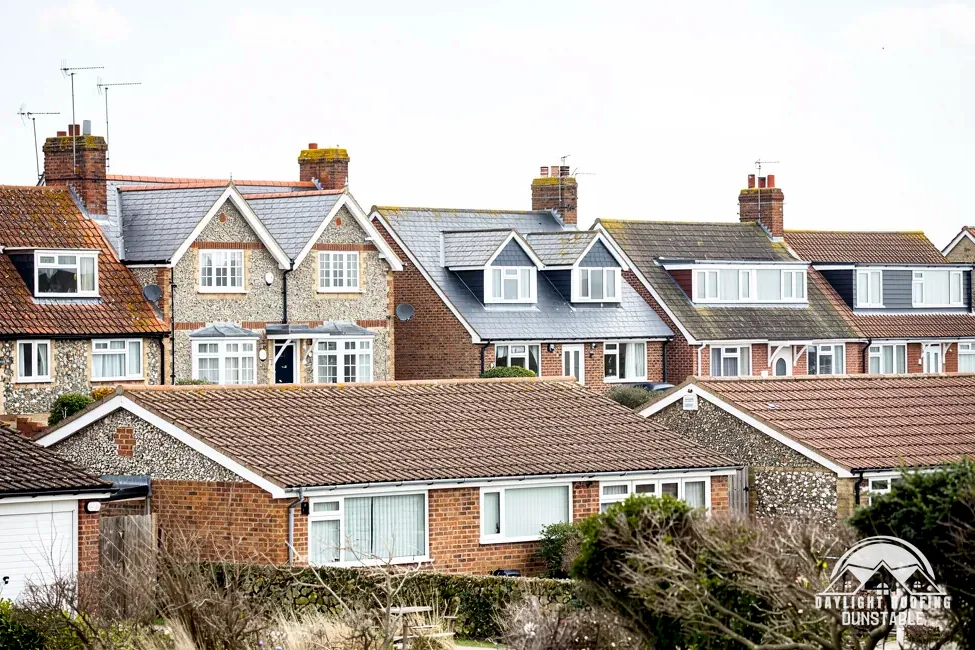
A row of low bungalow roofs on the flat land of the Selsey peninsula

The roof, in plain words

Listed building consent
Approval needed before a change that touches a listed building's character.
Faculty
The Church of England's own approval route for work to its churches.
Ridge tile
The capping piece laid along the highest line of a roof.
Verge
The slanted edge where a roof finishes at a gable wall.

The plain-as-day roof check

A ground-level look at Halton's rooflines

4 checks about 3 minutes to read

  1. Ridge and hip lines
  2. Listed rooflines in the village
  3. The church roof and its approvals
  4. Gutters and downpipes at the eaves

01 Ridge and hip lines

Stand back from the house and look along the top. A ridge tile sits where two slopes meet, and a hip tile caps the sloping edge where two slopes meet at a corner. A line that dips, a tile raised above the rest or a visible gap at a joint means the capping has moved. Marley notes that the 2015 amendments made it clear that mortar could no longer be relied upon as the only means of securing the roof covering. Look also for moss lines running down from the ridge, which can mark a joint that no longer sheds water.

Ridges held by crumbling mortar alone therefore deserve a survey. BS 8612 deals with ridges, hips and verges held by fittings rather than mortar, and Marley's guidance says ridge and hip tiles should be mechanically fixed to resist the calculated wind uplift force. That calculation belongs to the individual roof, because fixings follow a site-specific fixing specification. For one new ridge tile, Which? Trusted Traders give £80 to £300, excluding VAT, from a survey of 11 traders in November 2025. Hips are priced after a survey. More on this sits under pitched roofing.

02 Listed rooflines in the village

Close to the village, Halton House is listed Grade II* (National Heritage List entry 1332843, first listed 11 October 1985), and Ivy Cottage (entry 1118468, first listed 11 October 1985) and the Post Office (entry 1118469) are listed Grade II. When you look up at any of them, look at what makes the roof part of the building: the covering, the ridge, the chimney stacks and the edge details. A listed roof is judged on that character, so a repair that suits a house with no listing may not suit these.

On a roof like that, the details are read before anything is specified: how the ridge is finished, how the verge is dressed, where lead is used and how the flashings meet the stack. A repair has to sit alongside what is already there. Listed homes keep their permitted development rights for roof work, but listed building consent is needed for anything that affects the building's character; the planning guide sets out the planning side. A house next to a listed neighbour is not listed because of it. The council's records settle that, so check with Buckinghamshire Council.

03 The church roof and its approvals

The Church of St Michael and All Angels is listed Grade II (entry 1332842, first listed 21 December 1967) and is a Church of England church. A church of the Church of England in use comes under its own faculty jurisdiction, which stands in for listed building consent. An application for planning permission for exterior work may still be required, so the route is worked out job by job. Under the Faculty Jurisdiction Rules 2015, "The like for like replacement of roof lead or other material covering the roof of a listed building" is List B work, where the archdeacon's written notice replaces a full faculty.

From the churchyard path the checks are the ones a house needs, only larger: slipped or cracked covering, lead flashing at the wall joints, and rainwater goods that spill over. Correctly installed lead flashing can last for over 80 years, according to MyJobQuote, which is a reason to trace a failing lead detail to its cause before replacing it.

04 Gutters and downpipes at the eaves

Gutters are laid to a fall towards the outlet, and Brett Martin gives that fall as 1 mm for every 600 mm. A gutter that has sagged holds a pool along its run. From the ground the signs are a stain on the wall below a joint, or water dripping off the front edge instead of reaching the downpipe. A downpipe that is blocked at the shoe or bend sends the water back up the run.

Which? Trusted Traders price a front-and-rear clear-out of every gutter at £75 to £350, excluding VAT (November 2025). At the fascia, a retailer says that correctly installed uPVC fascia boards "can typically maintain reliable performance for between 20 and 40 years". Look at the board ends and corners for splits or lifted joints. The guttering, soffits and fascias page covers the work itself. Where the fascia is old timber instead, the paint or the board end is the first thing to give, and a photograph of the board end from the ground shows whether the wood has softened.

The dashed ring takes in the nearest towns and villages we cover around Halton. Map tiles © Esri; map data © OpenStreetMap contributors.

Roof questions from Halton homes

01What can I see from the ground on a Halton roof before anyone comes out?

Begin at the ridge: a straight line with no tile standing proud is what you want to see. Then scan for single tiles that have slipped or cracked, gaps along a gable edge, a chimney with crumbled pointing or lifted lead, and a stain under a gutter. Indoors, a torch in the loft after rain can pick out a damp patch on the timbers or underlay. Photograph whatever you find, because a dated picture is useful whatever happens next. A survey then covers the same places up close and ends in a plain account, including anything else we saw. Repairs of this kind sit under roof repairs.

02Does the Halton conservation area change what can be done to a roof?

Halton has a conservation area that Buckinghamshire Council designated, and the same council handles planning applications there. Ask Buckinghamshire Council whether an Article 4 direction applies to your address. An Article 4 direction can remove further permitted development rights, so we check with the council first. Which of the ordinary planning tests apply to a particular roof is set out in the planning guide, and the council has the final word on any address in the conservation area. If your house is outside the conservation area and not listed, the usual tests apply unless a direction reaches it.

03Does living beside Halton House or Ivy Cottage make my house listed?

No. Listing attaches to the building named on the list entry, such as Halton House (Grade II*, entry 1332843) or Ivy Cottage (Grade II, entry 1118468), and a neighbour is not listed by proximity. For a listed building, listed building consent is needed for works "in any manner which would affect its character as a building of special architectural or historic interest". The council holds the list and can confirm an address, so ask Buckinghamshire Council before ordering materials for any old house in the village. If the house is not listed, the ordinary rules for the roof apply instead.

04Does a scaffold on a Halton street need a licence, and from whom?

Section 169 of the Highways Act 1980 applies wherever a scaffold obstructs the footway or road, and the body that licenses it for Halton is Buckinghamshire Council. Buckinghamshire Council charges £402.78 for 28 days, with a renewal at £69.09 and a retrospective licence at £777.63, and its page says "You must be a registered scaffolding company to apply for a licence." We arrange the licence with our scaffolder. The one written total covers any scaffold needed. Where the scaffold would stand wholly in the garden, no licence is involved.

05Does a full re-roof in Halton need Building Regulations approval?

Under the Planning Portal's guide, re-roofing does not normally need a building regulations application if "Less than 25 per cent of the total 'building envelope'" is affected and "Less than 50 per cent of the roof is affected". Renewing every slope overshoots the second limit, and the Portal's main page says "In most situations, this work will need Building Regulations approval." Where a new covering would be "15 per cent or more" heavier, approval applies too, and the Portal tells owners to consult an engineer or a surveyor about the structure before any work begins on site. Building control for Halton is Buckinghamshire Council's own service, and the way to reach it is on the council's building control page.

06How is the price for a Halton roof worked out?

Everything starts with the survey, and one written figure comes out of it. Access to the roof, its size and covering, and what the survey finds all shape it. For scale, Which? Trusted Traders put replacing the whole roof of an average three-bedroom house at £7,000 to £21,000 excluding VAT (November 2025, a survey of 11 traders). That is a third-party range, not a quote. A listed or conservation-area roof may need the council's say-so first, and that route is checked before work starts. The written total is the only number you act on.

07Is a picture of my Halton roof any use before a survey is booked?

Yes: send it to 07880 284133 on WhatsApp and it will be looked at. A photo shows the kind of problem, such as a slipped tile or lifted flashing, but it is not a survey: the written price comes after the roof has been seen. Shoot from the ground, stepping back far enough to get the ridge and the chimney in one frame, then add a close-up of the problem. Never climb up for a better angle, and keep off a wet or sloping surface of any kind.

08Could a roof repair at a Halton house affect bats or nesting birds?

Yes, it could. The Wildlife and Countryside Act 1981 makes it an offence if a person intentionally takes, damages or destroys the nest of any wild bird while that nest is in use or being built, and damaging or destroying a bat roost is an offence whatever the intent. GOV.UK names "repairing or replacing a roof" among the jobs where bats may mean a Natural England licence is needed. If you have seen bats or a nest near your roof, mention it when you get in touch, so that it is known before anyone goes up.

09Can I cancel a roof job I agreed at home in Halton?

Planned work signed for at home has a cancellation window, and it closes at the end of 14 days after the day on which the contract is entered into. Asking us to begin sooner must be done in writing, and doing so keeps your right to cancel, though a charge for anything already carried out may follow. An urgent repair visit that you requested sits outside the right. Written confirmation of dates is worth keeping, and so are any messages about the start. The Citizens Advice consumer helpline, 0808 223 1133, explains the position if it is unclear.

Get a written price for your roof

10-year workmanship guarantee, in writing

Tell us about your roof

Call WhatsApp Written quote