
Call 01582 935272

Wilstone · 10 road miles south-west

Roofers in Wilstone

In Wilstone, a Hertfordshire village at 9.9 road miles south-west of Dunstable, homeowners can have slipped tiles refixed, flat garage roofs renewed and lead repaired, each job set out as one written figure once the roof has been surveyed.

Get a written quote

Call 01582 935272WhatsApp us

Council
Dacorum Borough
Road miles
10
Conservation area
Wilstone Conservation Area
Building control
Check with the council

Roofs round Chapel Farm and Brookside

Wilstone is a Hertfordshire village, 18 minutes from Dunstable by car and 9.9 road miles to the south-west. Wilstone lies in Tring Rural parish, which had 1,550 usual residents at the 2021 Census. Dacorum Borough Council designated the Wilstone Conservation Area, and the village has listed houses and a listed farm barn. Anyone replacing a covering here starts by asking where the address sits in relation to those protections, because the answer decides which questions go to the council first.

Dacorum Borough Council receives the planning applications for Wilstone houses, and whether an Article 4 direction applies to a particular address is for the council to confirm. The planning guide covers the permitted development rules for house roofs. Garage and extension roofs are dealt with on the flat roofing page, and the roof repairs page covers tile replacement and leak tracing.

  1. 01Barn at Chapel FarmhouseBarn Adjoining on North Chapel Farmhouse is listed Grade II*, National Heritage List entry 1342230, first listed on 23 April 1985.
  2. 02BrooksideListed Grade II, National Heritage List entry 1373885, first listed on 29 May 1986, so the council is asked before roof work.
  3. 03Paddock CottageListed Grade II, National Heritage List entry 1077980, where the council's view on character comes ahead of roof work.
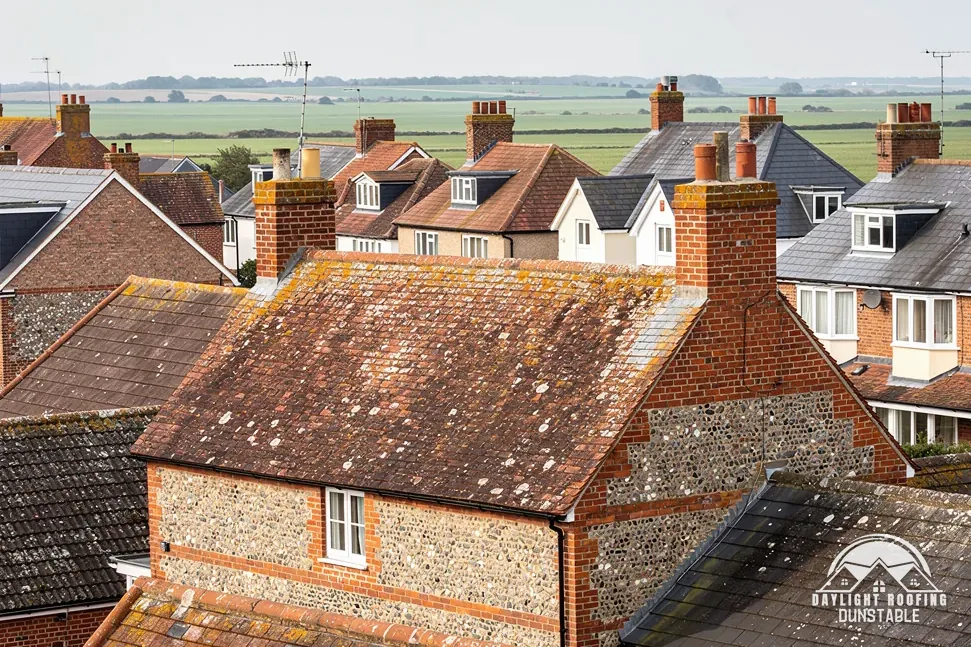
An old flint and brick cottage with a weathered clay tile roof

Wilstone roof terms

Slipped tile
A tile that has moved down its batten and left a gap.
Upstand
The short vertical edge where a flat roof membrane turns up a wall.
Valley
The angled channel where two slopes meet and send water down together.
Article 4 direction
A council order taking away certain permitted development rights.

The plain-as-day roof check

Four things to check from garage to valley

4 checks about 3 minutes to read

  1. Garage flat roof
  2. Cracked or slipped tiles
  3. Valley lead and linings
  4. Soffit and eaves vents

01 Garage flat roof

A garage or outbuilding with a flat roof lives or dies by its fall and its edges. Stand on the drive and look for a sag, a puddle that stays after the rest has dried, or a membrane that has curled at the corner. Inside, a damp patch on the ceiling or a dark line along the wall plate shows water entering at an edge. A roof that holds water is a roof whose seams are under constant load. Sweeping leaves from a flat roof in autumn takes minutes and spares the outlet.

The current flat-roof standard, BS 6229:2025, deals with continuously supported flexible membranes, and lead is outside it. NFRC gives a minimum 1:80 finished fall for general roof areas and internal gutters. HomeBuilding and Less disagree on how long a felt roof lasts, at 10-15 against 10 to 20 years "depending on quality and installation". Whether a patch is worth it or a new membrane is better is a survey call, made with the edges, the upstands and the outlet all in view. A garage roof that is dry inside may still have a failing edge.

02 Cracked or slipped tiles

A slipped tile has moved down the batten and left a gap above it; a cracked tile has split across its width. Both let water onto the underlay. From the ground, slipped tiles show as a break in the straight lines of the courses, and cracked ones as a darker line across a tile. Fallen pieces in the garden or on a path point to tiles that have failed above.

Which? Trusted Traders give £75 to £400 for replacing one to six tiles (November 2025, excluding VAT); for a given roof the survey settles the figure. A tile fixed back depends on the batten and the nail beneath it, so one slip calls for a look at the tiles around it. The roof repairs page covers what a repair visit involves.

03 Valley lead and linings

The valley takes all the water from the two slopes that meet at its angle. A lead lining or a purpose-made trough sits in the channel, with the tile edges lapping over it at each side. Look for tile edges that have crept across the channel, moss or debris packed into it, or a stain on the wall or ceiling below the join. A valley that overflows leaves a tide-mark down the wall under it, which can be seen from the garden. Ask yourself whether the stain sits directly under the angle.

Lead sheet is made to BS EN 12588 in codes 3 to 8, and Ecobat and Calder each publish weights for the codes, which differ for codes 3 and 6. MyJobQuote says correctly installed lead flashing "can last for over 80 years", which describes flashing, not a valley in every condition. The code for a valley is set in the specification once the survey has measured the run and the pitch.

04 Soffit and eaves vents

Soffit is the name for the board closing off the underside of the eaves, and some carry small vents so that air can enter the roof space. Look up at it for flaking paint, a sagging board or a vent blocked with paint or insects' nests. Inside the loft, check that the gap at the eaves has not been stuffed with insulation or stored items.

For an eaves gap, Marley's figures are 25 mm at 15 degrees pitch or less and 10 mm above 15 degrees, given for cold roofs under a high-resistance underlay, and a soffit vent only works while that gap behind it stays clear. Replacement soffits and fascias have to keep that ventilation, which is why the gutters, soffits and fascias page treats them together. Brown stains on a soffit under a gutter mean the gutter above has been leaking onto it, so the board and the gutter are assessed as a pair, and the survey looks at which of the two needs work.

The dashed ring takes in the nearest towns and villages we cover around Wilstone. Map tiles © Esri; map data © OpenStreetMap contributors.

Wilstone roof questions, answered plainly

01How can I tell a slipped tile from a cracked one on a Wilstone roof?

A slipped tile has travelled down its batten, leaving a visible gap in the course above it. A cracked tile is still in place but has a line across it that shows darker against its neighbours. Binoculars from a garden make the difference clear. The survey then goes under the tile to look at the batten and underlay, because a slip can mean the fixing has failed. Anything further seen on the roof is reported alongside, and the figure that comes back is one written total for the lot, even where the batten needs replacing as well as the tile.

02Does the Wilstone Conservation Area change how a roof is replaced?

Dacorum Borough Council designated the Wilstone Conservation Area. Before any work is ordered, a short enquiry to the council about the address settles whether a listing or a direction affects it. The council alone settles which addresses fall inside the boundary, and a house on the edge of the area is worth asking about as well. The planning guide sets out the permitted development rules for house roofs, and reading it first helps in choosing between a patch and a full re-cover.

03How do I find out whether an Article 4 direction covers my Wilstone house?

Check with Dacorum Borough Council whether an Article 4 direction applies. A direction can remove permitted development rights that a house would otherwise have, and the rights it removes differ from one direction to the next. Some directions control changes of use, houses in multiple occupation, employment sites or markets, and none of those touches a house roof. The directions recorded close to Wilstone belong to Buckinghamshire Council, across the county boundary, and apply to Buckinghamshire addresses. Asking the council about the actual address is the only reliable way to know which kind applies, and it costs a phone call. A house roof is not made subject to a direction just because one exists elsewhere in the area. The council's own planning officers hold the list of directions in force and can say whether a roof is touched by any of them.

04Does Brookside or Paddock Cottage need listed building consent for a re-tile?

Both are Grade II listed: Brookside is list entry 1373885 and Paddock Cottage is list entry 1077980. Listed building consent concerns works "in any manner which would affect its character as a building of special architectural or historic interest". Putting back what was there, like for like, and choosing a new material are different questions. Dacorum Borough Council can say which applies. The barn at North Chapel Farmhouse, listed Grade II* (entry 1342230), is treated in the same way, so a roof there goes to the council first. Photographs of both slopes give the council a first impression to work from, before drawings exist.

05Does scaffolding in a Wilstone lane need a licence?

A pavement or lane cannot be blocked by scaffold without a licence from Hertfordshire County Council, which is the highway authority for Wilstone, not the district. Hertfordshire County Council charges £134 for a 14-day licence and £59 for every week after, and says: "It usually takes 3 weeks to process an application." Its conditions include a 1.2 m clear walkway left on the footway. We arrange the licence with our scaffolder, and any scaffold the work needs forms part of the written total. A garage or side gate with room for a tower may need none.

06Is a new covering on a Wilstone house a Building Regulations matter?

In its re-roofing guide the Planning Portal sets two tests: "Less than 25 per cent of the total 'building envelope'" and "Less than 50 per cent of the roof is affected". Replacing the whole covering falls outside the second, so Building Regulations approval is needed. For Wilstone, check with Dacorum Borough Council's building control team about the route. The Portal also lists a new covering material that "increases the weight of the roof covering by 15 per cent or more" as needing approval, with a recommendation to involve a structural engineer or surveyor first, since the roof timbers must carry the new load.

07What lifespan does lead flashing have on a Wilstone roof?

MyJobQuote says correctly installed lead flashing "can last for over 80 years". That figure is for flashing that is fitted well, not a promise for any lead on any roof, and the word "can" carries weight. Splits, lifted edges and loose fixings shorten the life of a flashing whatever the sheet's age. A survey looks at the lead at chimneys, abutments and valleys and says plainly whether each piece wants repair or renewal, with the one written price covering whichever it is. A photograph of a split edge helps before the visit. Lead that has dulled to grey is not a fault in itself; lead that has cracked along a fold is.

08Will any grant fund a new roof in Wilstone?

Nothing pays for roof replacement or repair as a grant, so a grant for a new roof is not something to rely on. ECO "is closing on 31 December 2026", Ofgem describes the Great British Insulation Scheme as "closed to new installations", and the Warm Homes: Local Grant needs an EPC rated D to G while household income must usually be £36,000 a year or less. How Dacorum Borough Council runs its allocation under the local grant should be checked with the council directly.

09Where do I check flood risk for a Wilstone address before drainage work?

Flood risk is assessed address by address rather than for a whole village. The long-term flood risk service on GOV.UK shows the likelihood in an area, though a single home's chances are not what it measures. When planning permission is sought, the Environment Agency's flood map for planning supplies the site's flood zone. Gutters and downpipes carry roof water away to a drain, and a soakaway or a drain connection is a separate part of the job from the roof itself, so each is thought about on its own terms.

Get a written price for your roof

10-year workmanship guarantee, in writing

Tell us about your roof

Call WhatsApp Written quote