
Call 01582 935272

Little Heath · 26 road miles south-east

Roofers in Little Heath

Tile-hung gables, pipes through the roof, conservatory roofs and loft hatches in Little Heath, 25.5 road miles south-east of Dunstable: every job closes with a single written figure.

Get a written quote

Call 01582 935272WhatsApp us

Council
Welwyn Hatfield Borough
Road miles
26
Building control
Check with the council

Roofs beside the Folly Arch and Osborne House

Little Heath is a village in Hertfordshire, 25.5 road miles south-east of Dunstable (about 35 minutes by road). It lies in North Mymms parish, which had 9,387 usual residents at the 2021 Census. Welwyn Hatfield Borough Council takes planning applications for houses here. Before a re-cover, ask Welwyn Hatfield Borough Council's building control team about the route, and do it before the old covering is touched.

The Potters Bar Darkes Lane (West) conservation area, designated by Hertsmere Borough Council, lies close to Little Heath. Close to it is not inside it, and Hertsmere Borough Council holds the line and can say where an address sits against it. The planning guide sets out the roof rules, the roof repairs hub covers small faults, and the skylights and roof windows hub covers glazing in a roof.

  1. 01The Folly ArchListed Grade II*, National Heritage List entry 1100984, first listed 6 February 1952, so changes to it are weighed against its listing.
  2. 02Osborne HouseListed Grade II, entry 1380272, first listed 28 April 2000; any roof change there is raised with the council first.
  3. 03TivertonListed Grade II, entry 1295701, first listed 7 June 1973; it stands near Little Heath, over the boundary in Hertsmere, so Hertsmere Borough Council answers for it.
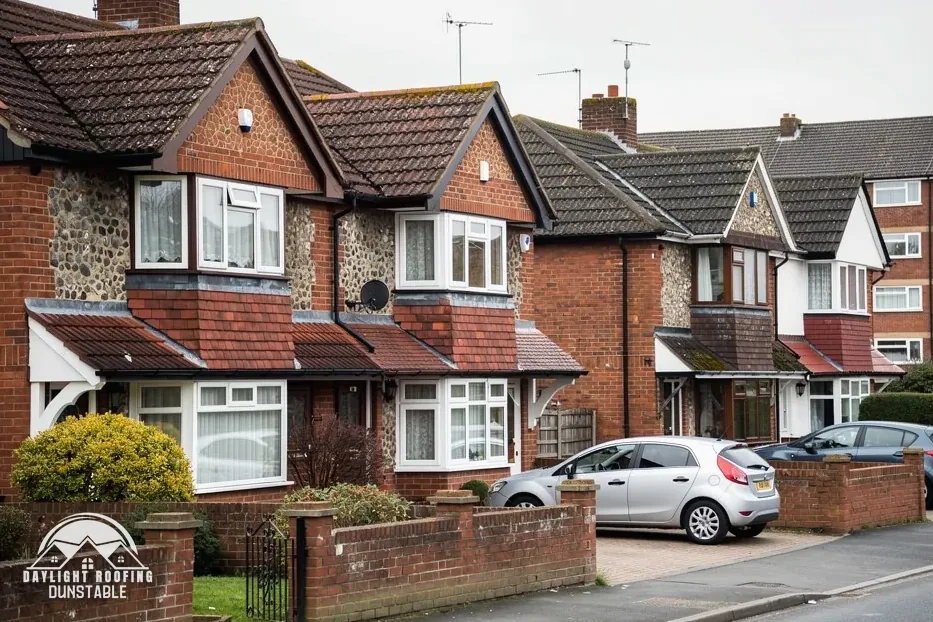
Edwardian brick and flint semi-detached houses with tiled gables

Roof language, simply

Tile hanging
Small tiles fixed in rows up a wall instead of across a roof.
Collar
The lead or rubber sleeve sealing a pipe where it leaves the roof.
Part K
The Building Regulations part setting safety standards for glazing.
Pantile
A clay tile with an S-shaped profile, laid in overlapping rows.

The plain-as-day roof check

Gables, pipes, glass and hatches: four checks round Little Heath

4 checks about 3 minutes to read

  1. Tile-hung gables at the roof edge
  2. Pipes and flues through the roof
  3. A conservatory roof and its frame
  4. What the loft hatch shows

01 Tile-hung gables at the roof edge

Tile hanging is a covering of small tiles fixed to a wall, and where it rises into a gable it meets the roof at the verge and at the eaves. Look at the line where wall tiles finish under the roof edge: a gap, a lifted lead trim, a missing tile or a streak of green below show that water is getting behind the cladding. A bulge in the tiles on the wall can mean the battens behind have rotted.

The junction is a small one, and a repair there can look minor from outside while the cause lies higher up, such as a failed verge or a blocked gutter dripping down the face. For that reason the survey follows a wet patch upwards. Ridge and verge tiles are fixed to the calculated uplift, and BS 8612:2018 is the current standard where those parts go on dry, without a mortar bed. The written total for a gable follows what the survey finds there, so a wet patch and its cause can be priced together. Check also the lead or plastic trim at the foot of the tile hanging, since a trim that has curled lets water slip behind the first row.

02 Pipes and flues through the roof

Pipes pass through a roof in several places: a soil vent from a bathroom, an extractor duct, a boiler flue. Each has a collar of lead, rubber or plastic where it leaves the covering, and each collar can crack, lift or split. Look from the ground at the base of each pipe for a dark ring on the tiles, a collar that has slipped down the pipe, or sealant that has been smeared round it. In the loft, a wet stain on the felt directly below a pipe points to the collar.

A new pipe through a roof is a small hole in a covering, and it has to be flashed properly. Rolled lead is made to BS EN 12588 in codes 3 to 8, and the specification sets each detail's code. Code 4 is 1.80 mm thick. Weights differ a little between makers at codes 3 and 6, so a weight is only given with the maker named. A repair at a pipe is priced after the survey, with the rest of the work in one written total. A pipe that has been boxed in or painted over may hide a collar that has failed, so a close photograph of the bare pipe is the most useful one to send.

03 A conservatory roof and its frame

A conservatory roof carries glass, polycarbonate sheet or tiles on a light frame. Look for cloudy or yellowed polycarbonate, cracked glass, glazing bars that have lost their seals, and algae in the corners. HomeBuilding says polycarbonate roofs "have a typical lifespan of 10 years". Roofing Megastore's managing director, quoted by HomeBuilding, says a glass roof "will likely last in excess of 30 years", and a tiled roof "will typically last in excess of 50 years".

A ground-level conservatory of up to 30 m2 with Part K glazing is left out of the energy rules in England on two conditions: some wall, door or window is left between the two rooms, and the house's heating stops short of it. The Planning Portal says "A new roof must comply with building regulations to ensure it is structurally safe, energy efficient and properly ventilated." MyJobQuote gives £3,200 to £6,000 as the average conservatory roof replacement in 2026, on a page dated 20 October 2026.

04 What the loft hatch shows

Opening the hatch with a torch shows the underside of the roof. Look for daylight at the eaves, at the ridge and round chimneys, because one pinpoint of light marks a hole in the covering. Look at the felt for tears, at the battens for dark staining, and at the insulation for patches that have gone dark or flat. Keep your weight on the joists; the boards between them will not take it.

Marley's published minimum pitches vary by product, from 40 degrees for its clay Canterbury tile to 35 for Ashdowne, with Hawkins and Acme Single Camber both at 30 and the Lincoln pantile at 15. Canterbury here is a tile and not a town. A roof pitched below its covering's minimum can let water in however well it is laid, and the angle can be read from the loft with a phone app held along a rafter. A spirit level on a rafter and a photograph of the bubble will do as a rough check.

The dashed ring takes in the nearest towns and villages we cover around Little Heath. Map tiles © Esri; map data © OpenStreetMap contributors.

Little Heath roofs: answers on glass and pipes

01How are the pipes that pass through a Little Heath roof checked?

Each pipe is looked at where it leaves the covering: the collar, the flashing, the tiles round it and the felt beneath. Cracks, slipped sleeves and smeared sealant are looked at on the roof, and a photo of any stain, taken from your own loft hatch, helps. Anything else found up there is explained plainly, and a single figure follows. A photograph of each pipe base, shared on WhatsApp, can be viewed ahead of a visit, which helps because collars are small and a close shot shows far more than a general view of the roof.

02Is the Potters Bar conservation area relevant to Little Heath?

The Potters Bar Darkes Lane (West) conservation area was designated by Hertsmere Borough Council, and it lies close to Little Heath. It is not inside the village, and for any address Hertsmere Borough Council can say where its line runs, while Welwyn Hatfield Borough Council handles planning here. An Article 4 direction can remove further permitted development rights, so we check with the council first, ahead of any choice of covering. Both councils can be asked by email, and the replies are kept with the quote so that nothing is decided twice.

03What does listing mean for the Folly Arch, Osborne House and Tiverton?

The Folly Arch is listed Grade II* (entry 1100984), Osborne House Grade II (entry 1380272) and Tiverton Grade II (entry 1295701). Listed building consent is the step before work that would alter what makes each building special. Householder permitted development for roofs carries on at a listed house; even so, swapping the covering material, moving the ridge or adding a rooflight can alter its character, so the council is asked first. The Folly Arch, a Grade II* structure, and Osborne House come under Welwyn Hatfield Borough Council, while Tiverton, just over the boundary, is a question for Hertsmere Borough Council, and the house next door is not covered by any of the three entries.

04Who checks a Little Heath re-roof under the Building Regulations?

The route runs through Welwyn Hatfield Borough Council's building control team, or through a registered building control approver instead. The Planning Portal says "In most situations, this work will need Building Regulations approval." Its interactive guide sets two limits for re-roofing, "Less than 25 per cent of the total 'building envelope'" and "Less than 50 per cent of the roof is affected", and a whole-roof job passes the second. Weight matters too: "15 per cent or more" heavier brings approval in, and a structural engineer or surveyor is consulted first.

05What does a scaffold licence cost on a Little Heath road?

Hertfordshire County Council is the highway authority, so the borough has no part in it. Hertfordshire County Council's licensing page says it costs "£134 for a 14 day licence" and is "£59 for every week after", and "It usually takes 3 weeks to process an application." We arrange the licence with our scaffolder. A 1.2 m walkway has to be kept clear of the scaffold, and where the tower fits on private land, no licence is wanted, though the licence period and the walkway are agreed before any scaffold goes up on the road side.

06Does a new glass or tiled roof on a Little Heath conservatory need approval?

The Planning Portal says a new conservatory roof "must comply with building regulations", so building control is consulted first. Three things keep a ground-level conservatory of up to 30 m2 outside the energy rules: Part K glazing, a separating wall, door or window kept in place, and heating that stops at the house. MyJobQuote averages £3,200 to £6,000 for replacing a conservatory roof (2026). A new covering has to be carried by the frame, the walls and the base beneath, so the frame's own condition is read at the survey, ahead of any new covering being priced or ordered, and what the survey found is explained plainly.

07What do two sources give for the life of uPVC roofline and its capping?

A retailer's guide says uPVC fascia boards "can typically maintain reliable performance for between 20 and 40 years" when installed correctly. MyJobQuote's page of 17 September 2026 gives an average of around £800 for capping fascias and soffits. The first is a seller's statement and the second is an average of other people's jobs. Neither is a price for a Little Heath house, which gets a survey and then a single written figure, so a roofline job is compared on that figure and not on a published average. Where boards are sound, painting or cleaning may be enough and capping is not needed.

08Do clay tiles all need the same minimum pitch?

No. Marley lists 40 degrees for clay Canterbury, 35 for Ashdowne, Hawkins and Acme Single Camber at 30 degrees apiece, and the Lincoln pantile at 15. Its concrete tiles run from 12.5 degrees for Mendip 12.5 to 35 for Plain. Those figures belong to those products. For natural slate, Cupa reports that BS 5534 points to 20 degrees as the lowest pitch for a 500 mm slate laid with a 115 mm overlap where exposure is moderate, with hook fixings reserved for pitches of 25 degrees or more.

09Can a Little Heath roofing contract signed at home be cancelled?

Yes. "The cancellation period ends at the end of 14 days after the day on which the contract is entered into", so the first day is the day after signing. Work starts inside the period only if requested in writing; asking leaves the right to cancel intact, with payment due only for work actually done. A visit that the customer "has specifically requested" for "urgent repairs or maintenance" carries no cancellation right. The Citizens Advice consumer helpline is 0808 223 1133, and it can explain the cancellation rules before anything is signed or returned.

Get a written price for your roof

10-year workmanship guarantee, in writing

Tell us about your roof

Call WhatsApp Written quote