
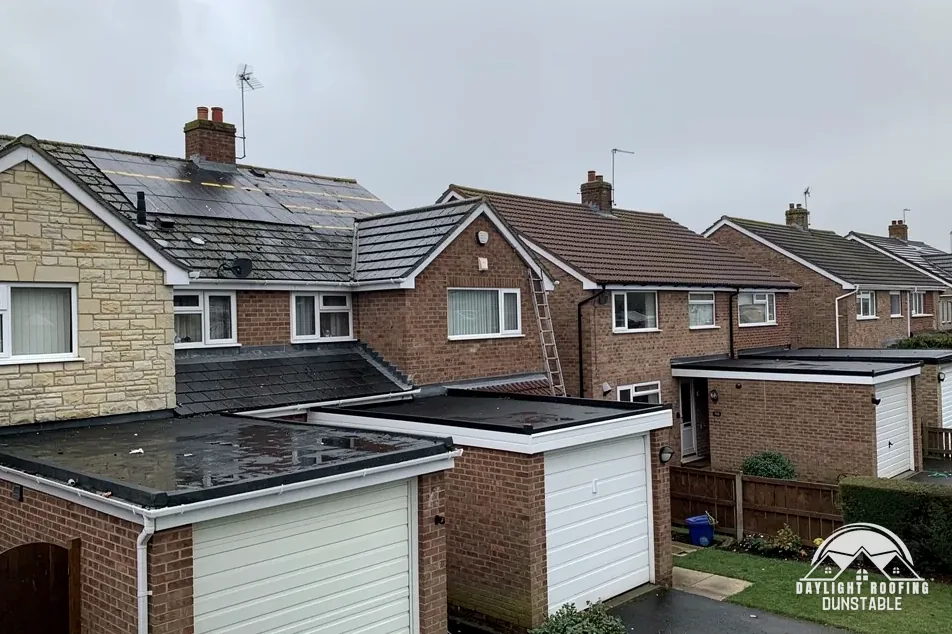
01 Ridge and hip tiles
Stand back and trace the ridge, the crest at which the two slopes come together. Ridge tiles rest on mortar or on a dry-fixed system, and one that has moved shows as a break in the straight line or a dark gap under its edge. Hips, the angled crests running down to an outside corner, carry the same tiles and share the same risk. Binoculars from the lawn show more than a glance from the pavement.
Marley's guidance is that "ridge or hip tiles should be mechanically fixed to resist the calculated wind uplift force", and that since the 2015 amendments "mortar could no longer be relied upon as the only means of securing the roof covering". A ridge that depends on old mortar alone, cracked or crumbling at the joints, is worth having surveyed before rough weather, not once tiles have come down. The fixing specification for a roof is worked out for the site's own exposure, so no single method suits every house. Cracked or missing ridge tiles call for a ladder and a trowel rather than a view from the lawn, so note what you see and let the survey do the climbing.