
Call 01582 935272

Aldbury · 9 road miles south-west

Roofers in Aldbury

Roof repairs, new roofs and chimney work in Aldbury, a Hertfordshire village 8.8 road miles south-west of Dunstable, each one priced as a single written total after surveying the roof.

Get a written quote

Call 01582 935272WhatsApp us

Council
Dacorum Borough
Road miles
9
Conservation area
Aldbury Conservation Area
Building control
Check with the council

Roofs beside the Stocks and St John's church

Aldbury is a village in Hertfordshire, 8.8 road miles south-west of Dunstable and about 15 minutes by road. At the 2021 Census, Aldbury parish had 924 usual residents. The village sits inside the Chilterns National Landscape and has its own conservation area, designated by Dacorum Borough Council. Its listed buildings are named below by grade and list entry, because a roof on one of them is judged differently from a roof on an ordinary house.

Planning applications for a house in Aldbury go to Dacorum Borough Council. The Chilterns Conservation Board advises and responds to consultations, and it decides nothing itself. Its roofing note calls plain clay tiles "universally predominant" on the Chilterns' traditional buildings, and its flint note says flint "is often combined with brick" in older buildings and boundary walls. The planning guide sets out the roof rules, and the pitched roofing page describes what a re-cover involves.

  1. 01St John the Baptist churchListed Grade I, National Heritage List entry 1078047, first listed on 30 November 1966, a Church of England church.
  2. 02Manor Cottage, Old Manor HouseListed Grade II*, National Heritage List entry 1100624, first listed on 14 May 1952, so a roof change is weighed against its character.
  3. 0312, Trooper RoadListed Grade II, National Heritage List entry 1078058, where the council is asked about consent before any roof work is priced.
  4. 04Barrows at Bridgewater MonumentTwo barrows form a scheduled monument, entry 1012406, near Aldbury, where works must be authorised before they start.
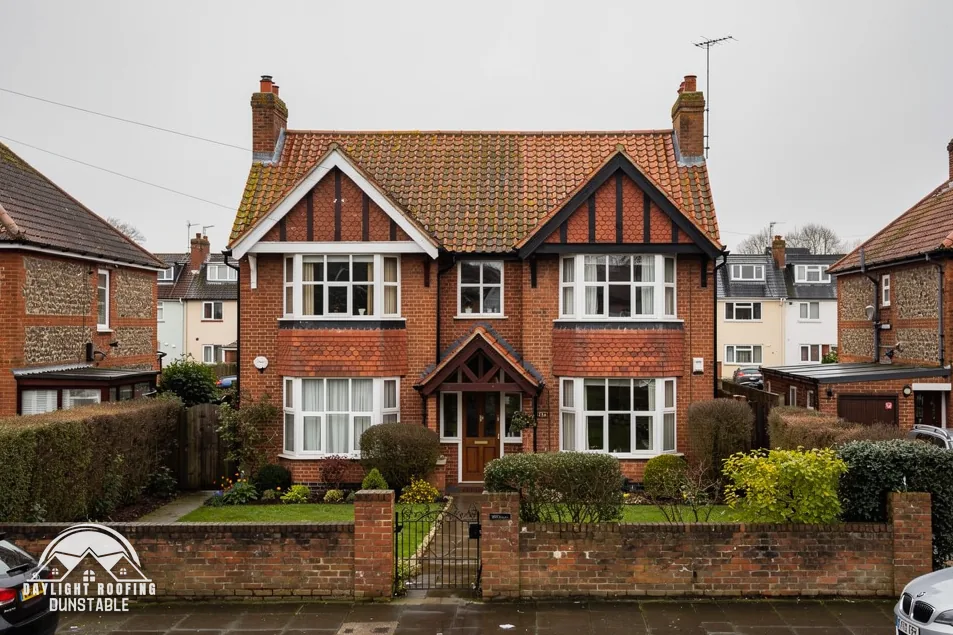
A detached Edwardian brick house with a clay tiled roof and gables

Aldbury terms, in plain words

Faculty
The Church of England's approval route for building work to a church in use.
Listed building consent
Permission needed before work that would affect a listed building's character.
Soaker
A small piece of lead worked in beside each tile along a chimney or wall.
Scheduled monument
A protected archaeological site where any works must be authorised first.

The plain-as-day roof check

Four roof checks round the Stocks and the green

4 checks about 3 minutes to read

  1. Ridge line and ridge tiles
  2. Chimney flashing
  3. Verge tiles at the gable
  4. Battens and felt in the loft

01 Ridge line and ridge tiles

Stand back across the road and sight along the ridge, the top line where the two slopes meet. It should run straight, with no dips and no gaps between the ridge tiles. A tile that has shifted, or a dark line where mortar has gone from between the pieces, suggests the bedding has let go. Binoculars help from a garden, and a photograph taken with the zoom shows more than the eye does from the ground.

Ridge and hip tiles are held down mechanically, with fixings chosen for the uplift calculated for the site, and BS 8612:2018 is the standard for details where the top edges and sloping corners go without a mortar bed. Marley says that since the 2015 amendments to BS 5534, mortar "could no longer be relied upon as the only means of securing the roof covering". A ridge that is rebedded therefore needs a fixing that does not depend on the mortar alone, and the survey looks at how the existing ridge is held.

02 Chimney flashing

Where a chimney stack leaves the roof, a lead flashing is dressed up the brickwork and tucked into a mortar joint. Look for lead that has lifted away from the brick, a gap along its top edge, or white crumbling mortar where it is tucked in. Indoors, a brown stain on the chimney breast of an upstairs room, level with the roofline, is a reason to go up and look properly.

Lead sheet is made to BS EN 12588 in codes 3 to 8, and code 4 is 1.80 mm thick. The specification sets the code for each detail, so the metal for a flashing is chosen after the survey. MyJobQuote says correctly installed lead flashing "can last for over 80 years". The chimney repairs page covers the stack itself, from the pots down to the brickwork.

03 Verge tiles at the gable

A verge is the edge of the roof that slopes up the side of a gable end, where the covering finishes above the wall. Look for edge tiles that sit proud of their neighbours, a crack of mortar running down the verge, or green staining on the wall beneath it. A verge with failed pointing lets the edge tiles loosen, and rain then reaches the top of the wall.

A verge can be rebuilt in mortar or finished with the dry-fixed systems that BS 8612:2018 sets out for edge details, where clips hold the end tiles. Either way the fixings are sized for the wind uplift worked out for the site. A cracked mortar verge can be renewed piece by piece, and the survey looks at what the tiles beside it are doing before the written price is set. Pointing that has gone green and soft is worth pointing out to the survey.

04 Battens and felt in the loft

With the hatch open, check the underside of the covering from below. Battens should lie straight, and the felt or underlay between them should be unbroken. A dark patch on a batten or a sodden stretch of felt shows where water has been coming in. A pinprick of daylight marks a gap in the covering. Step only on the joists, and take a torch rather than leaning on the ceiling.

With a high-resistance underlay in a cold roof, Marley gives 25 mm of eaves ventilation at 15 degrees pitch or less and 10 mm above 15 degrees. That underlay does not pass vapour, so the ventilation gap does the work, and it has to stay open when an underlay is replaced. A photograph sent on WhatsApp to 07880 284133 gets looked at before the survey, which helps when the fault sits somewhere awkward to reach.

The dashed ring takes in the nearest towns and villages we cover around Aldbury. Map tiles © Esri; map data © OpenStreetMap contributors.

Questions for an Aldbury roof

01What does a roof survey in Aldbury look at beyond the tiles?

The survey takes in the ridge, the hips, the verges at the gables, the valleys, the flashings round chimneys and walls, the gutters, and the fascia and soffit at the eaves. It checks the fixings and the covering slope by slope from the roof itself. We say plainly what turned up on the roof, including anything else we noticed, and the price that follows is one written total. A photograph of the problem sent by WhatsApp lets us take a first look before anyone visits, though a photo cannot replace climbing up and seeing the slope itself. Mention a flat porch roof on the same house too if it has a fault, so it is not missed.

02Does Aldbury's conservation area change a re-roof?

Dacorum Borough Council designated the Aldbury Conservation Area, so a roof on a house in the village can meet extra planning control over changes to the outside. Whether a particular address falls inside the boundary is a question for the council. An Article 4 direction can remove further permitted development rights, so we check with the council first. The planning guide shows how the permitted development rules fit together for a house roof, and it is the place to read before choosing a covering, whether the plan is a patch or a new roof.

03Who decides on a dormer or roof extension in the Chilterns part of Hertfordshire?

Aldbury is inside the Chilterns National Landscape, but planning applications still go to Dacorum Borough Council. The Chilterns Conservation Board advises and responds to consultations; it never decides or approves an application. Roof enlargements such as dormers have their own rules in a National Landscape, and the planning guide linked above sets them out in one place, so they are not repeated here. A conversation with the council before drawings are paid for saves wasted effort, and a house in the conservation area deserves the same call before any outline is drawn.

04Who approves roof repairs at the Church of St John the Baptist?

The church is listed Grade I (list entry 1078047) and belongs to the Church of England. Work to a Church of England church in use goes through the faculty system, which takes the place of listed building consent. Under the Faculty Jurisdiction Rules, "The like for like replacement of roof lead or other material covering the roof of a listed building" needs only the archdeacon's written notice, not a full faculty. Planning permission for outside work may still apply where the normal tests are met. A roofer's survey does not stand in for any of these steps, and the church's consent route is separate from the one for a house in the village.

05Is the consent route for Manor Cottage the same as for the barrows at Bridgewater Monument?

Not quite. Manor Cottage the Old Manor House is listed Grade II* (list entry 1100624), and the law asks for listed building consent for works that would affect a building "in any manner which would affect its character as a building of special architectural or historic interest". The two barrows at Bridgewater Monument are a scheduled monument (entry 1012406), near Aldbury, and works there must be authorised: consent is granted by the Secretary of State, and applications go to Historic England. Listed building consent is not the route for a scheduled monument, and the council is the first call for the house.

06Does scaffolding in an Aldbury lane need a licence?

Scaffolding that obstructs a pavement or road needs a scaffold licence under section 169 of the Highways Act 1980. In Aldbury the highway authority is Hertfordshire County Council, not the district. Hertfordshire County Council charges £134 for a 14-day licence and £59 for every week after, and "It usually takes 3 weeks to process an application." The county also requires a 1.2 m clear walkway kept on the footway. We arrange the licence with our scaffolder, and any scaffold the roof needs is part of the one written total. A drive or garden with room for the tower can avoid the question.

07What do the Planning Portal's limits mean for a full re-roof in Aldbury?

The Planning Portal says no application is normally needed if "Less than 25 per cent of the total 'building envelope'" is affected and "Less than 50 per cent of the roof is affected". Replacing the whole covering goes past the 50 per cent limit, so Building Regulations approval is needed. For a house in Aldbury, check with Dacorum Borough Council's building control team about the route. A covering that is 15 per cent or more heavier than the old one also needs approval, and the Portal advises a structural engineer or surveyor to look first. Heavier coverings load rafters and walls sized for the old one.

08What if birds or bats are using the eaves of my Aldbury house?

The law protects both. The Wildlife and Countryside Act 1981 makes it an offence to intentionally take, damage or destroy a wild bird's nest "while that nest is in use or being built". Damaging or destroying a bat roost is an offence whatever the intent, and Natural England can license some roof work, a licence being something to ask about before a roof is repaired or replaced. If something is nesting in the roofline, the sensible move is to hold off and ask before any work starts on that part of the roof, because the roost or nest decides what can be done and when.

09Where can I check flood risk for a roof drainage job in Aldbury?

Flood risk is worked out for each site, not for a village as a whole. GOV.UK's long-term flood risk service shows the risk for an area, and it says nothing about whether one home will flood. For a planning application, the Environment Agency's flood map for planning shows a site's flood zone. New downpipes and soakaways are sized for the roof they serve, and a gutter that overflows onto a wall is a separate fault from a flooded lane, so check both questions on their own. The gutters, soffits and fascias page covers the roofline side.

Get a written price for your roof

10-year workmanship guarantee, in writing

Tell us about your roof

Call WhatsApp Written quote