
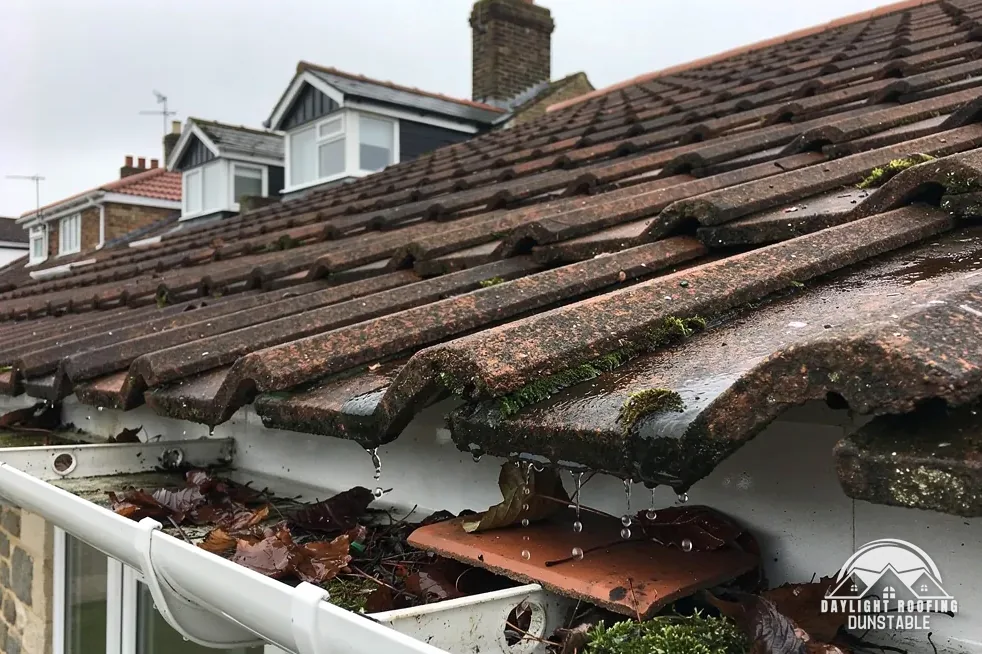
Gutters, fascias and soffits: what each part does
The roofline is four parts working together, and the rules in this post refer to them by name. The gutter catches water running off the slope and carries it along the eaves to an outlet. The downpipe takes the water from the outlet to the drain. The fascia is a long board running along the lowest edge of the slope, and the gutter hangs from it. The soffit is the underside panel that closes the eaves, running from the fascia back to the wall.
Each part can be a different material on the same house. A gutter might be cast iron, aluminium or uPVC. A fascia might be timber with paint on it, or a board capped in plastic. A soffit might be timber, plastic or, on an older building, asbestos insulating board. The material matters to the rules because an Article 4 direction and a listing both look at how the outside of a building appears, and painted timber and white plastic do not look alike.
Brett Martin gives a fall of 1 mm for every 600 mm along the gutter towards its outlet, which means a gutter is set slightly out of level on purpose. That detail is why replacing one is more than a swap: the brackets, the fall and the outlet position all have to be right, and the fascia behind them has to be sound enough to carry the weight.
The page on guttering, soffits and fascias sets out the work in general. In some places a planning rule, an Article 4 direction or a listing, sits on top of it.
- GutterCatches roof water along the eaves.
- DownpipeCarries water from the outlet to the drain.
- FasciaThe board along the slope's lower edge that holds the gutter.
- SoffitThe panel closing the eaves from below.
How Article 4 changes the question
GOV.UK describes an Article 4 direction as "a direction under article 4 of the General Permitted Development Order which enables the Secretary of State or the local planning authority to withdraw specified permitted development rights across a defined area." A direction does not forbid work. Works that would otherwise need no application need one, and only the works the direction names.
That last point is easy to miss. A direction lists its own works, and each council's list is different. One area's direction may name porches and walls, another's may name painting, and a third's alterations to roofs and chimneys. Whether a direction reaches gutters or fascias depends on the works it names and on the council's reading of them, and one that names painting may reach further than a front door.
Conservation areas add a general layer. Central Bedfordshire Council's page says "Permitted development rights are stricter for properties within conservation areas." That sentence is about the area, not the direction, and the two are separate: an area can have a direction, or none. The council's My Central Bedfordshire map, searched by postcode, shows if an address falls within a conservation area.
- Is the address inside a conservation area, and which council is it?
- Does the council's list name an Article 4 direction for that area?
- Does the direction name painting, alterations to elevations or the roofline?
- Is the house also listed, which brings in a separate consent?
Put those four questions in that order, to the council, before any quotation is signed. The answers decide whether the job is a repair, a change that needs an application, or a change that needs listed building consent.
Husborne Crawley: Central Bedfordshire's list names painting
Central Bedfordshire Council's list of Article 4 directions includes one for the Husborne Crawley conservation area. It names the same householder works as the Toddington direction, from extensions and porches to walls, fences and dropped kerbs, and then adds "painting the exterior of a building". It names no roof item.
The table sets three Central Bedfordshire entries beside one another, so the difference is easy to see. The Fairfield parish direction has applied since 5 January 2021 and puts dormers, extra storeys on roofs and porches under planning control. Toddington and Husborne Crawley name householder works without any roof item.
| Area | Roof item named | Painting named |
|---|---|---|
| Fairfield parish | Yes | No |
| Toddington | No | No |
| Husborne Crawley | No | Yes |
What follows for a fascia is a question and not an answer. The direction's words are "painting the exterior of a building", and whether repainting a fascia board or a gutter falls inside that wording is for Central Bedfordshire Council to say. An owner in the area should ask before a painter is booked, and keep the reply, because a repaint in a new colour is the change a neighbour or a planning officer is likely to notice.
A Dunstable address is not placed in any of these areas by this post. The same council covers Dunstable, so the same list and the same map apply, but each address has to be checked for itself.
Wolverton and Olney: Milton Keynes City Council's wording
Milton Keynes City Council has conservation-area directions for both places, and the council's own text is the safest guide. For Wolverton it says "All dwellinghouses in this area are affected, but only in so far as extensions or alterations to elevations fronting a road (including side elevations on corner properties, and including painting), and the creation of hard surfaces, removal and replacement of walls, and installation of satellite dishes to the front."
For Olney the wording is "All dwellinghouses in this area are affected, but only in so far as any extensions or alterations, erection of porches, and the painting of exterior walls." Both pages use two quoted tests for "exterior brick, slate and stonework": "maintained as existing", and "matched where replacement is required". Both also note that repairs which do not "materially affect the external appearance" are not development.
| Area | Painting item |
|---|---|
| Wolverton | Elevations fronting a road, painting included |
| Olney | Painting of exterior walls |
The reading for roofline work needs care. In Wolverton the elevations facing a road are the ones that count, and whether a fascia and gutter along a front or corner eaves form part of such an elevation is for the council to say. In Olney the painting item refers to exterior walls. On the councils' pages a repair that matches the existing building falls outside development, and a change of material or colour is the case to ask about.
For any change, ask Milton Keynes City Council whether the direction applies to the work before it starts. A place on the New Town Heritage Register does not remove a house's permitted development rights, because "Being on the NTHR leaves any existing permitted development rights intact and unchanged."
Cast iron gutters on a listed building
A listed house brings a separate test. The legal test for consent on a listed house is whether the work is "in any manner which would affect its character as a building of special architectural or historic interest". The householder roof classes still apply to a listed home, but that consent requirement sits on top of them for anything touching the building's character.
Cast iron gutters are part of how older buildings look, and replacing one with another material is a change to the elevation, not just to a fitting. Whether it affects character is a judgement for the council, and the safest order is to ask first. A repair that keeps the existing gutter, such as re-sealing a joint or replacing a damaged length with a matching section, is a different question from a switch to uPVC or aluminium.
A listing is a fact about a particular house. It comes from the house's own list entry and not from the age of the street, so a cottage inside a conservation area is not listed for that reason alone, and a listed house outside any conservation area is still listed. The two designations can apply together, and when they do each one is checked separately.
- Find out whether the house has a list entry, and its grade.
- Ask the council whether the work affects character before ordering materials.
- Keep the council's reply in writing with the quotation.
- Check Article 4 as well, if the house is in a conservation area.
The comparison of uPVC, aluminium and cast iron gutters sets out the three materials side by side.
What roofline work costs and how long it lasts
Third-party guides give a starting point, and each is dated. MyJobQuote's page of 20 October 2026 says "The average gutter replacement cost in the UK is around £1,000 to £1,600." Its page of 17 September 2026 says "The average cost of capping fascias and soffits is around £800."
Which? Trusted Traders, from a survey of 11 traders in November 2025, put clearing out the gutters front and rear at £75 to £350, excluding VAT.
| Job | Page date | Average |
|---|---|---|
| Gutter replacement | 20 Oct 2026 | around £1,000 to £1,600 |
| Capping fascias and soffits | 17 Sep 2026 | around £800 |
On lifespan, a uPVC roofline retailer says that when installed correctly its fascia boards "can typically maintain reliable performance for between 20 and 40 years". That is a retailer's statement about its own product type, and it promises nothing for any one house.
Averages of this kind stop short of a price for the house in front of you. In a conservation area or on a listed building, the material, the colour and the route through any consent can change the work and so the figure. For our own work the price is a written total, set once the roofline has been surveyed, and the page on guttering and fascia costs explains what moves it.
Asbestos soffits, scaffold licences and the next step
Older soffits raise a safety question before a planning one. HSE's rule is "If the building was built or refurbished before 2000, assume that there is asbestos in it." HSE's list of asbestos locations includes "AIB white soffit panels to underside of roof eaves" and "Damaged AIB soffit", and most work on asbestos insulating board is licensed. A board that might be AIB is not drilled, cut or stripped until a specialist has said what it is.
Roofline work can need scaffold. Where the scaffold stands on or over the road or pavement, a Highways Act 1980 scaffold licence comes from the highway authority. Central Bedfordshire Council licenses scaffolding on its roads, which takes in Husborne Crawley. Milton Keynes City Council lists a standard scaffolding licence of up to one month at £189 excluding VAT, and that is the council for Wolverton and Olney. We arrange the licence with our scaffolder.
A survey of the roofline comes first. It looks at the gutters, the fall, the brackets, the fascia and the soffit, and whatever else shows up while on the roof is relayed in plain terms. You then receive one written total price. In a conservation area or on a listed house, the council's reply on Article 4 or consent is kept alongside it.
A photograph taken along the eaves from the ground is a way to start. Send it to WhatsApp 07880 284133 and we will take a look. The guide to asbestos soffits covers what to do about an older board.