
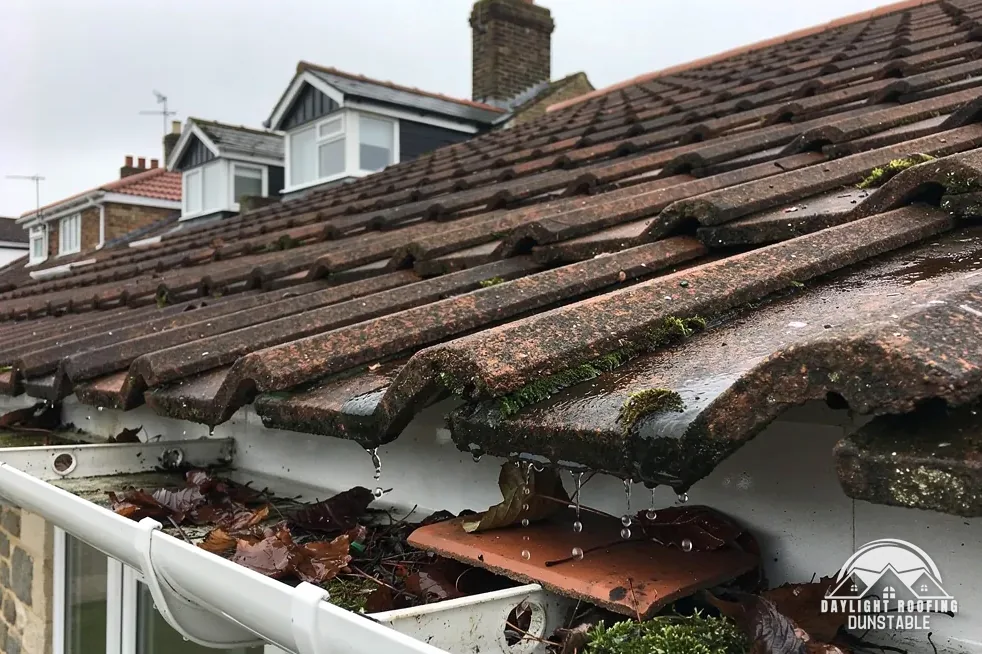
What ends up in a gutter
A gutter is a long open channel, so anything that blows or washes onto a roof can end up in it. Leaves are the obvious load, but they are only part of it. Seeds and twigs drop from overhanging branches, moss comes away from the roof slope, and grit sheds from the tile surface and rinses down into the channel with every shower. Birds can build in a gutter end or in the mouth of a downpipe.
Each of these does the same thing in the end. It settles at the lowest point of the gutter, which is the outlet where the water is meant to drop into the downpipe. The outlet is a small opening compared with the length of channel feeding it, so a handful of debris on top of it can slow the whole run.
Wet leaves and silt break down into a dark, heavy sludge. That sludge holds water, and it can sprout seedlings of its own, which is why a neglected gutter can grow grass in its bed. The load adds weight to brackets that were fitted to carry water, not a bed of wet material.
Trees do not have to touch the house for this to happen. Wind carries leaves a long way, so a gutter on a house with no tree in the garden can still fill.
Look for these at the gutter edge
- green growth along the channel bed
- a dark line of silt at the outlet
- twigs sticking out of the end
- a tide mark inside the lip
How a blocked outlet overflows
Water runs along a gutter towards the outlet, drops into the downpipe and leaves the roofline. When debris blocks the outlet, the water has nowhere to go. It rises in the channel until it reaches the lowest edge, and that edge is the front lip, so the water spills over it and falls past the wall.
Where it lands tells you something. A stream that pours over the lip near one point can mean the blockage sits at or just beyond that spot, while a spill along a whole run suggests the channel is full from end to end. Spillage close to a corner or a joint can mean a leak at the joint as well as a full channel.
The rainwater is not harmless once it leaves the gutter. It can run down the fascia board behind the channel and soak the timber, drop onto the ground against the foundations or splash back onto the wall below. A wall that stays wet can grow green algae.
| What you see | What it can point to |
|---|---|
| Spill at one point | A blocked outlet or a kinked run |
| Spill along the whole run | A full channel or a downpipe that is not clearing |
| Drip at a joint | A failed seal at the union |
| Wet wall below | Water running behind the lip |
Watch the gutter during a downpour from a doorway or window rather than from beneath it. The spill pattern is clearer while it is happening than the marks it leaves behind. A photograph of the spill sent on WhatsApp is useful context for a survey.
You might hear
Gutters only overflow when the rain is very heavy.
Plain as day
A partly blocked outlet can send water over the lip in modest rain.
Why winter makes it worse
A gutter that has been filling quietly through autumn is tested when the wet months arrive. Rain falls for longer, roofs shed water for hours at a stretch, and a channel already half full of sludge cannot take the extra flow. The overflow you never noticed in a light summer shower shows itself in a long, steady spell of rain.
Cold adds a second problem. Water that stands in a blocked gutter can freeze, and ice takes up more room than the water it came from. A frozen mass can press on the sides of the channel, and a plug of ice in the mouth of the outlet can make melt water back up behind it when the weather turns milder.
Weight is the third problem. A gutter full of wet leaves, standing water and ice puts a heavy load on its brackets. A bracket that has loosened can bend or pull away from the fascia, and a sagging run holds water in the low spot, which makes the blockage worse. A plain clear-out does not stop that cycle, because the dip is still there when the channel is empty.
Leaf fall comes before the winter rain, so the timing of a check matters more than a fixed number of visits. A look after the trees have dropped their leaves, and another after a spell of strong wind, shows what the gutters are holding. How soon a channel refills depends on the trees, the roof and the run of the weather.
Looking at the gutters safely
A gutter check looks simple from the ground, and ladders are where it goes wrong. The safest first step is to look without climbing. A walk around the house after rain shows where water is spilling, which downpipes are running and which are dry, and which stretches of fascia are stained.
Binoculars from the garden can pick out leaf growth along the top of a run, and a phone held up at arm's length can show the inside of a channel from an upstairs window. Do not lean a ladder against the gutter itself. Plastic gutters can crack under the pressure, and a ladder resting on a full channel can slip.
- look from the ground first, after rain
- never rest a ladder on the gutter
- stay off the roof slope
- keep clear of overhead cables near the eaves
- postpone the job on a wet, icy or windy day
Work at height needs the right equipment, a firm footing and a second person on the ground. A leaning ladder on soft or sloping ground can move, and a gutter above a lean-to, a porch or a conservatory is harder to reach than it looks. Where a stretch cannot be reached from the ground, leave it to someone equipped for it. Where the eaves are high and the scaffold stands on the road, a highway licence is needed, and we arrange the licence with our scaffolder.
What a proper clear-out involves
Clearing a gutter is more than scooping the top layer. The sludge sits along the full length of the channel, and the blockage that matters is at the outlet and in the downpipe below it. A clear-out that leaves the outlet half choked only moves the problem on by a few weeks.
The material comes out by hand or with a tool made for the job, and it goes into a bucket or bag rather than being dropped to the ground, where it blocks drains and gullies. Once the channel is clear, a flow of water from a hose at the high end shows whether it runs freely along the fall and out through the downpipe.
| What the water does | What it can mean |
|---|---|
| Runs freely to the outlet | The channel and fall are working |
| Pools in the middle | A sag or a loose bracket |
| Drips at a union | A worn seal or joint |
| Backs up at the outlet | A blocked downpipe or drain |
A gutter is laid with a downward fall towards the outlet, and Brett Martin gives that fall as 1 mm for every 600 mm. The slope is gentle, so a small dip can hold a pool. A pool that remains after the clear-out is the cue to look at the brackets, which the repair or replace guide goes through.
What clearing costs
Which? Trusted Traders price a complete gutter clear-out, covering the whole house at both front and rear, at £75 to £350. The figure comes from a survey of 11 Which? Trusted Traders gathered in November 2025, and it excludes VAT. It is one range for many different houses, so read it as a scale and not as a figure for your own.
Access is one of the things that moves a price. A bungalow with low eaves and a clear path round the house is a smaller job than a three-storey house with a conservatory roof under the gutter line. Where the work needs a tower or scaffold, the access forms part of the job, and the written quote after a survey is one total price for the whole of it.
A clear-out price covers clearing and nothing else. A bracket that needs refixing, a joint that needs resealing or a cracked length of channel is a repair, and a job that starts as a clear-out can turn into one once the channel is empty and the faults show.
Replacing gutters, fascias and soffits is a different scale of job. MyJobQuote gives an average gutter replacement cost of around £1,000 to £1,600, on a page last updated on 20 October 2026. The guttering, fascia and soffit costs guide lines the dated figures up with their units.
When cleaning is not enough
A clear gutter that still overflows, drips or leans is showing a fault in the gutter and not in what it carries. A fall that has gone wrong, a bracket that has moved, a cracked section or a failed seal are all possible causes. None of these is cured by a clear-out, and a repeat clear-out on a faulty run treats only the symptom.
Timber behind the gutter matters as well. Water that has overflowed for a season or two can soak the fascia board and the soffit below it, and soft or flaking timber is a reason to look at the fascia and not only the channel. The signs your gutters need work guide lists what to look for along the roofline.
Older roofline materials need a different approach. HSE's advice for any property that was built or refurbished before 2000 is to assume asbestos is present. Rainwater goods made of asbestos cement are non-licensed work only when carefully removed without breaking up, and HSE names white AIB soffit panels beneath the eaves as an asbestos insulating board material. A cracked older gutter or soffit is not something to scrub, drill or pressure wash.
- water that pools after the channel is clear
- joints that drip in light rain
- brackets pulling off the fascia
- timber behind the gutter that is soft or stained
- boards or gutters that may be asbestos cement
A photograph sent on WhatsApp to 07880 284133, or a call to 01582 935272, is the easy way to start. A survey looks at the gutter, the outlet, the fascia and the soffit together and gives one written total price.