
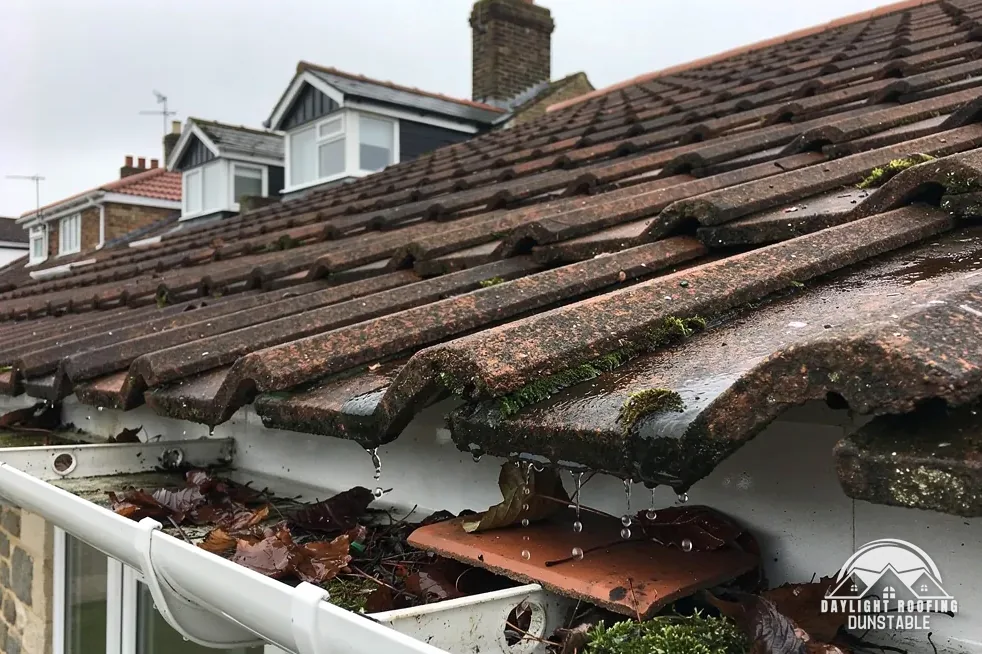
What each board does
The fascia is the board fixed along the ends of the rafters, facing outwards beneath the lowest row of roof tiles. It carries the gutter on its brackets, so it takes the weight of the channel and everything the channel holds. It also closes off the ends of the rafters from the weather.
The soffit is the board on the underside of the overhang, running between the fascia and the wall. It closes the gap between the two, so that birds, insects and rain driven by the wind cannot get into the roof space. Many soffits carry a vent or a row of small holes, because the air that moves through the eaves helps to keep the roof space dry.
The two boards work as a pair, and they age as a pair. Water that gets into one can reach the other, since the boards meet at the corner of the overhang. A fascia that has rotted can let damp into the soffit joint, and a soffit that has lost its vents can trap moisture against the back of the fascia.
Because both sit right at the roof edge, they are among the first parts of the roofline to meet rain running off the tiles. They also stand at the point where a leaking gutter delivers its water. How long they last is largely a question of how much water they meet and how well the material copes with it.
The figure for uPVC
Writing in a guide to its fascia boards, a uPVC roofline retailer says: "When installed correctly, they can typically maintain reliable performance for between 20 and 40 years". The line comes from a seller, so it is not a test result or a promise, and it depends on correct installation.
Two boards of the same age can be in very different states. A board fixed straight and ventilated well, under a gutter that sheds its water cleanly, is in a different position from one that has stood under an overflowing run for years. The figure cannot say which of those your house is.
| Material | Figure | Source |
|---|---|---|
| uPVC fascia boards | 20 to 40 years | A uPVC retailer, as installed correctly |
Timber, aluminium and cast iron have no figure in this guide, because a fixed number for them would be a guess, and a guess is no help when a board has to be judged by its condition.
Treat the retailer's 20 to 40 years for fascia boards as the outer picture and look at the board itself. A board of any age that is sound, straight and dry is doing its job, and a much younger one that is warped or split is not.
You might hear
A uPVC fascia is fitted once and never needs another look.
Plain as day
The retailer says correctly installed fascia boards can keep performing for 20 to 40 years.
How timber ages
Timber has no single lifespan because wood does not wear out on a timetable. It lasts while it stays dry and protected, and it fails when water gets in and stays. A painted fascia that is kept sealed, with its end grain protected and its gutter in good order, can stay sound for a long time. One that has been soaked by a leaking joint can go soft in a short time.
The weak points are easy to name. The cut ends of the board take in water along the grain. The lower edge sits where drips collect, and the joints between lengths hold moisture. The back face is out of sight, and an overflowing gutter can wet it for months without a sign on the front.
Paint is the board's coat. When it cracks and flakes, bare wood is exposed to rain, and each wet spell lets in a little more water. Repainting a sound board before the paint has failed is a way to protect it, though it cannot rescue timber that has already started to rot.
- paint that has cracked, lifted or peeled
- dark patches that stay damp after dry weather
- wood that gives when pressed with a thumb
- splits along the grain near the ends
- fungal growth or a musty smell from the soffit
A board that fails the thumb test is a replacement candidate, since soft timber does not hold fixings. A board that is only flaking on the surface may be a repainting job, and a look from close quarters is the way to tell the two apart.
What shortens life
Water is the common thread. A gutter that overflows, a joint that drips and a slipped tile that lets rain run onto the board all do the same job: they put water where the board is not built to take it. Fixing the water source can add more to a fascia's life than any change of material. Blocked ventilation is another cause. A soffit vent that has been painted over, or one clogged by debris, stops air moving through the eaves, and moisture can linger in the roof space and at the back of the boards. That can matter for timber boards more than for plastic.
Fixings play their part. A fascia held by corroded nails can sag, and a gutter bracket that has torn through a weak patch of board can drop the run. Where a bracket has pulled out of the same spot twice, the timber behind it is likely to be at fault.
Sunlight acts on plastic. Long exposure can fade uPVC or turn white boards yellow, and an old board can become brittle, so it cracks when knocked or when a ladder is rested against it. Heat can also move the boards slightly as they expand and contract through the seasons, which is why joints and fixings are worth a look.
A scaffold may be needed to reach the roofline safely for any of this, and we arrange the licence with our scaffolder where the scaffold stands on the road or pavement.
Signs a uPVC board is tiring
uPVC does not rot, so its failures look different. The signs are changes of shape and surface. A board that bows between its fixings, or one that has pulled away from the soffit and left a gap, is no longer doing its job. Cracks near the ends, or at the points where it is nailed, can let water behind it.
Joints are the weak spot of a uPVC roofline. Where two lengths meet, the join can open as the material moves, leaving a gap that shows daylight or lets in rain. A cover strip that has slipped, a corner piece that has cracked or a vent that has fallen out are small faults that matter more than they look.
Discolouration is mostly a matter of appearance, but it can give a hint of age. A white board that has gone yellow or chalky has been in the weather for some time, and cleaning may bring the colour back without changing what condition the board is in underneath.
| Sign | Timber | uPVC |
|---|---|---|
| Soft or spongy | Rot | Not applicable |
| Bowing or gaps | Warping | Movement or loose fixings |
| Cracks | Splits along the grain | Brittleness at ends and nails |
| Flaking surface | Failed paint | Not applicable |
Older houses and asbestos soffits
Age is not only about the boards themselves. HSE's rule of thumb for a property built or refurbished before 2000 is to treat asbestos as present, and its list of asbestos-containing materials has a white AIB soffit board under the eaves. A soffit in an older house can therefore be something other than ordinary timber or plastic.
Asbestos insulating board does not rot or soften like wood, so a soffit that looks sound is no evidence of what it is made of. A flat, pale, hard-looking panel with a smooth face is the kind of thing that needs checking. Only a sample taken by a qualified person can say what a board contains.
Do not drill, saw, scrub or pressure wash a soffit that might be asbestos. Most work on asbestos insulating board is licensed, and HSE counts damaged or broken-up cement as notifiable non-licensed work. A lockable skip is HSE's advice for the waste.
A board that is intact and left alone is not the same hazard as one that is broken. The point of identifying it early is to avoid disturbing it by accident when a gutter is replaced. The asbestos soffits guide covers the rules in more detail, and a photograph of the soffit sent on WhatsApp is a start.
Deciding what to do next
Once a board looks tired, the choice is between a repair, new covering boards over the old or a full replacement. A sound board with flaking paint needs treatment and paint. A tired but dry board may take a cover. A soft or split board needs replacing, together with any rotten timber behind it.
Rafter ends matter in that decision. If the fascia is off and the rafter feet behind it are damp or soft, the fault runs deeper than the board, and the repair grows with it. That is one reason a price given from the ground can change once the board is lifted.
Timing is easier when you act on signs and not on a calendar. A board that shows no soft spots, no gaps and no staining after a wet spell does not need replacing because of its age. A board that shows any of them is worth looking at now, since a small repair costs less than a larger one later.
For a sense of scale on money, the guttering, fascia and soffit costs guide gives dated outside prices, each with its source. The signs your gutters need work guide lists what else to check along the same line. We survey before quoting, and the price is a single written total. Send a photograph to 07880 284133 on WhatsApp, or call 01582 935272.