
The short answer
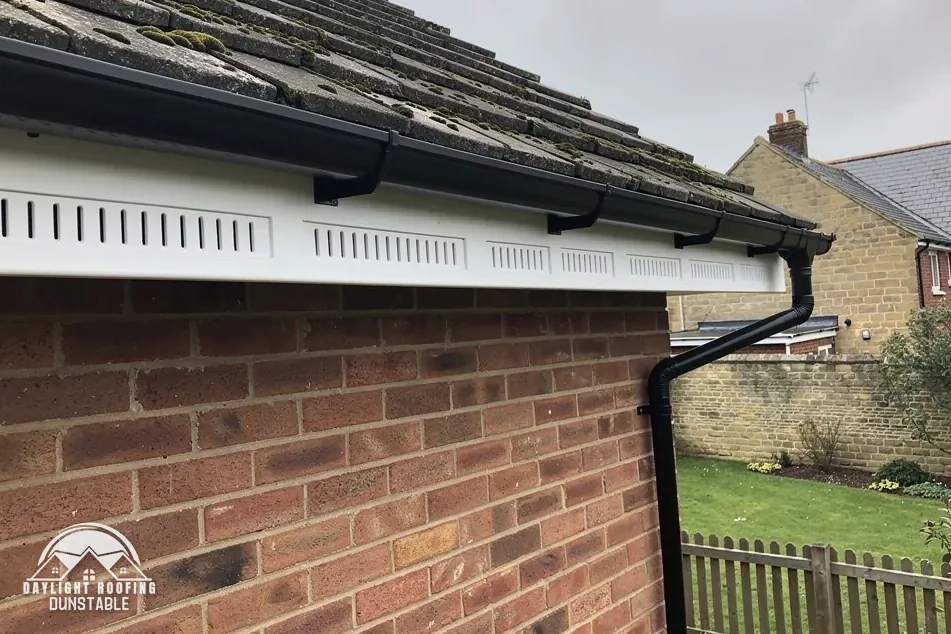
A fascia board is the long horizontal board fixed to the ends of the rafters along the eaves, facing outwards. It closes the gap beneath the lowest row of tiles and carries the gutter on its front face. Timber, uPVC and aluminium are all used, and a board that rots or splits can let the gutter sag.
Where the fascia sits and what it does
Stand in the garden and look up at where the roof ends. The board you see running along it, facing outwards, is the fascia. Behind it are the ends of the rafters, the angled timbers of the roof frame, and the board is fixed across them. It finishes the edge neatly, and it gives the gutter something solid to hold on to, since the gutter brackets screw into the fascia, or into the rafter ends behind it.
Below it sits a second part, the soffit. This is the panel across the underside of the overhang, and it is a separate piece covered on the what is a soffit page. Fascia and soffit are fitted together and can be replaced together, but they do different jobs. The fascia is seen from the front and carries a load. The soffit is seen from below and closes the eaves from underneath.
The board also protects. It shields the rafter ends and the top of the wall from rain driven sideways, and the lowest course of tiles may overhang the gutter behind it. Because it is exposed on its outer face, its top edge and its underside, it ages faster than much of the structure it protects. On a house with a clear view of the eaves, it is one of the easiest roof components to look over from the pavement.
What fascia boards are made of
Older houses were built with timber fascias, painted to keep the weather out. Timber is straightforward to cut, fit and repaint, though it needs paint or stain to last, and it can rot where water sits against it. Newer boards are made in uPVC, aluminium and composite materials, and a uPVC board can be fitted over the old timber as a cover, which is known as capping.
- Timber: can be repainted and repaired in part, and can rot or split if water reaches the wood.
- uPVC: needs no painting, and can distort or discolour with age.
- Aluminium: is a thin sheet formed to shape, and can dent if struck.
- Composite boards: are manufactured to resist rot, and vary by maker.
On lifespan, a retailer selling uPVC roofline products writes that its fascia boards, when installed correctly, "can typically maintain reliable performance for between 20 and 40 years." That is the seller's own figure for plastic, and the board behind it still has to be sound. For timber there is no equivalent figure to quote, because it depends on the wood, the paint and how well water has been kept off it. The how long fascias and soffits last guide gives the sources side by side.
How a failing fascia shows itself
A fascia does not fail overnight. It softens, splits or loosens over time, and the evidence can be seen from the ground if you know what to look for. The marks below point to a problem with the board, though only a close look can say how far it has gone.
- Paint that is flaking, bubbling or peeling from the board.
- Dark patches, or timber that feels soft when pressed with a screwdriver.
- Splits or gaps along the length of the board, or at the corners.
- A gutter that sags, or brackets that are coming away from the face.
- Gaps between the board and the soffit beneath.
- Staining or damp on the wall directly below.
Where a board is rotten, a new gutter screwed to it will fail in time, because the screws have nothing sound to bite into. So gutter work and fascia work are worth looking at together. MyJobQuote gives "The average cost of capping fascias and soffits is around £800", on a page dated 17/09/26; that is a national average for capping, not a price for any particular house. A written total follows a survey of the eaves. The guttering, soffits and fascias hub links the guides together.