
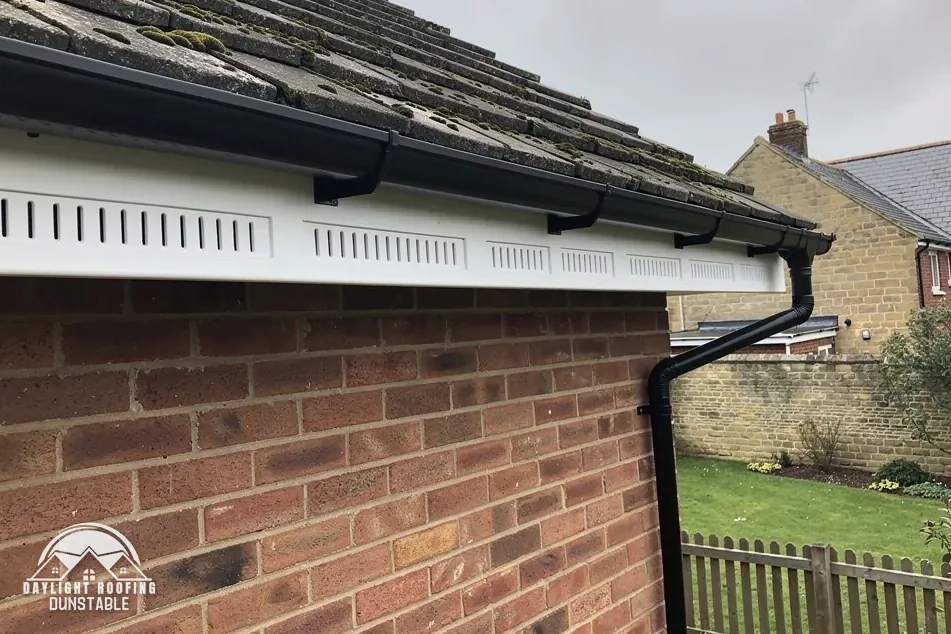
Three materials, one job
Whatever it is made of, a gutter does the same work. It collects water running off the roof edge, carries it along a gentle fall to an outlet and sends it down a pipe to a drain. Brett Martin gives that fall as 1 mm for every 600 mm, so each material has to be fixed accurately and kept in line, whichever one you pick.
What changes from one material to the next is how the parts are joined, how the surface weathers and what happens when something goes wrong. uPVC is a plastic that comes as lengths with clip-in joints and rubber seals. Aluminium is a metal that can be supplied in lengths or, in the case of seamless gutters, formed into one continuous run. Cast iron is an old, hard metal made in sections that bolt together.
Shape is a separate choice from material. Half-round, square and ogee profiles are made in more than one material, and the profile can matter as much to the look of a house as the substance. A run that suits the period of a property can look right where a mismatched one stands out.
No ranking appears in this guide, because the right choice turns on the house, the budget, the age of the building and what you want to do about upkeep. The aim is to set out what each material is, so that the questions you put to a quote are the right ones to ask.
What uPVC is and how it ages
uPVC is a rigid plastic. Gutters in it are moulded in white, black, brown, grey and other colours, and they are fitted with brackets, union pieces that hold a rubber seal and push-fit stop ends and outlets. The colour runs through the plastic, so there is nothing to paint.
One seller of uPVC roofline products writes of its fascia boards, "When installed correctly, they can typically maintain reliable performance for between 20 and 40 years". The line comes from the retailer's guide to uPVC fascia boards, the board a plastic gutter hangs from, so it describes the board and not the gutter, and it is a seller's line that rests on correct installation, not a promise.
The signs of age are different from those of metal. Sunlight can fade the colour or turn white plastic yellow, and an old run can become brittle and crack at the brackets or at a knock. The seals in the unions can dry out, and joints can open as the plastic moves through the seasons.
- no painting needed to keep it weatherproof
- joints rely on rubber seals that can age
- colour can fade or yellow in sunlight
- old plastic can crack where it is touched
- a repair can be a swapped part
A cracked length is replaced as a length, and a failed seal is renewed at the union. Because the parts are standard, a run from one maker does not always fit another maker's brackets or joints, so a repair to an old system calls for parts that match it.
What aluminium is and how it ages
Aluminium is a light-coloured metal that does not rust in the way iron does. Gutters in it are made in lengths with joints, in the same range of profiles as plastic, and they can also be formed on site as seamless gutters, one continuous run that is jointed only at corners and outlets. A painted or powder-coated finish gives the colour.
Seamless gutters remove the joints along a straight run, which are places a gutter can leak. They can only be made where a machine can be set up beside the house, and a run that turns many corners still has joints at each corner. The finish protects the metal and carries the colour, so a scratched coating is worth touching up.
Aluminium can dent when something hits it, for example a ladder, and water can pool in the dent. It can also be affected by contact with other metals in some conditions, which is a reason to use compatible brackets and fixings. The surface can pit or discolour at the edges where the coating has been broken. Aluminium has no lifespan figure in this guide, since a number would be a guess. Judge a run by its condition: a level, clean, firmly fixed channel is serving its purpose at any age.
Upkeep is the same as for any gutter. Clear the channel and outlets and look at the fascia behind it, since the metal is only as secure as the board it hangs from.
- Seamless guttersA continuous run with joints only at corners and outlets
- Powder coatingA baked paint finish on metal
- OgeeA gutter profile with an S-curved front
What cast iron is and how it ages
Cast iron is the old material for rainwater goods, and it is still made. The gutter comes in sections that join with bolts and a sealing compound, and it takes a painted finish, in black or a heritage colour. It is hard and rigid, so a section does not flex or sag like thin plastic.
Iron rusts when moisture reaches bare metal. A coat of paint is its protection, inside as well as out, and the inside of a gutter is the part that stays wet. When the paint fails, rust can start and spread, and in time it can thin the metal and let a hole through. Keeping the paint sound is the upkeep this material asks of you.
The joints are bolted and sealed with a compound. Where the seal dries out, a joint drips and can be resealed. A cracked section is repaired or replaced, and old sections can be reclaimed or matched with new castings made to the same patterns. Brackets and fixings for iron are strong, but they can rust, and a rotten fascia can let a run pull away from the wall. Because the metal is rigid, a fall that has gone wrong shows as a stretch that holds water and not as a droop.
Cast iron is also found in downpipes, and a break in an old downpipe can be hidden behind ivy or paint. Looking along each one from top to bottom is part of the check.
The three side by side
A table is a quick way to see how the three differ on the points that matter once the gutter is up. It does not rank them, and it does not put a price or a weight on any of them. Each row is a question to ask about your own roofline.
| Material | Surface | Upkeep | Where it can fail |
|---|---|---|---|
| uPVC | Colour moulded in | Clearing; no painting | Brittle plastic, aged seals |
| Aluminium | Painted or powder-coated | Clearing; touch up the finish | Dents, damaged coating |
| Cast iron | Painted | Clearing; repainting | Rust, dried joint compound |
The table shows why the question is not which one wins. A house with a long, plain roofline and low eaves has a different set of needs from a period house with a bay and a tall wall. A home that is listed or in a conservation area may have a material fixed by its setting, which the next section covers.
Think about what you want to do afterwards as well. If you do not want to paint at height, a material that needs no repainting is easier to live with. If you want a period look and are willing to maintain the paint, iron suits it.
Questions to ask of each material
- how are the joints made
- what does the surface need
- how does it fail
- can a part be swapped
- does it suit the house
The council and an older roofline
The material can be a planning matter in an old building. Listed homes keep their permitted development rights for roof work, but listed building consent is needed for anything that affects the building's character. Replacing cast iron guttering on a listed house with plastic may affect that character, so the council's conservation officer is the person to ask first.
A conservation area is the other case. Replacing a gutter like for like is the safer course, and a change of material or profile on a street elevation is worth raising with the council before any work starts. Article 4 directions can remove permitted development rights in some areas, and your council can tell you whether one applies to your address.
Where a house sits in the Chilterns National Landscape, applications still go to the local council. The Board that looks after it advises and responds to consultations, and the National Landscape does not itself decide anything about gutters.
- ask the council before changing the material on a listed house
- match the profile and colour where the house is in a conservation area
- ask whether an Article 4 direction applies to your address
- keep an old iron run in repair where the house needs it
Repairing like for like is the simplest route in each of these cases, and where a new run is needed, a call to the council's planning team is a short step that avoids a larger problem. We check the route with the council before work starts.
Choosing for your house
Start with the roofline you have. Look at what the existing gutters are made of, how well they have lasted and what the fascia behind them is like. A run that has done its job for decades is a pointer to what suits the house and the weather it faces.
The fascia matters in any material. A gutter is only as secure as the board that holds its brackets, so a soft or rotten board has to be repaired or replaced before a new run goes up. The fascia and soffit lifespan guide covers the boards.
Cost is a separate matter, and no price comparison between the materials appears in this guide. For dated third-party figures, the guttering, fascia and soffit costs guide gives a sense of scale. Whether to mend what you have or start again is in the repair or replace guide.
The survey is done ahead of the quote, and the price you receive is one written total. If you want to start with a picture, send it to 07880 284133 on WhatsApp, or call 01582 935272. A photograph of the whole run and one of any joint that worries you are enough to start with, and they show which material is already up there.