
The 2000 line and what HSE tells you to assume
HSE's advice on whether asbestos is present in a building starts from the date. Its words are: "If the building was built or refurbished before 2000, assume that there is asbestos in it." The line is about the building, and about refurbishment as well as construction, so a house refurbished before 2000 falls inside it just as one built before then does.
The advice is an instruction to assume, which is different from saying that asbestos is certain to be there. It sets the safe starting point: until the material has been identified, treat suspect parts of an older building as if they contain asbestos. The people who handle the work then plan accordingly instead of finding out halfway through.
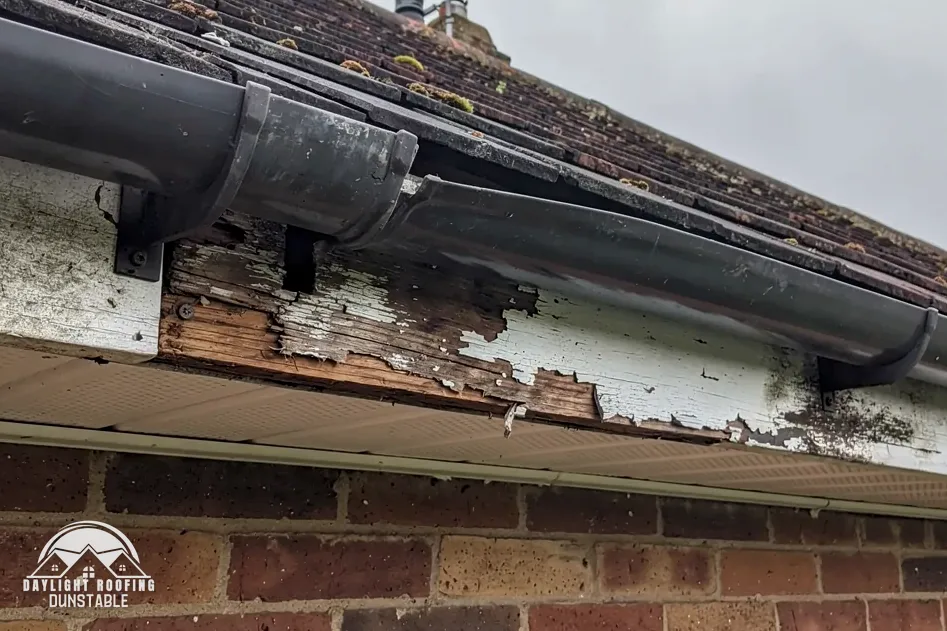
A soffit is one of the parts that can carry the question. It is a board fixed beneath the roof eaves, closing the space between the house wall and the fascia, and in an older building it may be of a material that contained asbestos. The next section sets out what HSE lists.
None of this means a house is dangerous. Asbestos materials that are in good condition and left alone are in a better position than materials that are disturbed. The rule exists so that the decision about what to do is made before a soffit is touched, not after.
What HSE lists for soffits
HSE's page on where asbestos materials are found names, among others, "AIB white soffit panels to underside of roof eaves". AIB stands for asbestos insulating board, a flat board made with asbestos and used in buildings for fire protection, insulation and linings. A second entry on that page reads "Damaged AIB soffit", which tells you that condition matters as well as material.
That entry covers one type of soffit and not every soffit. Timber soffits, uPVC soffits and other boards exist, and a soffit's material cannot be told from the ground with certainty. Looking at a photograph can show the age of the building and the state of a board, but it cannot prove that a board is or is not asbestos.
An older soffit may also have been replaced in the past, so the boards on one house can be of mixed ages. A quick check is to ask what is known about the house's history, and a more reliable one is an asbestos survey, which identifies materials instead of guessing. MyJobQuote gives an average of around £325 for an asbestos survey in 2026.
Our guide to what a soffit is explains the part itself, and the guide to how long fascias and soffits last covers the other materials.
Licensed, notifiable and non-licensed work
HSE sorts asbestos work into three groups, and the group depends on the material and its condition. Asbestos cement is treated differently from insulating board. The table sets out what HSE's pages say for the products that matter on a roofline, and the paragraphs after it add the detail.
| Material and state | HSE group |
|---|---|
| Asbestos cement, taken out whole | Non-licensed work |
| Asbestos cement, substantially damaged or broken up | Notifiable non-licensed work |
| Short-duration removal of AIB in refurbishment | Notifiable non-licensed work |
| Work on AIB where the risk assessment says it is not short duration | Licensed work |
Asbestos cement is a cement-bound product, and HSE puts items such as roof sheeting and rainwater goods in the non-licensed group on one condition: the material has to come out without being broken up. HSE adds that weathered cement still counts so long as it has not been badly damaged in some other way. Insulating board does not get the same treatment, and that difference is the point of the table.
Most work on asbestos insulating board, which HSE lists among soffit materials, is licensed. Licensed work has to be done by a contractor that holds the licence for it, and a general roofing or building firm is not that by default. A soffit cannot be treated as a simple board swap until it has been identified, and a soffit that proves to be AIB moves the job into a separate trade.
What to do with a soffit you suspect
If a soffit may be AIB, the first move is to leave it alone. Drilling, cutting, sanding, scrubbing and forcing a board off its fixings can release fibres, and a board that is damaged or breaking up is a worse position than one that is intact. HSE's list has a separate entry for a damaged AIB soffit for good reason.
- do not drill, cut, sand or scrub the board
- do not pull it off or pressure wash it
- keep children and pets away from damaged areas
- photograph the soffit, the fascia and the eaves
- make a note of the age of the house and any earlier works
Then have the material identified. An asbestos survey does that, and the result sets the route: if the board is not asbestos, the roofline job is an ordinary one. If it is, the choice is between leaving it in place in good condition and having it removed by someone who works to HSE's rules for that material.
A photograph sent to 07880 284133 on WhatsApp is a useful way to show us the house, the eaves and the board's condition before a visit. It does not identify asbestos, and no one should say from a picture that a board is safe. A roofer's survey and a laboratory or surveyor's identification are two different steps.
Before a fascia and soffit job starts
Replacing fascias and soffits is a roofline job, and a soffit can be disturbed when a fascia comes off. In a building that falls under HSE's pre-2000 rule, that makes the soffit's identity a question to settle before the work, because the board may be touched at the first stage.
The order of things is therefore: identify the board, decide who can lawfully do the work, then price it. A quote that was given before the board was identified is a quote for a job that may turn out to be another one. For that reason a written total for a roofline in an older building follows the survey, and the survey is where the material is raised. A householder can help by writing down the year the house was built and the dates of any earlier roofline work.
If the soffit proves to be something other than AIB, the work carries on as an ordinary roofline replacement. Our guide to guttering and fascia costs sets out dated third-party ranges for that.
If it proves to be AIB, the question moves to licensing. The firm replacing the fascia and the contractor removing the board may be different businesses, and each quote should say plainly which parts of the job it covers and what happens to the waste. Two quotes that cover different halves of the job cannot be compared as if they were the same.
Waste: lockable skips and consignment notes
Asbestos waste is hazardous waste, and HSE's guidance on it is specific. In its EM9 guidance, HSE says: "Use a lockable skip for asbestos". It adds that "it is not good enough to throw sheeting over a standard skip". An open skip is therefore not an option for asbestos, however well it is covered.
Hazardous waste moves with a consignment note, and there is an exemption for household waste. GOV.UK's guidance says the exemption covers domestic hazardous waste "(other than asbestos waste)". Asbestos waste is the exception to the exemption, so a householder cannot assume the note is not needed.
GOV.UK also says that waste carriers hold either upper-tier or lower-tier registration with the Environment Agency. A firm moving asbestos waste can be asked how it is registered, and a householder is entitled to ask. Where the waste goes after that is part of the removing contractor's job and not something to improvise.
Taking board down is a matter for the contractor named in the quote, together with the skip, the carrier, the consignment note and the waste route. On a properly run job, those questions have answers before the first fixing is touched, and the householder can ask to see them.
Costs and what comes next
MyJobQuote gives an average asbestos survey cost of around £325 in 2026, and says the average cost of asbestos removal for a roof in the UK is around £2,750. The second figure is for a roof, not for a soffit, and it is another publisher's average, not our price. They show the scale of the money involved.
A soffit job is priced from the survey, giving one written figure, and where asbestos is in question the survey comes first. Scaffold, where a job needs it, belongs inside that total, and where it stands on the highway we arrange the licence with our scaffolder.
If you are planning to replace fascias and soffits on a house built or refurbished before 2000, start by reading what HSE says and then ask for the material to be identified. If you are not sure when the house was built or refurbished, assume the date falls inside the rule until you know otherwise.
Questions about a particular roofline can be sent by email to info@daylightroofingdunstable.co.uk, or phoned through on 01582 935272. Photographs help, since they show the house and the state of the boards even where they cannot name the material, and a note of the house's age helps more.