
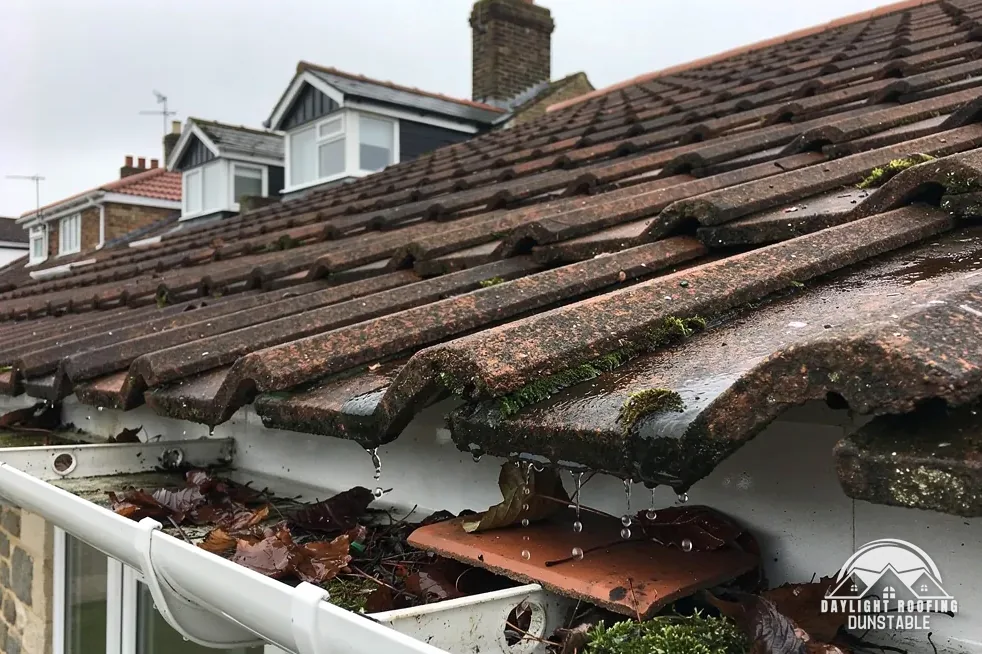
What an emergency looks like on a commercial roof
A commercial or industrial roof can be larger, flatter or lower in pitch than a house roof, and the consequences of a failure reach further. Water through the covering can land on stock, machinery, electrical equipment or a production floor, and a business may have to stop work. The same triage applies as for a home, with extra weight on what is below the leak.
Plain emergencies include water entering during rain, a profiled sheet blown off or lifted, a rooflight that has cracked or fallen in, a membrane peeled back from its edges, an outlet or gutter blocked so water ponds on the roof, and any sign that the structure has moved, such as a sagging purlin or a new crack in a wall at roof level.
Things that can wait are the faults that are dry and stable: an old stain, a patch of moss, a small lifted flashing with a dry interior. Waiting is still a decision to be made against the forecast, because a small fault can become a large one in the next storm.
The household version of this triage is in what counts as a roofing emergency. For the services behind it, see commercial roofing, and for the whole sequence of an urgent repair, the emergency roof repairs hub.
Fragile roofs and rooflights: nobody walks on them
Some commercial roofs cannot carry a person. Sheeting that looks solid can fail under a person's weight, and the failure is sudden. A fall through a roof is a fall from height onto a hard floor, with nothing to break it on the way down.
| Roof element | Hazard |
|---|---|
| Cement sheeting | Fragile, may contain asbestos |
| Rooflights | Can fail underfoot |
| Old profiled sheets | Corroded fixings, weak spots |
| Wet flat roof | Slippery, soft deck beneath |
The HSE is plain about cement sheets: "AC roofs are always fragile". The same body advises, "If the building was built or refurbished before 2000, assume that there is asbestos in it." A cement-sheet roof on a building of that age is therefore treated as fragile and possibly asbestos-containing until someone competent has shown otherwise.
Rooflights deserve the same caution as the sheets around them, because they can be glazed with materials that crack or sag, and moss or old paint can disguise them. The rule for staff, tenants and visitors alike is the same: nobody goes onto the roof, and nobody leans over the edge of an opening to look. Where access is needed, it is for people with edge protection and a plan.
Asbestos cement sheets: what the HSE says
Asbestos cement sheeting may be present on older industrial and agricultural roofs, and an emergency on such a roof carries an extra duty of care. The HSE's guidance separates the work by risk, and a building owner or manager needs to know where those lines fall.
Cement sheeting with asbestos in it, where it is lifted off whole and not broken, counts as non-licensed work, and that includes cement that is "weathered but not otherwise substantially damaged". Where asbestos cement sheeting "has been substantially damaged or broken up (eg as a result of fire or flood damage)", the HSE treats the work as notifiable non-licensed work. Most work on asbestos insulating board is licensed, and the HSE lists "AIB white soffit panels to underside of roof eaves" among the places it is found.
What that means in an emergency is to stop and take advice. A storm that has cracked or broken sheeting is a damaged asbestos cement roof if the material is asbestos cement, and debris should not be swept, scraped, drilled or driven over. Broken pieces must go in a lockable skip, because the HSE's guidance says "Use a lockable skip for asbestos".
The practical steps for a building owner are to keep people away from damaged sheets, to avoid disturbing debris, and to ask a competent asbestos adviser what the material is and how it can be dealt with. The HSE website sets out who can do which kind of work, and a roofing contractor should be able to say plainly what its own work covers.
Making safe first on a large roof
The first stage is to stop the damage growing and remove danger, not to repair the roof. On a commercial roof that means closing or covering an opening, refixing or removing loose sheets, and protecting what is beneath. It can also mean cordoning off an area where sheets or debris could fall, and moving stock or machinery out from under a leak.
Scale changes the method. A tarpaulin on a house slope is a modest piece of work, while sheeting over a large span needs fixings along the edges, weights or battens that hold in wind, and a plan for water so that a cover does not become a pond. Temporary roof covers describes the principles, and they apply with more force on a bigger roof.
Safe access is the central issue. Working on or beside a fragile roof needs edge protection, crawling boards or a platform, and an approach that spreads weight and keeps people off the sheets. A roofer who proposes to walk a fragile roof to assess it without these is taking a risk that no emergency justifies.
Inside the building, protect equipment first. Cover machines and stock with sheeting, switch off and isolate electrical equipment that water might reach, and photograph the area before anything is moved. A business may be able to carry on working in an unaffected part while the roof above the damaged part is made safe.
CDM 2015 and the construction phase plan
Roof work on business premises is construction work, and the Construction (Design and Management) Regulations 2015 apply to it. The regulations spread duties across the client, designers and contractors, and an emergency does not suspend them. Everyone involved needs to know who is responsible for safety on the roof.
The HSE defines a domestic client as "any individual who has construction work carried out on their home, or the home of a family member, that is not done as part of any business." A shop, unit, warehouse or office is not that, so the household shortcut, under which the duties pass to the contractor, is not the starting assumption for business premises. The client's own duties are set out by the HSE.
A plan of this kind is a feature of every project. For a single contractor the regulations require the contractor to draw up "a construction phase plan" before work starts, and for a project with more than one contractor a principal contractor takes on that role. In an emergency the plan can be short, but it should say how the work at height will be done and how others will be protected.
As a client, you are entitled to put a question to the roofer about how CDM 2015 is being handled, what the plan says about access and fragile surfaces and who is in charge on site. Ask too who will be on the roof and how they will be kept off the fragile parts of it. The answers belong in writing, with the quote.
Survey first, then repair or replace
Once the roof is safe, a survey decides what comes next. It looks at the visible damage and then at the surrounding covering, the fixings, the deck or purlins beneath, the drainage and the condition of every junction. A commercial roof can hide a lot, and water that entered at one point may have spread along a deck or sheet joint before it showed.
The decision between repair and replacement rests on a few questions. How much of the covering is damaged, and is the rest sound? How old is the roof, and is it near the end of its life? Is the structure beneath healthy? Are other failures likely nearby? A repair suits damage that is confined to a defined area of a covering that is otherwise in good order.
Replacement suits a roof where the failure is widespread, where fragile or deteriorated sheeting cannot be safely repaired in place, or where repeated repairs have stopped holding. It costs more at the outset and gives one new covering in place of a patchwork. For flat coverings, flat roof splits and blown membranes describes how patching compares with re-covering.
Every commercial roof differs in size, access, covering and condition, so the work is priced after the roof has been looked at in person, and the quote is written. Ask what it covers, what it leaves out and how the work at height will be arranged.
Keeping the business running and the paperwork in order
A roof emergency is also an operational one. Decide which areas are safe to use, which must be closed and how deliveries, staff and customers reach the building. A roofer's survey can say what the roof will allow, and the plan for making safe can be arranged around the working day where it is possible to do so.
- photograph the damage, the water and any affected stock or equipment, with dates
- tell the building's insurer, and read what the policy says about roof damage
- work out who looks after the roof if the premises are leased, because the lease decides
- keep every quote, message and receipt together
The insurer decides what a policy pays for, and policies differ in what they cover and in what conditions apply to the condition of the roof. Report the damage early, and keep the damaged material until the insurer has been told. Pictures shot while the scene is undisturbed are the record of what happened, so take them before the clear-up begins.
If the premises are rented, the lease sets out whether the landlord or the tenant looks after the roof, so read it before ordering work and tell the landlord what has happened. Where the work is the landlord's, they need to know quickly. A message to the Daylight Roofing team on WhatsApp, 07880 284133, with photographs of the roof and the damage, lets a roofer see what has happened before the visit.