
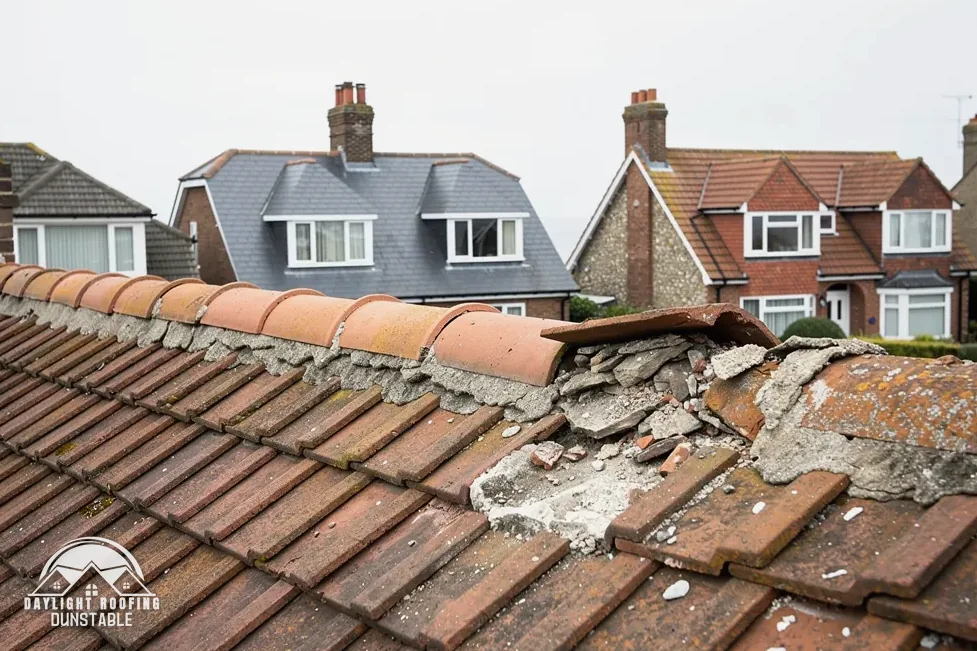
What a temporary cover is for
Laid over damage, a temporary cover stops rain reaching the structure below. It does one job: it keeps the roof space and the rooms beneath from taking more water than they have taken already. It does not restore the roof, and it holds up poorly once the weather turns hard.
The need arises when the damage and the conditions rule out a repair on the spot. A tile roof that has lost a patch to wind cannot be re-tiled in the dark or in a gale, a fallen limb may have left a hole with broken timber around it, and a flat roof may be too wet to receive new membrane. Covering the opening protects the house while those conditions pass.
Think of the cover as buying time, measured in days or a few weeks and not in seasons. The permanent repair follows when the slopes have dried out, the damage has been looked at properly and the materials have been ordered. A cover left on without that follow-up becomes a problem of its own, because it degrades, chafes and hides what is going on underneath.
Whether a fault is urgent at all is sorted out in what counts as a roofing emergency. The make-safe stage as a whole is described in what a roof make-safe is, and the main emergency roof repairs page places covers within the whole sequence, from the first phone call to the finished repair.
Tarpaulins, sheeting and boarding compared
Three materials cover the ground in temporary protection, and each suits a different kind of damage. What follows is a general description of the trade rather than a specification, and the right choice for a particular roof is a decision made on site, with the damage in front of the person fitting it.
| Material | Suits | Limit |
|---|---|---|
| Tarpaulin | Lost tiles, slipped slates | Flaps in wind |
| Heavy sheeting | Larger slopes, flat roofs | Needs firm fixing |
| Boarding | Holes, broken structure | Needs sound timber |
A tarpaulin is the lightest option and the one a householder will picture first. It is a sheet of woven plastic with eyelets, and a good one is thicker than a garden-centre sheet. Its weakness is movement: a loose edge flaps, wears through and lets in water at the corners.
Heavier sheeting covers a larger area and sits better on a flat roof, where there is no slope to shed the water and ponding is a risk. Boarding, which can be plywood or a similar sheet material, closes a hole where something has come through. It gives a rigid surface that a tarpaulin can then cover, and it can be cut to fit around timbers that have broken.
How a cover is held on the roof
Fixing is the hard part. A sheet that is simply laid over damage will lift as soon as wind gets under it, and wind passing over a roof pulls upward at the edges. A cover stays put only when its edges are secured to something solid and the sheet is stretched across without slack.
One method is to batten the edges, sandwiching the sheet between a length of timber and the roof structure, then fixing the batten to a sound part of the roof. On a tile roof that can mean fixing to the rafters or battens beneath, with the sheet carried up and over the ridge so water has no path under the top edge. Where work is at height on a pitched roof, access is by scaffold, ladder and harness, not by climbing the slope.
- edges secured to timber, not just weighted down
- the sheet carried over the ridge, not tucked under the top row
- no slack where wind can get in and billow it
- fixings placed so each hole can be made good afterwards
The aim is to protect without adding damage. Every fixing is a hole, so a careful cover uses as few as the job allows and puts them where a later repair will be disturbing the roof anyway. Weights such as sandbags or bricks can hold a flat-roof sheet in place, but they are only for low-risk positions, since a weight that slides can fall.
What a cover cannot do
A cover cannot make the roof sound. A cracked batten stays cracked beneath the sheet, a torn underlay stays torn, and a slipped tile stays slipped. Water that has already got into insulation or timber remains there, and a sheet laid over wet material can trap the moisture instead of letting it dry.
It also cannot be trusted in all weather. A tarpaulin on an exposed slope is working against the wind every hour, and repeated flapping wears through the fixings and the sheet itself. After a spell of strong wind, a cover that was sound the day before may have worked loose, so it needs looking at from the ground, with the same caution as before.
Light, condensation and ventilation are the other casualties. A roof sealed under plastic cannot breathe, and the loft below can turn damp and mouldy if the cover stays long. The roof timbers need air to dry out, which is another reason the cover has to be short-lived.
None of this makes a cover a bad idea. It means a cover is judged against its aim, which is to stop further water for a short period, and nothing beyond that. A roofer who treats a cover as the repair is selling the wrong thing, and the written price for the permanent work should be asked for separately.
Covers on flat roofs and over holes
Flat roofs behave differently because water does not run off them. A split or a blown section lets water settle on the deck, so a temporary cover has to shed water towards the gutter or outlet and must not hold a pool of it. A sheet that dips in the middle gives rainwater a place to collect, and the weight of the pool can drag the cover off.
Holes from fallen branches or failed rooflights call for boarding. The edges of the opening can be ragged and may expose broken timber, so the first step is to make the surround sound enough to fix to. Boards are laid to span between solid supports, then sheeted over so that no joint between them lies open to rain.
On any roof, the cover has to avoid clogging drainage. A sheet that covers a gutter outlet, a valley or a downpipe head sends water somewhere it was never meant to go, and that can mean an overflow into the wall. Where cement sheeting or asbestos insulating board may be present, leave it undrilled and unbroken, because the HSE advises: "If the building was built or refurbished before 2000, assume that there is asbestos in it." What a gale does around such a cover is set out in wind damage to roofs.
The structure of a flat roof and the repair choices for a split are covered in flat roofing, which is where the permanent side of the work is described.
Why it is not the permanent repair
A permanent repair returns the roof to a condition that can keep weather out through the seasons. It deals with the layers behind the visible damage, replaces the parts that failed and refixes the covering to its fixing specification. It is planned from a survey that takes in every slope and every junction, because the point where water showed indoors may sit far from the point where it entered.
The price follows from that survey and arrives as one written total, with any scaffold the repair needs folded into it. A cover is a separate piece of work from the repair, so what the first costs does not predict what the second will cost. The published guides on what an emergency visit costs are in emergency roof repair costs.
Leaving a cover in place into the winter is a risk. Frost, wind and the weight of standing water test it, and the longer it stays, the less each fixing grips. Planning the repair while the cover is still sound gives a margin that a collapsed cover would remove.
Ask any roofer who fits a cover what is being done and what is left for later. A clear answer names the damage, the materials used and the repair still outstanding. A vague one suggests the cover is being treated as the end of the job, and that is the moment to ask for the permanent work to be described in writing before anything else is agreed.
What to check and keep after a cover goes on
Look at the cover from the ground after each spell of strong wind or heavy rain. Check that the edges have not lifted, that no corner has torn, and that the sheet is still drawn tight. A cover that has started to flap should be reported at once, since the repair of a failing cover is quicker than the repair of the water damage that follows.
Look in the loft and in the rooms below for new damp. A stain that is spreading, or a drip that has started again, means water is getting past the cover. Mark the edge of any stain in pencil with the date, so it is plain whether the patch is growing or has dried.
- keep photographs of the damage from before the cover went on
- keep the receipt for the temporary work
- note the date the cover was fitted
- tell the insurer what has been done
An insurer may ask for evidence of the damage and of what was done about it, and one policy can differ from another on what temporary work it pays for. Ask before agreeing to work if that is possible. The Financial Ombudsman Service says it will "usually look at expert reports and photos", so the pictures taken before the roof was covered carry weight. Photographs can also be sent on WhatsApp to 07880 284133 for a roofer to look at.