
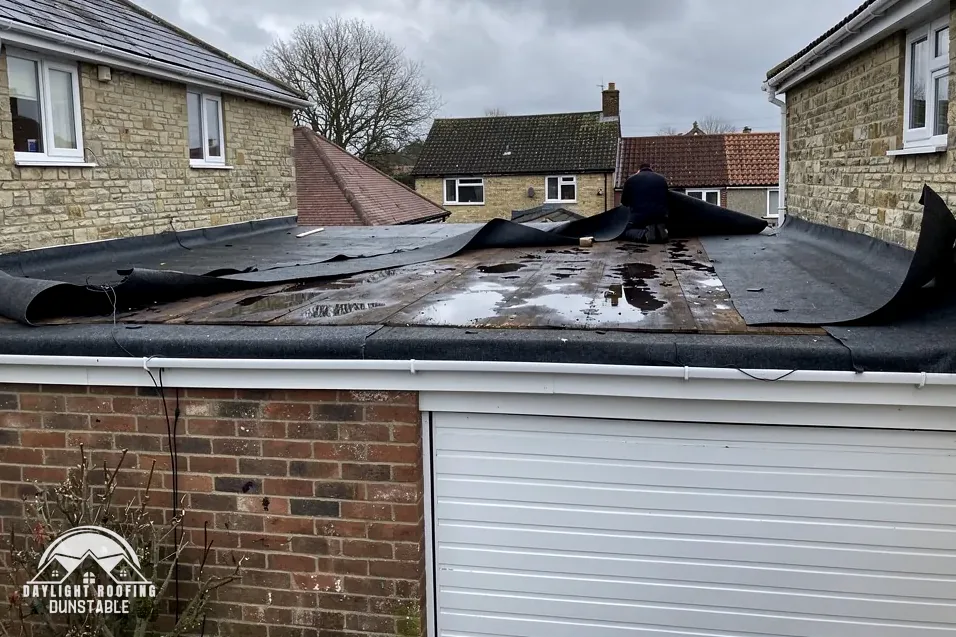
One thin skin between rain and the deck
On a tiled slope, overlapping units mean a few failures need not add up to a leak. A flat roof has no such cushion. Its covering is a continuous membrane laid over a deck, and that membrane is the sole barrier. A tear, a lifted edge or a puncture lets water straight into the layers beneath.
Those layers can be timber boards, plywood or concrete, with insulation sitting between the deck and the covering. Wet timber softens and can rot, and wet insulation stops insulating. Because water travels sideways between layers, the stain that appears on a ceiling may be a good distance from the damage on the roof.
Wind attacks a flat roof in a different way from a pitched one. The roof is a large, level surface, and suction across it can lift a membrane at its edges, at upstands where the covering turns up a wall, and along laps and joints. Once an edge lifts, gusts can get under the sheet and peel it back across the roof.
Splits have a different cause. They open where the membrane has aged, where the structure beneath moves, or where something has struck it. A storm can finish a covering that was already tired. The flat roofing hub describes the systems in full, and the emergency roof repairs hub places a failure like this within the whole sequence of make-safe, survey and repair.
How felt, EPDM and GRP give way
Felt, EPDM and GRP are three of the coverings found on flat roofs over houses, extensions and garages. They fail in different ways, so the first step in any repair is knowing which one is on the roof. What a particular roof shows depends on its age and how it was laid.
| Covering | Weak points in wind | Typical damage |
|---|---|---|
| Built-up felt | Laps, edges, upstands | Blisters, splits, lifted sheets |
| EPDM rubber | Edge trims, bonded seams | Peeled edges, punctures |
| GRP fibreglass | Edge trims, joints | Cracks, lifted trims |
Felt is made of layers of bitumen-coated fabric, and when it ages it can crack and open at the laps. EPDM is a rubber sheet, laid in one piece where the roof size allows, so it has few joints, but its edges and any bonded seams are what wind can reach. GRP is a rigid fibreglass shell, and it can crack where the deck beneath flexes or where something has hit it.
Single-ply is the name for sheet systems such as EPDM or TPO; built-up felt and GRP belong to other families. Telling the three apart from the garden is not always easy, so a roofer checks on the roof itself before proposing a repair, and the covering's identity shapes what that repair can be.
What the lifespans say about the age of the covering
Age shapes the decision, since an old covering is more prone to split and less worth patching. Two published sources give different lifespans for each covering, so both appear below. Neither is a promise, and each carries its own date and wording.
| Covering | HomeBuilding | Less |
|---|---|---|
| Felt | 10-15 years | 10 to 20 years |
| EPDM | 25-30 years | 30 to 50 years |
| GRP | 25-30 years | 25 to 40 years |
HomeBuilding's figures are approximate lifespans, last updated 30 September 2025. Less says torch-on felt lasts "10 to 20 years depending on quality and installation", EPDM "typically lasts 30 to 50 years" and GRP "lasts 25 to 40 years with minimal maintenance"; its page was last updated on 12 November 2026.
What to take from the table is the scale. If you know roughly when the roof was laid, you can set that against the ranges. A felt roof of fifteen years that splits in a storm is a different case from an EPDM roof of eight, where a strong gust may simply have peeled one edge. Neither source treats these as guarantees, and the state of the deck, the drainage and the standard of the original installation all push a particular roof either way. A roofer who has seen the roof can place it within the range far better than the calendar can.
Reading a split before anything is done
A split need not be the whole story. On felt, a crack along a lap can be the visible end of a seam that has been losing its grip for months. On GRP, a crack may follow a line where the deck has flexed. A puncture from a fallen branch is simpler, since it is a hole with a cause, but even then the water that entered may have travelled.
What to look for, through an upstairs window or from a ladder footed at ground level and never on the roof itself, is the pattern. A single clean tear suggests impact or a failed joint. Many fine cracks across a surface suggest an ageing covering. A blister that has burst shows moisture trapped beneath, and puddles that remain for days after rain show that the roof holds water, which stresses the membrane further.
The deck is the next question. If water has been getting in, the boards beneath can be soft or stained, and wet insulation under the covering holds moisture against the deck long after the surface looks dry. Those hidden layers decide whether a repair holds, because a patch bonded to a wet surface is only as sound as what is underneath it.
Photographs help. Pictures showing the split, any ponding, the ceiling stains below and the edges where the membrane meets walls tell a roofer a lot before the first visit, and they are the evidence an insurer will want to see. A picture can be sent by WhatsApp to 07880 284133 for a roofer to look at.
Patching a split or blown section
A patch is a repair to one defined area: a section of felt cut out and replaced, a piece of EPDM bonded over a puncture, or a crack in a GRP shell ground out and laminated. Done well, it makes a roof watertight again at a modest cost, and it suits damage that is confined to a small, sound area of an otherwise healthy covering.
Patching has limits. The new material joins an old surface, and the join is the weak point. If the surrounding covering is brittle, blistered or lifting, a patch only moves the failure along. If the deck beneath is wet or soft, the repair will not hold until the deck is dealt with. And if several areas have gone, the patching can add up to more than the cost of re-covering.
A temporary cover is a different thing from a patch. Where the damage is open and the weather is bad, a sheet laid across the opening buys time, as temporary roof covers explains. The patch or the re-cover follows once the deck has dried out.
Before agreeing to a patch, ask what the roofer found beneath the damage and how far the problem reaches. A repair priced low because it covers only the visible split can leave the rest of a failing covering to fail in the next storm.
When the whole roof needs re-covering
Re-covering strips the failed membrane, checks the deck, replaces any damaged boards and lays a new covering across the whole surface. It is the sensible course when splits and lifts are spread across the roof, when the covering is old, or when the deck has taken in water. It costs more at the outset, and it replaces a patchwork of weak points with one new skin.
It also gives a chance to put right how the roof drains. NFRC says BS 6229:2025 sets "a minimum 1:80 finished fall for general roof areas and internal gutters", and a roof that holds standing water is working against its covering every day. BS 6229:2025 applies to flat roofs with continuously supported flexible waterproof coverings, the membranes covered in this guide, and not to lead.
On price, MyJobQuote's page of 20 October 2026 says "In 2026, the average flat roof replacement costs between £1,500 and £6,000." That range spans small and large roofs and different coverings, so it says little about one roof. The figure for your own roof is the one in the written quote after the survey, and any scaffold needed is part of that quote.
A new waterproof layer also raises a question for building control, because the energy rules in Part L of the Building Regulations can reach a renovated roof, so check the route with the council's building control team or a registered building control approver before work starts. The emergency roof repair costs page sets out the figures for the urgent side of the work.
Keeping water out while you wait
Indoors, the aim is to limit harm. Move bedding and furniture out of the room below a leak, put a container under each drip and keep clear of any ceiling that bulges. Water running through a ceiling light needs the circuit switched off, if that can be done safely, and an electrician if it has reached wiring.
Outdoors, stay off the roof. A wet flat roof is slick, a softened deck can fail beneath a person, and a fall from a single-storey extension can be as serious as a fall from a house. Roof access for inspection is a job for someone with a ladder, edge protection and the training to use them.
- photograph ceiling stains with the date
- note when the leak started and how it behaved in the rain
- sweep standing water towards the outlet only from a ladder and only if it is safe
- keep any pieces of membrane or trim that have blown off
Tell your insurer, and read what the policy says about storm damage. The Financial Ombudsman Service says it will "usually look at expert reports and photos", and it describes how it reads a storm: "a storm usually involves violent winds, usually with rain, hail or snow". The wind damage to roofs page covers what gusts do to pitched coverings.