
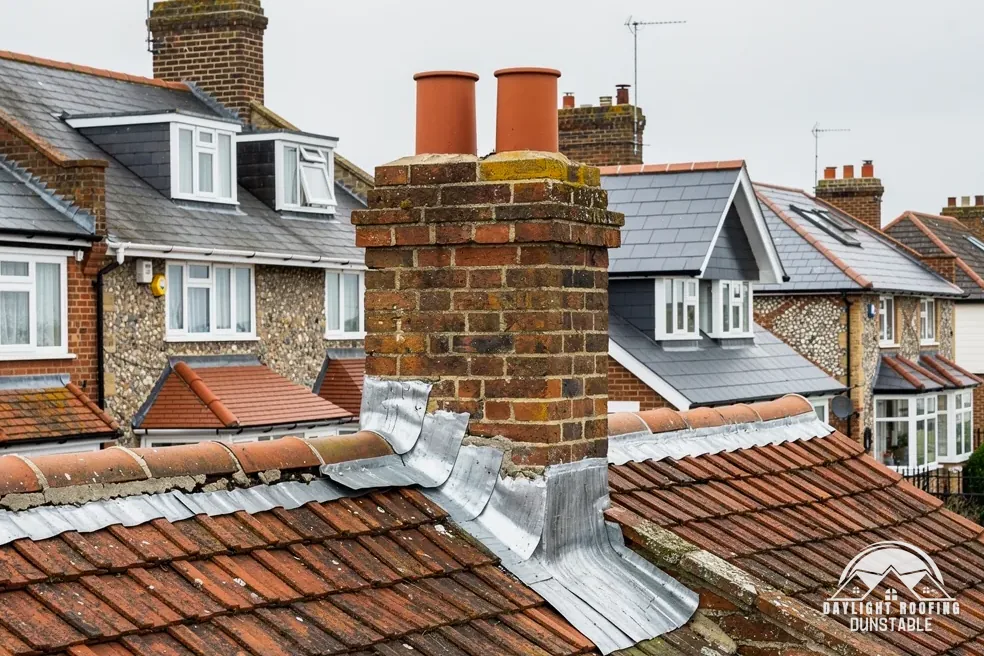
Why a stack takes the brunt
A chimney stack is a tall column of masonry that rises through the roof and stands clear of it on every side. Nothing shelters it. Wind strikes all four faces, rain soaks the brick from every direction, and frost works into any joint that has softened. The part above the roof line weathers faster than the walls of the house below.
Several parts make up a stack, and each can fail separately. The brickwork forms the shaft. Mortar joints, known as pointing, hold the bricks together. Across the top runs a mortar crown, the flaunching, which grips the pots and slopes water off. Pots or cowls sit in it. At the base, lead flashing seals the junction between the stack and the roof covering.
Storm damage can reach any of these. A pot dislodged by a gust, a crown cracked open by frost, pointing washed out of the joints and flashing lifted at the corner are four different faults, and the sound of the wind through a chimney is not a reliable test of any of them.
Whether a fault counts as an emergency depends on movement and on water. What counts as a roofing emergency gives the plain triage, and a leaning or cracked stack sits firmly on the urgent side of it.
Pots and flaunching after a gale
The pot is the highest part of the stack and the first to catch the wind. A pot can slide on its bed, tilt, or fall, and a cowl can be torn off its seating. A pot that has moved only a little can still drop later, so a pot that looks tilted from the ground should be treated as loose.
Frost and rain crack the flaunching long before a storm arrives, and strong wind then works into the cracks. Pieces drop off, the pot loses its grip, and rain soaks the brick underneath the crown. From the garden, a failing crown can appear as dark gaps, ragged crumbling edges or lumps of mortar lying on the slope or in the guttering.
| Sign | Possible cause |
|---|---|
| Pot leaning | Flaunching broken |
| Pot missing | Fell in the wind |
| Crumbs on the slope | Crown breaking up |
| Dark wet bricks | Water entering the top |
A pot that falls through the roof or onto a path is heavy and can do real harm to a person. If one has slid, keep people and pets off the ground beneath, and leave the fireplace unlit until a roofer or a sweep has examined the stack, because a cracked flue and a loose pot are not a safe combination.
Cracked brickwork and pointing
Storm wind can shift a stack that is already weak. The pointing between the bricks may have eroded over the years, and a strong gust works a loose joint a little wider. Horizontal cracks running across the shaft and bricks that have shifted out of line mean the stack has moved. A stack that leans is the plainest warning sign, and it needs to be made safe before anything else.
Moisture does the slow damage. Water that soaks into soft brick and mortar freezes in winter and expands, which can break the face off a brick or push a joint open. Over time, a stack can lose its strength from the inside before it shows much on the outside.
A stack that is out of line can pull on the roof beneath it. The weight of a tall column of masonry is carried by the structure below, and if the stack tips or part of it falls, it can crash through the covering and the rafters. That is why movement is the line between a stack that can wait for a survey and one that cannot.
Repairs range from repointing joints to rebuilding the top courses and, where a stack is beyond saving, taking it down. Repointing is priced after a roofer has judged the extent of the weathering. Rebuilding or removing a stack can be structural work, so ask building control about the route before it starts.
Flashings and leaks around the base
Around the base, where brickwork meets roof slope, the junction is sealed with flashings: lead sheet set into the mortar joints and laid over the tiles. On the high side a back gutter can carry water round the stack. A storm can lift or tear these, and wind-driven rain then runs behind them into the roof.
A leak at the stack shows indoors as a stain on the chimney breast or on the ceiling beside it, or as damp that appears in strong wind and rain and fades afterwards. That timing points to the junction rather than to the main roof covering. Outdoors, flashing that stands away from the brick, a gap at a corner or lead that has been folded back are visible from the garden.
Lead is a durable material. MyJobQuote says correctly installed lead flashing "can last for over 80 years". Rolled lead is made to BS EN 12588, and the code chosen for a stack flashing is a matter for the specification. A flashing that has been pulled loose can sometimes be re-dressed, while one that has torn needs replacing.
On cost, MyJobQuote's page last updated on 22 September 2026 gives "around £200" typically for a patch to a chimney's lead flashing and "around £570" on average for replacing it in full. Both figures relate to chimney leadwork alone. The chimney repairs hub covers the permanent work around stacks.
Why a damaged stack is a make-safe job
A stack that has moved is a risk to people and to the roof beneath it, so the first step is to remove the danger and not to repair the whole chimney. That can mean taking off a loose pot, securing or taking down the top courses, or covering an opening so that rain does not enter. The permanent repair then follows after a proper survey.
The work is at height on a narrow, exposed structure. A ladder against a wall does not give safe access to a stack, and a person standing on a slope next to one has little to hold. Scaffold, roof ladders and harnesses are the safe means of reaching a stack, which is one reason the job is not for a householder.
Where a temporary cover is needed over an opening around the stack, temporary roof covers explains what a tarpaulin or boarding can and cannot do. A cover over a stack has more edges and corners than one over a plain slope, so it needs careful fixing.
After the make-safe, the survey looks at the whole stack: the shaft, the joints, the flaunching, the pots and the flashings. Only then is a single written price drawn up for the permanent work, and what the make-safe cost does not predict it.
Repair routes from patch to removal
Several routes open up once the stack is safe, and the right one turns on how much masonry is still sound. A pot refixed and the crown renewed suits a stack that is otherwise in good order. Repointing suits a shaft with weathered joints but straight, solid brickwork. Rebuilding the upper courses suits a stack where the top has broken up but the lower part is sound.
Taking a stack down is the last resort, and it is also a decision some households make when a chimney is no longer used. MyJobQuote's page of 3 November 2026 says "The average cost of removing a chimney breast is around £2,500." It also gives "around £3,000 to £3,500" for removing the entire chimney stack with the breast. These are published averages, not a quote for your house.
Building Regulations approval will always apply when removing chimney breasts, as the Planning Portal puts it, and a breast shared with the neighbouring house adds a party wall notice. Taking out the breast inside the house is a bigger undertaking than taking down the part above the roof, and both are decided after a survey.
If falling masonry has hit the roof covering around the stack, the repair extends beyond the chimney. Tiles, battens and underlay may need replacing, and the timbers beneath get checked for damage. A roofer who looks only at the stack can overlook harm done to the slope beside it.
Checking a stack without climbing
Study the chimney from the lawn with binoculars if you have a pair, and never from a ladder or the roof. Note whether it leans, whether any pot is missing or tilted, and whether bricks or mortar have dropped. Scan the slope and the gutters for fragments, and keep children and pets out of that area.
Inside the house, check the chimney breast and the ceiling beside it for new stains, flaking paint or damp patches, and check the fireplace for fallen soot or debris. Water that comes down a flue can wet the hearth, and fallen brickwork inside the flue can block it.
- take dated photographs of the stack from several angles
- photograph any stains inside, with something in the frame to show size
- keep fallen pieces until the insurer has seen the pictures
- leave the fire unlit until a roofer or sweep has checked the flue
Tell the insurer, and keep each reply. The Financial Ombudsman Service says it will "usually look at expert reports and photos", so the pictures count. Storm damaged roof and insurance goes through the claim in order, and a picture sent to 07880 284133 on WhatsApp lets a roofer see what you are describing. The emergency roof repairs page sets the whole sequence out.