
Water coming in while it rains
The plainest emergency is rain getting into the house while a storm is on. A ceiling stain that is still wet, a drip that keeps refilling a bucket and water running down the inside face of a wall all show that the covering has let go somewhere above. Water that is spreading, rather than a patch that has dried, is the point to ring a roofer instead of waiting for a dry day. Call for emergency roof repair while the weather is coming through the roof.
Indoors, the aim is to limit the harm. Move bedding, rugs and plugged-in equipment out of the wet zone, put a bucket under each drip and lay a towel round the rim so it does not splash. If a ceiling is bulging or sagging, nobody should stand beneath it, because plasterboard soaked through can drop in one piece.
Water that appears only during a heavy downpour and dries within a day is still worth a call, but it is a repair to book rather than a night-time scramble. The test is whether water is entering now and whether it is reaching anything that can be harmed: wiring, a bed, a child's room, a stairwell.
Tracing the entry point is a separate job, covered in how to find a roof leak. In an emergency the need is to get weather out of the house, and the detective work follows once the roof is dry and safe to examine.
Loose material that could fall
Wind can leave tiles, slates, ridge pieces or a chimney pot hanging loose, and a slipped tile on a steep slope can drop onto a path or a door without warning. This is an emergency even when nothing is leaking, because the danger is to whoever walks underneath and not to the house.
- tiles or slates visibly slipped, cracked or sitting at an angle
- a ridge or hip line that has opened or shifted
- a verge or barge board hanging away from the wall
- guttering pulled off its brackets and hanging
- a chimney pot or cowl leaning or loose
Cordon off the strip of ground beneath with a chair or a bin, and move parked cars. A pair of binoculars gives a closer view than a ladder does, and a ladder is the wrong tool for the job. A snapshot taken from the garden shows a roofer what has moved, and it can be sent by WhatsApp to 07880 284133 for a roofer to look at.
Pieces that have already landed on the ground belong in the assessment too. Sharp slate and broken tile on a drive or lawn need clearing with gloves, and the pieces are worth keeping until an insurer has seen the photographs. Bagging them in a heavy sack stops them cutting anyone later, and also keeps the evidence together in one place.
A chimney stack that has moved or cracked
A chimney stack stands well above the roof and takes the full force of weather on all four faces. Brick that has shifted, a pot that has slid, a stack that visibly leans or mortar that has dropped out in lumps are signs that the structure is no longer sound. A stack that falls through the roof does far more harm than a handful of lost tiles, and it can reach the rooms below.
Treat a leaning or cracked stack as an emergency, and exclude people from the ground around it and from any rooms directly beneath it. Do not light a fire in a fireplace that feeds a damaged stack, because heat and smoke would be passing through brickwork that may have opened up.
Damage that is only cosmetic, such as moss, light staining or weathered pointing with the stack standing true, can wait for a survey. The dividing line is movement: if the stack has shifted, split across its width or shed pieces, it needs making safe before anything else.
The full account of what storms do to stacks, pots and flashings is in storm-damaged chimney stacks, and the permanent work belongs to the chimney repairs hub. Stack repairs differ from tile repairs because a stack is a tall, slim column standing clear of the slope, so reaching it needs proper access.
An open flat roof or a hole through the covering
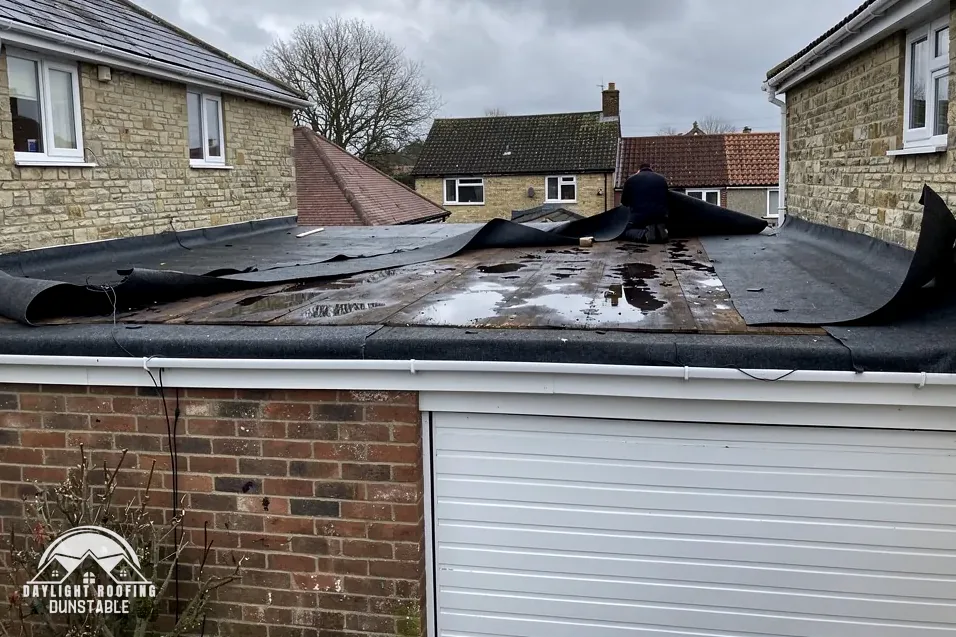
A flat roof that has peeled back, split along a joint or lifted in the wind has no second layer to rely on, because the membrane is the only barrier between rain and the deck. Once the deck is wet it can soften, and water spreads sideways between layers before it shows as a stain indoors, so the visible leak may be a long way from the damage.
A hole is the other plain emergency. A fallen branch, a dropped chimney part or a failed rooflight can leave an opening that rain drives straight through. The size of the hole matters less than what is below it: an open roof over a bedroom or a kitchen with electrics needs attention more urgently than the same hole over a cold garage.
| Damage | What it puts at risk |
|---|---|
| Peeled membrane | Deck, insulation, ceiling |
| Hole from a branch | Rooms below, wiring |
| Failed rooflight | Room beneath, floor |
Spreading a cover from inside the loft, if a fixed loft ladder gives safe reach, limits the water. Staying off the roof is the rule for anyone not trained to work at height, and flat roof splits and blown membranes explains what each failure looks like on a membrane roof.
What can wait for a booked repair
Plenty of roof faults are worth fixing without being emergencies. Dry stains left by an old leak, a single slipped tile with no water getting in, moss, a gutter that overflows only in heavy rain and a lifted piece of flashing that is not letting water through can all go in the diary instead of the urgent list.
| What you can see | Emergency | Can wait |
|---|---|---|
| Water entering during rain | Yes | No |
| Sagging wet ceiling | Yes | No |
| Stack leaning or cracked | Yes | No |
| Old dry stain | No | Yes |
| One slipped tile, dry loft | It depends | It can |
A faulty roof that is not an emergency still deserves a survey before the next bad weather. A small gap that lets in a little water on one wind direction can soak insulation for weeks, and the damage stays out of sight in the loft until the ceiling shows it. Waiting is a decision to be made in terms of weeks, with the forecast in mind.
If you are unsure which side of the line a fault falls on, send a photograph on WhatsApp or ring 01582 935272. A roofer looking at the picture can tell you whether it needs making safe or can be booked, and what else in the picture deserves a closer look.
What to do while you wait for a roofer
Stay on the ground and inside the house. The roof is wet, slippery and possibly weakened, and a fall from it is a serious injury. The HSE advises, "If the building was built or refurbished before 2000, assume that there is asbestos in it." Its guidance adds, "AC roofs are always fragile", so sheeting that looks sound can give way underfoot.
Take dated pictures of the damage: the outside of the house, the ceilings and walls below, and the loft hatch view. The Financial Ombudsman Service says it will "usually look at expert reports and photos" when a storm claim reaches it, so images captured early are worth having before anything is moved or thrown away.
Report the damage to your insurer, and keep each reply they send. Cover and claims vary by policy, so ask the insurer what temporary work it expects and whether receipts are needed. The page on storm damaged roof and insurance goes through the claim in order.
Protect the contents of the room as well. Mop any water off the floor so nobody slips, shut the door to hold damp in one space, and if water is dripping through a light fitting, leave that light off. If it has reached wiring, an electrician is the right call, because a roofer deals with the opening and not the circuit.
Calling a roofer: what to have ready
A clear description saves time on the phone. Say where the water is coming in, whether it is raining now, how large any hole looks from the ground, what type of roof it is and whether the house has a flat section. Say if a chimney is involved, and whether any tiles have landed in the garden. The more exact the description, the better a roofer can judge what equipment the visit needs.
- the address and the part of the house affected
- photographs of the outside and of the rooms beneath
- whether water has reached wiring, a light fitting or a bedroom
- your insurer's name and the policy number, if you have it
The firm surveys the roof before quoting, and the figure goes into the written quote when that survey is done. A call-out to make a roof safe and a permanent repair are two separate pieces of work, and the first does not fix the price of the second. Emergency roof repair costs sets out what published guides say about each, and the main emergency roof repairs page brings the topic together.
Be sceptical of a stranger at the door after a storm offering to fix the roof there and then. A contract signed at home, whoever knocked first, carries a 14-day right to cancel; an urgent repair visit you specifically asked for does not.