
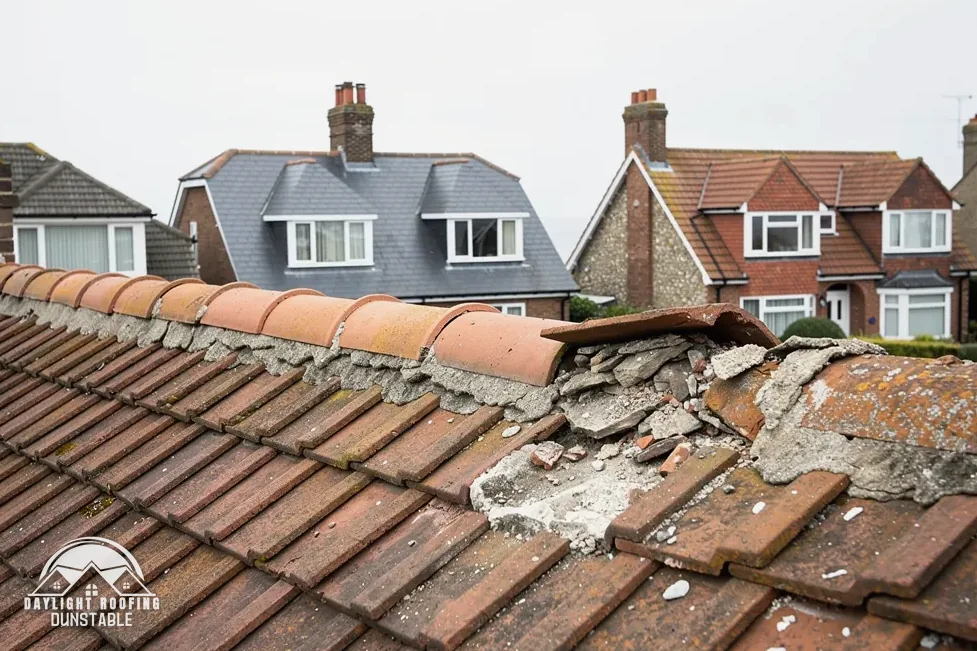
How wind gets hold of a roof
Gusts do more than shove at a house. Air sweeping over the ridge and round the gable ends creates suction, a lifting force that tries to peel the covering off the structure. Pressure varies across the roof, and it builds at the edges and the high points, where the air is forced to speed up and turn.
That explains where damage collects. Ridges, hips, gable edges, eaves and corners carry heavier loads than the middle of a slope. A tile in the centre of a plain roof is held down by the weight of its neighbours, while a tile at the end of a row has nothing on one side to share the strain.
A covering that has been fixed properly resists this lifting through its fixings, not through its own weight. Where nails are missing, corroded or driven into rotten timber, a tile can rise and drop in a gust, working a little looser each time. Once one tile is out, the gap lets wind under its neighbours and the damage spreads along the slope.
Damage may appear days after a storm, because a weakened fixing can fail in the next ordinary blow. A roof that looked sound before a gale can lose pieces afterwards, so a glance up at each slope after any strong blow is sensible. What counts as urgent is sorted out in what counts as a roofing emergency.
Tiles and slates lifted or slipped
Plain tiles, interlocking concrete tiles and natural slates are all held by a combination of overlap, gravity and fixings. Wind attacks the fixing. A slate is nailed at its head or held by a clip, and a tile hangs on a batten by its nib, so a lifted unit can unhook, slide or crack when it lands.
From the garden you can sometimes see the signs. Look for tiles sitting proud of their course, gaps where a unit has gone, a slate tilted out of true, or fragments in the gutter and on the lawn. A course that no longer runs straight points to movement, and a missing unit leaves the underlay beneath it uncovered.
| Sign | Possible cause |
|---|---|
| Tile out of line | Fixing has lifted |
| Gap in the slope | Unit blown off |
| Slate hanging | Nail or clip failed |
| Pieces in gutter | Cracked units above |
The underlay below the covering is a second layer, and it can shed some water, but it is not built to sit exposed for long. Wind can tear it as well. A gap left open also admits rain onto the battens, which can rot over time. As a guide to a small job, Which? Trusted Traders priced a handful of broken or missing tiles (one to six) at £75 to £400 excluding VAT, after surveying 11 traders in November 2025. How many tiles have gone, which tile it is and how high the slope sits decide where a job lands in that range, or above it.
Ridges and hips under load
The ridge is the crest joining the slopes; hips are the angled crests running down to the corners of a hipped roof. Both are capped with special tiles, bedded on mortar in older work or fastened dry with clips and screws in newer systems. They stand highest on the roof and meet wind from every side.
Marley, a tile maker, says "In all cases, ridge or hip tiles should be mechanically fixed to resist the calculated wind uplift force." It adds that mortar "could no longer be relied upon as the only means of securing the roof covering" since the 2015 amendments. A cap held by mortar alone has little to resist uplift, and the bed can crack and crumble.
From below, trouble can appear as a visible gap along the crest, a cap tile that has slid off, or mortar crumbs in the gutter and on the path. A ridge that has shifted can open the joint at the top of both slopes, so rain reaches the roof space even where the slopes are sound.
On cost, MyJobQuote's page of 1 October 2026 says "In 2026, the average ridge tile replacement costs between £225 and £550." A hip repair is priced after a survey, since ridge figures do not carry over to hips. The ridge and verge repairs hub has the permanent side.
Verges and barge boards at the gable
Where a gabled roof finishes against its end wall, the exposed edge of the covering is the verge. It meets the wind head-on, with no further slope to share the load, and the tiles along it are fixed to resist lifting. Older work bedded them in mortar on top of the wall, while newer roofs can carry a dry verge system held by clips.
Mortar at a verge can crack, loosen and drop out, leaving the end tiles with little to hold them. A gust then lifts those tiles and a gap opens along the edge. Beneath, a barge board or fascia can be dragged away from its fixings, so look for a board that hangs or leans clear of the masonry.
A dry verge fitted to BS 8612:2018 swaps mortar for fixings and a trim. Whichever system is on the house, a lifted verge needs its edge secured, because each tile left at the end of a course carries more load than its neighbours.
Keep the ground below a damaged verge clear. Verge tiles can drop in a gust, and a loose barge board can swing on its last nail. A photograph taken on the lawn and sent on WhatsApp to 07880 284133 is a safe way to ask a roofer to look at what the edge is doing.
Flashings and the places roofs meet walls
Strips of lead or other metal seal the junction between the roof and anything that rises through or beside it: chimney stacks, parapet walls, roof windows and abutments. These flashings are fixed to the wall and tucked under the covering, and wind lifts them where a fixing has weakened or a joint has opened.
A lifted flashing may leave a gap that lets rain run behind it, down the face of the wall or into the roof space. The signs inside are damp patches at the top of a wall next to a chimney, stains on the ceiling near a junction or a drip that begins only in wind-driven rain. Outside, a flashing that stands away from the brickwork or hangs loose is plain to see from the ground.
Correctly installed lead flashing, MyJobQuote says, "can last for over 80 years". Wind damage can end that life early where the metal has been pulled or folded back. Re-dressing a lifted section can be a repair in itself, but where the metal has torn or work around a chimney is needed, the repair belongs to storm-damaged chimney stacks and the chimney repairs hub.
Wind also drives rain sideways into places that stay dry in ordinary rain. A junction that never leaked before can start to after a gale, so a new stain deserves attention even where the roof looks unharmed from outside.
What BS 5534 fixing means for a repair
BS 5534 is the code of practice for slating and tiling work, and its current edition is BS 5534:2014+A2:2018. Marley says installing to it "isn't required by law", yet it is the document that anyone fixing a covering is expected to follow, and the fixing figures in it are minimums.
Marley states that those minimums "will always be superseded by the generation of a Fixing Specification, which is site specific". In plain terms, nails or clips are counted for the roof in question, allowing for how exposed the site is, so one house can need more fixings than the next house of identical design.
That matters when tiles blow off. A repair that simply sets new tiles into the gap, without checking how the tiles beside them are held, restores the same weak point. A sound repair examines the fixing of the surrounding units and refixes any that have worked loose, so the patch does not turn into the next failure.
When you compare repairs, ask how replacement tiles will be fixed and whether the roof around the gap has been checked. Nails, clips or both, and how many per tile, are fair things to ask about. After the survey, the price is written down as a single total for the repair.
What to do after a windy night
Begin outdoors. Circle the house looking up at each slope, the ridge, the verges and the chimneys, and scan the ground beneath for tile fragments, mortar and bent metal. Keep children and pets off any patch where pieces might still be loose, and resist the urge to climb up for a closer view.
Indoors, scan the ceilings and the upper parts of the walls for new marks. A look through the loft hatch can reveal pinpricks of light where there should be none, or damp patches on the underlay or insulation. Light in the roof space means the covering has a gap, and wet insulation shows that water has reached the roof space. Both findings belong in the report to the insurer.
- take dated pictures of the slopes from the lawn and of the roof space from the hatch
- store whatever has fallen until your insurer has viewed the photographs
- cover belongings under any leak and put a bucket under each drip
- send the insurer a written report of the damage, and keep the reply
If the roof needs protection before it can be mended, temporary roof covers describes the limits of tarpaulin and boarding as protection. The main emergency roof repairs page sets the wider sequence from first call to permanent repair.