
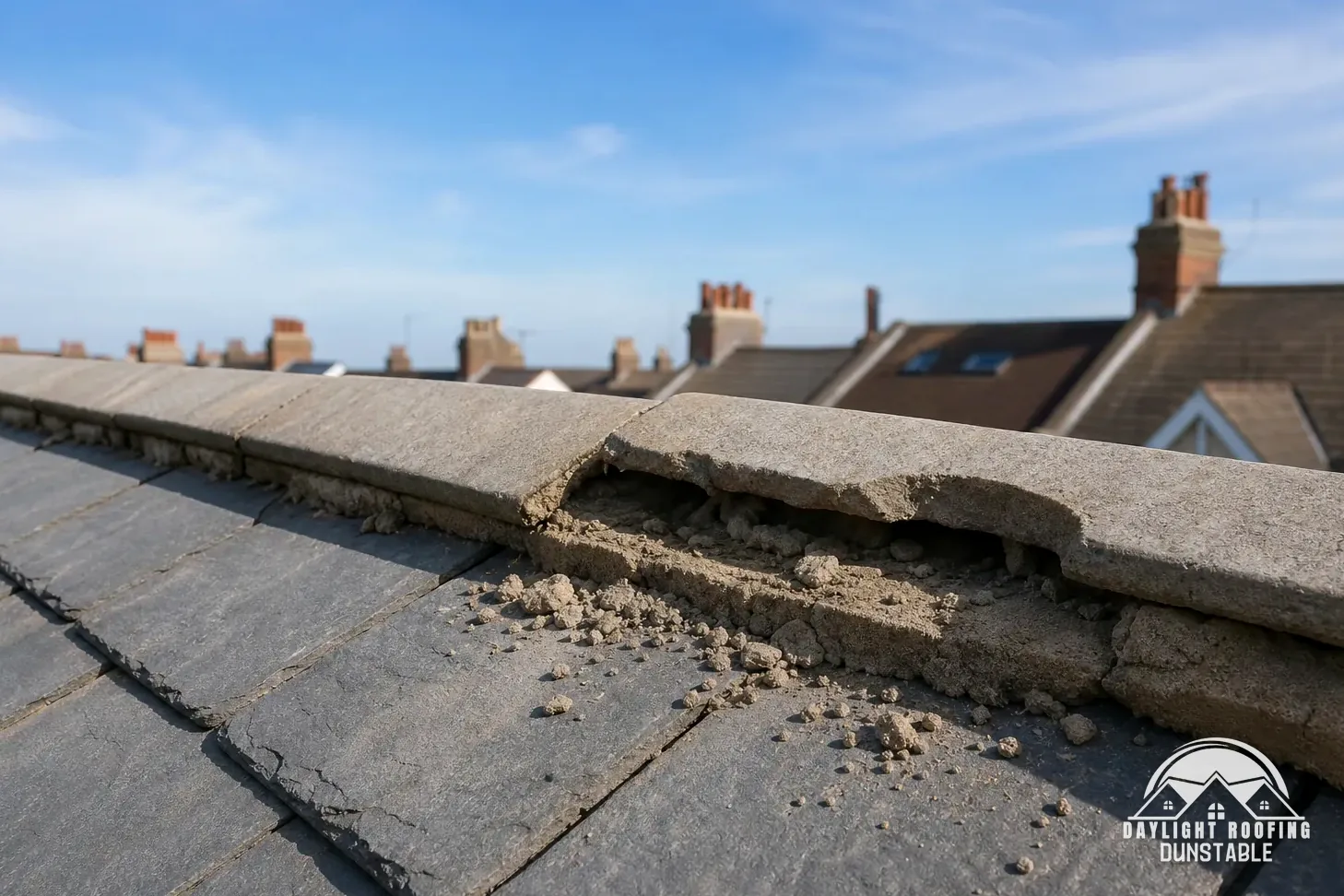
Why a knock at the door after bad weather
Storm damage is visible from the street. A missing tile, a hanging gutter or a tarpaulin on a neighbour's roof tells a passer-by that a household may be worried and ready to say yes. Some callers use that moment, and the pitch can sound helpful: they have noticed a problem, they have the materials in the van, and they can start now.
None of that makes a caller dishonest, and a genuine roofer may sometimes turn up unasked. The difficulty is that the circumstances favour pressure. You are anxious, the weather may still be poor, and a decision made at the doorstep leaves no time to compare, to check who is asking or to ask an insurer what the policy covers.
Damage from a caller's phone pictures cannot be checked either. A photograph of a rotten timber or a broken tile may show a roof from anywhere, and you have no way to know it is yours. The only reliable look at your roof is one you can see for yourself from the ground, or one made by a roofer you have chosen to invite.
Three things protect you: the signs that call for caution, the 14-day right to cancel a contract signed at home, and knowing the cases where that right does not apply. What counts as a genuine emergency is covered in what counts as a roofing emergency.
Warning signs of a caller to doubt
There is no single test for a dodgy roofer, and a caller who ticks one box is not necessarily dishonest. The signs below are warnings that justify slowing down and asking questions, and several together are a reason to say no and shut the door. Take your time, and do not let the weather rush you into signing.
| Sign | Why it matters |
|---|---|
| Pressure to decide today | Leaves no time to compare |
| No business name or address | Hard to trace afterwards |
| Only a spoken price | Nothing to hold them to |
| Damage you cannot see | Claims you cannot check |
| Demand for money up front | You pay before work exists |
Ask for the business name, a landline or an address where a letter would reach them, and a written quote. Someone who runs a real firm can supply all three while standing on the step. Refusal, or a promise to write it down later, is itself a sign.
A fair quote names the business, sets out the job in words you follow and ends in a single price. It does not need to be long, and it should be on paper before any money changes hands. Emergency roof repair costs gives published figures, so you can see whether a spoken price is sensible before agreeing to anything.
14 days to cancel a contract signed at home
The Consumer Contracts Regulations 2013 treat a contract made while you and the trader are physically together somewhere other than the trader's business premises as an off-premises contract. Your own home qualifies. Under regulation 5, that covers a contract "concluded in the simultaneous physical presence of the trader and the consumer, in a place which is not the business premises of the trader".
Regulation 29 lets you cancel such a contract "at any time in the cancellation period without giving any reason". Regulation 30 sets the length: "the cancellation period ends at the end of 14 days after the day on which the contract is entered into". The first of the 14 days is therefore the one after the contract is made, not the day of signing.
- sign on a Monday and the 14 days start counting on the Tuesday
- you do not need to explain why you are cancelling
- tell the trader in writing, and keep a copy
- the right applies to a contract made at home, not to every roofing job
Citizens Advice explains the right on its page about cancelling building work. If the trader never told you about the 14 days, do not assume anything about your position: the Citizens Advice consumer helpline, 0808 223 1133, can advise on the particular contract, and it helps to have the paperwork beside you when you ring.
Urgent repairs you asked for: the exception
The cancellation right has an exception that matters after a storm. Regulation 28(1)(e) removes it where "the consumer has specifically requested a visit from the trader for the purpose of carrying out urgent repairs or maintenance". Citizens Advice describes the same exception.
The wording turns on who asked. Suppose water is pouring in and you phone a roofer and ask for a visit: that visit is one you requested, so the 14 days do not cover the urgent work. Suppose instead a roofer arrives unasked and talks you into signing: the contract did not come from your request for an urgent visit, so the 14 days are more likely to apply.
That is a good reason to be clear about what you ask for. A request for an urgent repair is a different thing from a request for a quote on a larger job, and a trader who arrives for the first can propose the second. Whether work counts as urgent in a particular case is a question to put to Citizens Advice, not to the trader.
Even where the cancellation right falls away, the other protections do not. Section 49 of the Consumer Rights Act 2015 still applies, and the trader must still give the information the law requires. Agree the scope and the price in writing before work starts, so there is a record of what was urgent and what was an extra added at the door.
Asking for work to start early
A contractor may want to begin inside the 14 days, and that is allowed on one condition. Under regulation 36, for an off-premises contract, work can start in the period only if the consumer "has made the request on a durable medium", which means in a form you can keep: a signed note, a text or an email.
A written early-start request leaves the 14 days running. Should you cancel once work has started, you may owe the trader for what was done up to that point. That is the trade-off, and it is worth weighing before you put your name to a request.
Do not sign an early-start form just because it is put in front of you. Read what it says, ask what would be done in the first days, and keep a copy. A roofer who wants to begin while a roof is open to rain may have a good reason, but the request belongs on paper and the work should be described in it.
If you would rather work began after the 14 days have passed, say so, and the contract can state a start date. That removes any doubt about what you agreed, and it leaves the whole cancellation period untouched. A caller who objects to a later start, when the roof is not letting water in, is giving you information about the caller.
What a written quote should contain
A quote you can rely on names the business, gives a contact address and a phone number, describes the work and arrives at a single price. It should say what the roofer will do to make the roof safe, if that is part of it, and what is left for a permanent repair. Vague wording such as "roof repairs as required" is a reason to ask for more detail.
Daylight Roofing surveys a roof before quoting, and the price goes into the written quote as one total after that survey. A roofer who quotes without looking at the roof is guessing, and a guess made on a doorstep in poor weather has little behind it.
- the trading name and an address or landline
- the work described in plain words
- one total price, in writing
- when payment is due and what for
Take time to compare. A second look at a quote, even for an urgent job, is a reasonable request, and a roofer who is confident in the price will not mind. Ask a neighbour or relative to sit in on the conversation, if one is nearby, because a second pair of ears notices pressure that you may not. Also ask when payment falls due and what each payment is for. Where a roof needs covering in the meantime, temporary roof covers explains what a make-safe is and what it is not.
If the work goes wrong
Section 49 of the Consumer Rights Act 2015 requires a service to be "performed with reasonable care and skill". If a repair leaks, or the work differs from what was agreed, the trader has a duty to put it right. Begin by complaining to them in writing, and keep copies of the quote, any messages and your photographs. A calm, dated letter is harder to ignore than a phone call, and it is the paper trail a later complaint would rest on.
A trader must also tell you about any dispute-resolution arrangement that is available if you are unhappy with the outcome. Since 6 April 2026 that duty sits in section 308 of the Digital Markets, Competition and Consumers Act 2024, and the earlier ADR Regulations were revoked on that date.
Citizens Advice runs the consumer helpline on 0808 223 1133, and it advises individuals on a particular contract. Trading Standards gives no advice to individuals on their own contracts, which makes the helpline the first call. Describe what was agreed, what was paid and what happened.
If the damage is storm damage, tell your insurer too, and keep the roofer's paperwork with the claim. The emergency roof repairs page sets out the order of events from the first call to the permanent repair, and the insurance page, storm damaged roof and insurance, covers the claim.