
The short answer
Wind-driven rain is rain pushed at an angle by gusts, so it hits a house sideways and can be forced up and under tile laps, verges, flashings and ridge joints. A roof that stays dry in still rain can leak in a gale for that reason. Leaks that appear only when the wind is in one direction point to it.
How the wind turns rain into a leak
A pitched roof sheds still rain by gravity. Every course of tiles or slates sits partly over the course beneath, so water runs down the face and off the bottom edge. The overlap, or lap, is built to stop water running backwards, and it works against water that falls and runs downhill.
Wind changes the direction of travel. A gust can drive droplets and a film of water sideways across the roof, and sometimes upwards under the lower edge of a tile. Water pushed up through the gap between two overlapping tiles can reach the underlayer or the timber beneath. The underlayer is there as a second line of defence, but a roof that relies on it for every gale is carrying more than it was meant to.
One slipped tile, a gap at a verge or a worn bedding joint is a small opening in a still shower and a larger one in a gale. That is why a leak showing up only in a particular storm, or only on one side of the house, deserves a proper look. The page on wind damage to roofs covers the damage a gale can do to the covering itself.
The places it gets in
Some parts of a roof depend on a seal or a junction rather than on a simple overlap, so they are the places where blown water is forced in. Verges, the ridge, flashings, tile laps and roof windows are the places to look. A roof that is old, or has been patched more than once, has more of these weak points than a new one, because each patch adds another junction to keep sealed.
| Place | Why it is exposed | What to look for |
|---|---|---|
| Verge | The edge faces the wind | Cracked or missing pointing, loose tiles |
| Ridge | Joints between ridge tiles | Gaps, loose or shifted tiles |
| Flashings | Junction with a wall or chimney | Lifted or split lead, gaps |
| Tile laps | Water pushed up the joint | Slipped or cracked tiles |
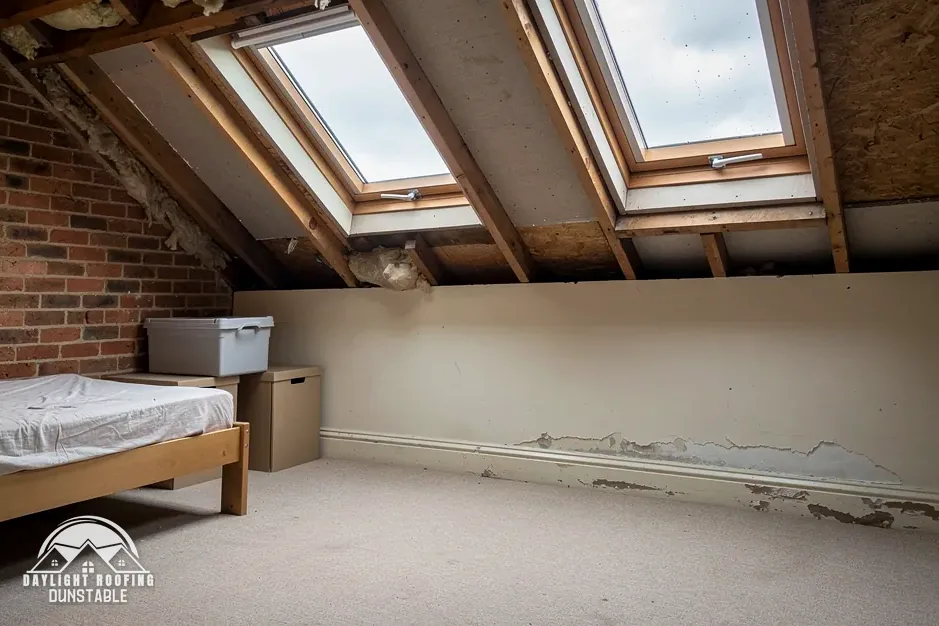
| Roof windows | Frame meets the covering | Staining around the frame |
Chimney junctions can be affected too, and the page on storm-damaged chimney stacks covers them. Inside the house, a stain that appears on one wall or in one corner during a gale, and dries off afterwards, may point to blown water rather than to a roof that leaks in all weather. Writing down the wind direction and the date when it happens gives the roofer something to work with when the survey takes place.
Exposure, fixings and what to do next
How exposed a roof is changes what it needs. BS 5534, a code of practice, sets out how pitched coverings are fixed, and Marley says its minimums "will always be superseded by the generation of a Fixing Specification, which is site specific". The fixing for a given roof is therefore set for the exposure of that site, which is a matter for the specification rather than for a rule of thumb.
A roof built to a sound specification and kept in repair copes better with a gale than one with slipped tiles and a failing bedding joint. Where a roof has been patched, the patch is worth looking at as part of the survey, because a repair is only as secure as the fixing that holds it.
If a ceiling shows a stain after a windy storm, photograph it, contain the water, and check the loft only if you can do so safely. Do not go onto the roof. Send shots of the stain and the roofline from ground level to 07880 284133 on WhatsApp if you would like us to look before a survey is arranged. The emergency roof repairs hub explains how an urgent repair runs from making safe to the permanent fix.