
The short answer
Yes. Guttering can be replaced in winter, because taking off old runs and fixing new ones does not depend on the month. Cold, ice and rain do affect sealants, the safety of the access and the working day, so a job may be paused for a spell rather than rushed through.
What cold changes on a gutter job
A gutter system is fixed in a simple order. Brackets go onto the fascia board, the lengths of channel clip into the brackets, and each joint is closed with a gasket or a sealant, depending on the system. Nothing in that order becomes impossible in cold weather. What shrinks is the margin for error. A cold bead of sealant takes longer to set, a damp joint face may not bond, and a plastic length that has spent the night outdoors can be stiffer to work than one kept warm.
Sealant and adhesive makers print a working temperature range on the tin or the data sheet, and a product used outside that range may not cure as intended. The range on the packaging, not a date in the diary, decides whether a joint is closed on the day or left for a milder spell. A gasket joint depends less on curing, but its surfaces still have to be clean and dry for the seal to sit properly.
The fall matters in cold weather too. Brett Martin gives a fall of 1 mm for every 600 mm towards the outlet. Water drains from a channel laid to that fall between showers, so less is left standing to freeze. A channel that keeps a pool through a cold night can crack a joint or load a bracket with ice.
Ice, rain and access in winter
The larger winter question is the access, not the gutter. A ladder foot on frozen ground or a wet paving slab can slip, a scaffold board with ice on it is a hazard, and a gloved hand handles a bracket screw less surely than a bare one. When the surfaces are icy, stopping for the day is a safer call than pressing on, because the old gutter will still be there tomorrow.
- Ice on the ladder feet, the boards or the paving below the eaves.
- Rain heavy enough to wet the fascia and the joint faces while they are being fixed.
- A frost forecast shortly after sealant has been applied, before it has set.
- Snow or ice sitting in the old gutter, which has to be cleared before the run can come down.
- Fading light, which arrives early in winter and shortens the working day.
A leaking or overflowing gutter in a cold spell is a reason to act, not to wait. A run that spills over a wall or a doorway can leave a sheet of ice below it. A repair to the worst joint or a cleared outlet may bridge the gap until the weather allows a full replacement. The gutter cleaning and winter guide covers what blocked channels do in cold weather.
Planning a winter replacement
| Condition | What it affects | Sensible response |
|---|---|---|
| Cold, dry day | Sealant sets more slowly | Follow the maker's stated temperature range |
| Rain on the fascia | Joint faces stay damp | Pause until the surfaces are dry |
| Ice on the access | Ladders, boards and paving | Stop until the ice has cleared |
| Frost after sealing | Fresh joints may not cure | Hold sealed joints for a milder spell |
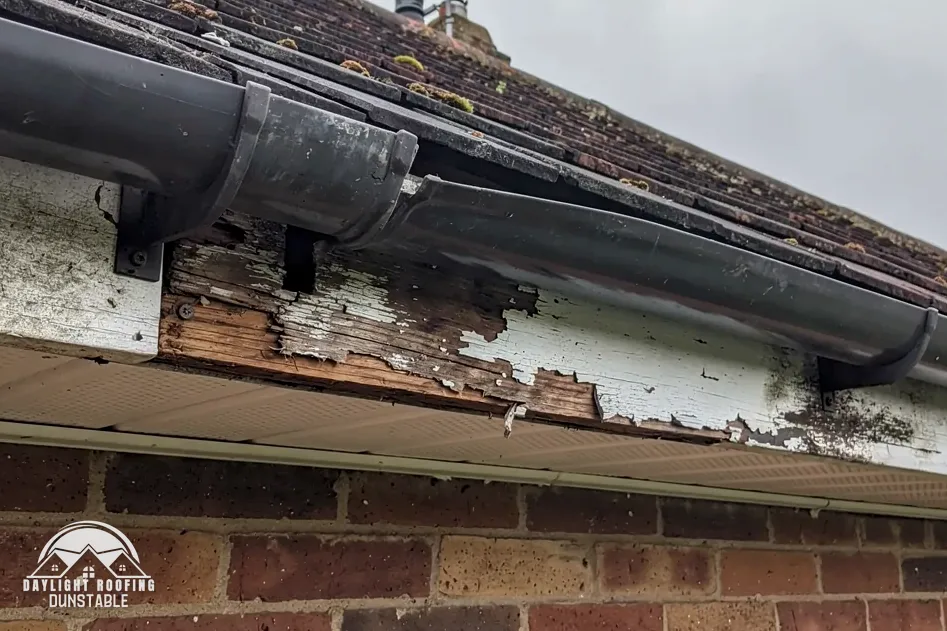
Before any quote there is a survey, and the fascia boards behind the gutter get looked at then. Brackets screwed into rotten timber will not hold a full channel, so soft boards are better found before the new runs go on, not after a winter storm has loaded them with water. The written quote that follows the survey is one total price, whatever the season, and the repair or replace guttering guide explains how to weigh a patch against a full change.
Replacement work belongs to the wider guttering, soffits and fascias service, where the boards, the soffits and the gutters are treated as one run of the roofline.