
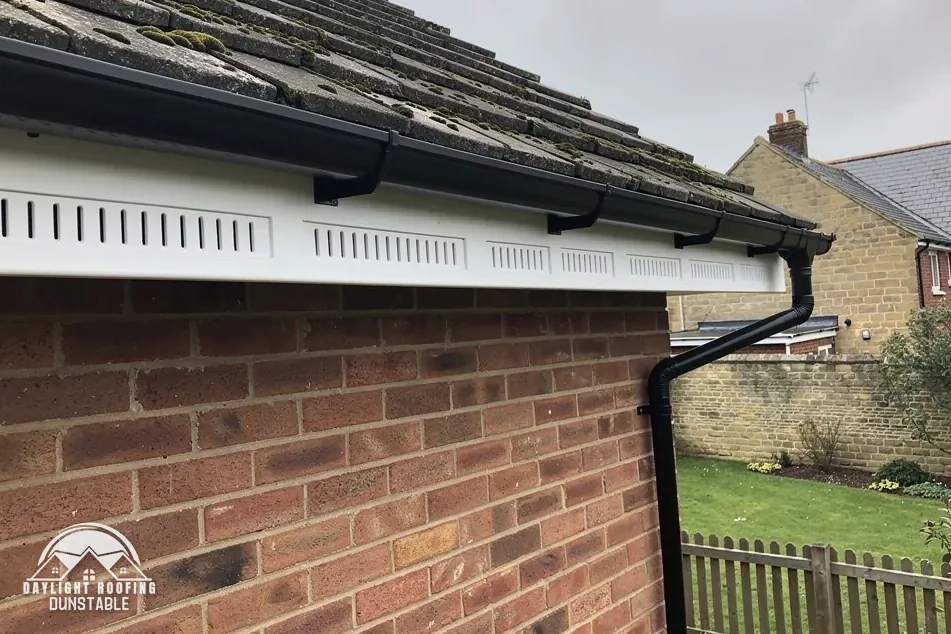
The short answer
Find where the water backs up, then clear the gully or drain at the foot of the pipe. Push a flexible rod up from the bottom to break the blockage and flush it through with a hose. Stay on the ground where you can, and call a roofer if the pipe is damaged or out of safe reach.
Finding where the pipe is blocked
Water leaves the gutter at the outlet and drops through the downpipe to a gully or drain below. A block can sit at the outlet, inside the pipe, at a bend, or in the gully, and the cure differs for each. Watching what happens in heavy rain is the quickest guide. If the gutter overflows above the pipe, the block is at or near the outlet or in the pipe. If water pools around the base while the gutter drains, the gully or the drain is the problem.
- Overflow at the gutter near the outlet: leaves or moss sitting at the head of the pipe.
- Water spilling from a joint halfway down: a block at or below that joint.
- Standing water around the foot of the pipe: a blocked gully or drain.
- A pipe that stays dry in a downpour while the gutter overflows: a block close to the outlet.
- Green streaks down the wall behind the pipe: a leak, or an overflow that has run for a while.
None of this needs a ladder. A look from the pavement, or through an upstairs window, shows most of it. Moss washed off the roof, silt and leaves from nearby trees build up in the same few places, which is why the gully is worth looking at first.
Clearing a downpipe safely
Wear gloves and eye protection, because what comes out of a downpipe is wet, dirty and sometimes sharp. Begin with the gully, since a clear pipe above a blocked gully will still back up. Lift the grid, scoop out the silt and leaves into a bag, and rinse the grid. Then work a flexible drain rod or a length of stiff cable up the pipe from the bottom, pushing gently and turning it, so that the blockage is broken and drops out below.
- Put a bucket or a bag under the foot of the pipe and clear the gully.
- Feed the rod up from below, pushing slowly and never forcing it.
- Pull out debris as it loosens, and keep it out of the drain.
- Run clean water down the pipe from a hose or a watering can, from a safe position.
- Watch the foot of the pipe, then watch the gutter in the next rain.
One check comes first. HSE's advice is to assume asbestos in any building built or refurbished before 2000, and it names asbestos cement products such as "roof sheeting and rainwater goods". A grey, rigid downpipe on an older house may be cement. Do not scrape, snap or drive a rod hard through one; the asbestos soffits guide explains why such materials are left whole.
Roofer or drainage firm: who deals with it
| Problem | Who deals with it | Why |
|---|---|---|
| Block at the outlet, out of reach | Roofer | Needs safe access at height |
| Cracked or split pipe | Roofer | Needs a new length or brackets |
| Gutter sagging above the pipe | Roofer | The run needs resetting |
| Gully clear but water still backs up | Drainage firm | The problem is underground |
A block that returns soon after clearing is a message that something above is wrong: a gutter that holds water, a run that has slipped out of fall, or leaves arriving from a tree faster than a pipe can pass them. Brett Martin gives a fall of 1 mm for every 600 mm towards the outlet, and the signs your gutters need work guide lists what else to look for. A pipe that has been blocked for a long time may also have rotted its bracket or stained the wall, so the bracket is worth a look.
A survey looks at the whole run, outlet, joints and fall, and what follows it is a quote in writing, set as one total. If the pipe is only blocked, the gutter cleaning and winter guide covers clearing, and the roofline work sits under guttering, soffits and fascias.