
The short answer
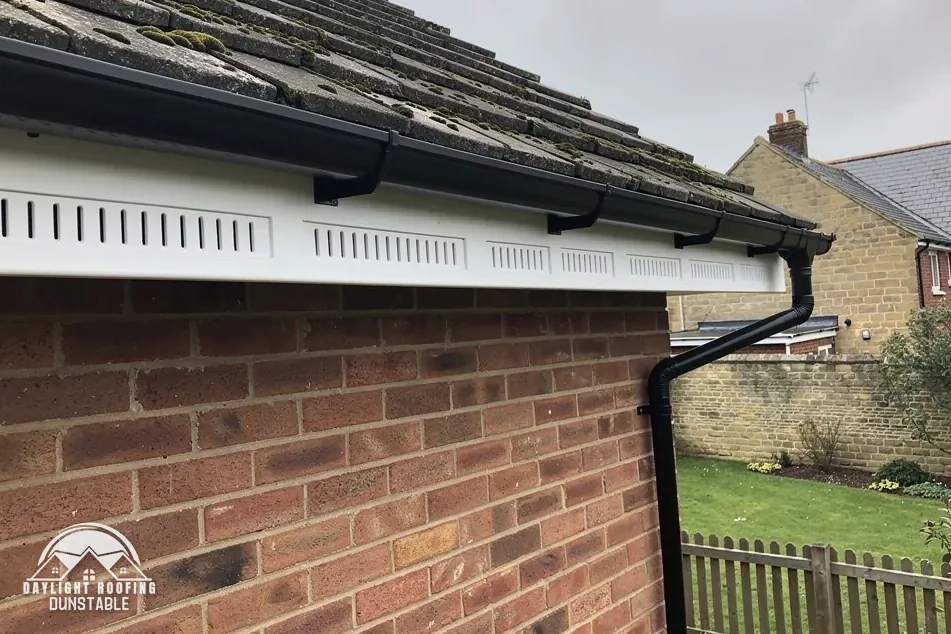
Seamless gutters are continuous aluminium channels, rolled from a coil of sheet metal to the length the wall needs, so a level stretch has no joints along its length. Joints still exist at corners, outlets and end caps, where leaks can start, so fewer joints does not mean none.
How seamless gutters are formed
A conventional gutter arrives in fixed lengths of two or four metres, joined with connectors along the wall. Seamless gutters are made differently. Flat aluminium sheet comes on a coil, and a roll-forming machine bends it into the gutter profile as it feeds through. The channel leaves the machine as one long length, cut to match the wall, and each cut end is closed with an end cap. The downpipe connects at an outlet that is cut into the base of the channel. Because the machine can be taken to a site, the length can be formed at the house.
The channel is fixed to the fascia on brackets and set to a fall towards the outlet. Brett Martin gives 1 mm of fall for every 600 mm, and the same principle holds for an aluminium run. Along a level stretch there is nothing to leak, because there is nothing joined. Where the run turns a corner, ends or meets a downpipe, the metal has to be cut and joined, and those joints are sealed.
Aluminium moves a little as the temperature changes, so a long run has to be fixed in a way that allows for it. A run fixed too tightly can strain at its corners and outlets. The sheet is supplied with a coating in a range of colours, chosen by the maker, and the finish may differ from one maker to another.
Where joints remain
The name describes the long length, not the whole system. Corners, stop ends, outlets and the points where a run joins a downpipe are still made from separate pieces. The table sets the two kinds of gutter side by side, so that the difference is easy to see. A house with a bay window, a porch or an extension has more corners than a plain terrace, and every corner is a joint that has to be made on the day and sealed well.
| Part | Continuous run | Sectional run |
|---|---|---|
| Level stretch | No joints along it | A joint at each length |
| Corners | Joined and sealed | Corner fitting |
| Outlets | Cut in and sealed | Outlet fitting |
| Length | Formed for the wall | Cut from stock lengths |
Fewer joints means fewer places where a seal can fail, which is the case for seamless gutters. It does not mean a gutter that cannot leak. A blocked outlet still overflows, a dip still holds water, and a failed corner seal still drips. A repair to a damaged length can mean cutting out a section, which adds a joint where there was none, so the saving in joints is not permanent once a repair has been made.
What to ask before choosing them
Seamless gutters are one choice among several, and the uPVC, aluminium and cast iron gutters guide compares the materials. A long run on a rear elevation is where a continuous length gives the clearest gain. A short run with several corners gives less, because the joints that remain are the ones that count.
- Whether the fascia boards behind the run are sound enough to carry new brackets.
- How many corners and outlets the house has, since each one is a joint.
- Whether a roll-forming machine and the access it needs can reach the house.
- How long the longest run is.
- What a quote covers, and whether the roofline work behind the gutter is part of it.
Before any quote, a survey looks at the boards, the corners and the fall, and the price afterwards is written down as one total. MyJobQuote's page on gutter replacement, last updated on 20 October 2026, gives an average of around £1,000 to £1,600, and that covers gutters in general, not for seamless gutters specifically. The guttering and fascia costs guide explains what shifts a price, and the work sits under guttering, soffits and fascias.