
The short answer
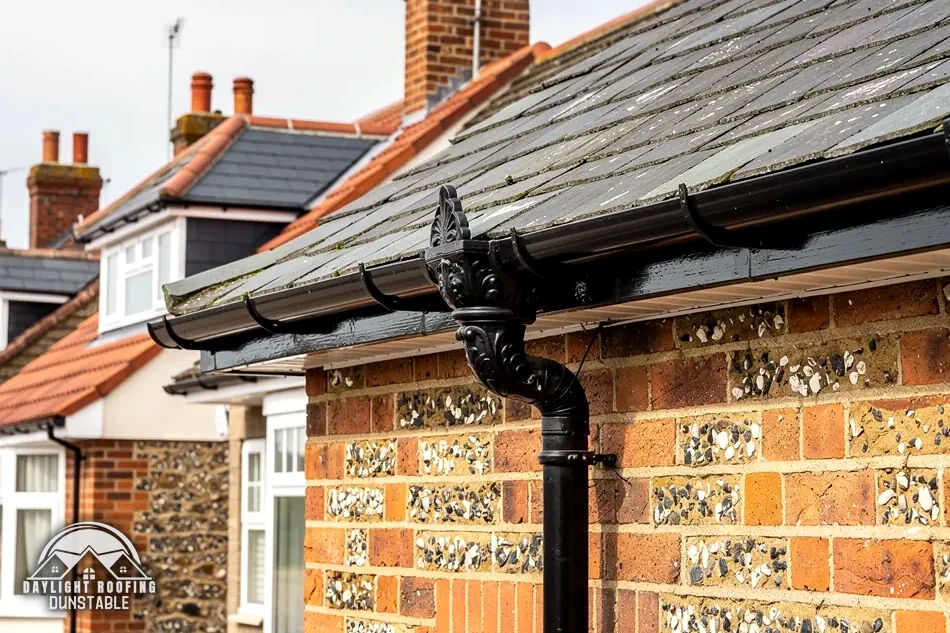
A downpipe carries the water collected by a gutter down the outside of the house and away to a drain or soakaway. It connects to the gutter at the outlet and ends at a gully or a shoe at ground level. If it blocks, the gutter above can fill and spill, and if it leaks, the wall beside it can stay wet.
The route water takes to the ground
A roof gathers a lot of water in a downpour, and it has to go somewhere. The gutter catches it at the roof edge and sends it along to an outlet. The downpipe starts there. It runs down the wall, fixed to the brickwork with clips, and brings the water to ground level, where it empties into a gully, straight into a drain or into a soakaway. A soakaway is a pit that lets water seep into the ground.
The pipe is round or square in section, and it is made in lengths that push together. Near the top it can have a bend, called an offset, which carries the pipe round an overhang. At the bottom it can end in a shoe, a curved piece that throws the water away from the wall, or in a socket that fits straight into a drain. Each of these pieces is a joint, and each can fail on its own.
The gutter and downpipe work as a single path, so a fault in one shows up in the other. A downpipe that is blocked makes the gutter above overflow even if the gutter itself is clear. A gutter with a wrong slope can send water the wrong way even though the downpipe is open. The guttering, soffits and fascias hub shows how the parts relate.
What downpipes are made from and how they fail
Downpipes come in plastic, aluminium, cast iron and steel. Plastic is light and cheap to fit, and it can crack if it is hit or if the pipe is full of ice. Aluminium resists rust and can dent. Cast iron is heavy, strong and traditional, and it can rust and crack where it has been painted badly or left wet. The comparison of uPVC, aluminium and cast iron covers the three in more detail.
- Leaves, moss or silt packed into the top of the pipe or the outlet.
- A block lower down, in a bend or at the shoe.
- A cracked length, where water sprays out in a heavy shower.
- A loose or leaking joint between two lengths.
- Brackets that have come away, so that the pipe leans or bows.
- A shoe or gully that is full of silt and cannot take the flow.
Signs that a downpipe has failed can show some distance from the pipe itself. A damp or stained patch on the wall beside it, green growth running down the brickwork, water splashing out of a joint during rain, or a puddle at the foot that does not drain away all point to it. Water pouring over the gutter's edge directly above can mean the pipe below is blocked. The signs your gutters need work guide lists what else to watch for.
Clearing, mending or replacing
A blocked downpipe is cleared from the top or the bottom, depending on where the blockage sits. A cracked length can be taken out and replaced with a fresh section, and a loose bracket can be fixed back to sound brickwork. If several lengths are damaged, or the pipe has corroded, replacing the whole run can be the more sensible choice, and the repair or replace guttering page explains how to weigh it.
Where the pipe lands matters too. If water is discharged beside the wall and not into a gully, it can soak the foot of the wall and the ground around it. A downpipe that empties into a drain should do so without splashing the brickwork. Where a downpipe runs behind a parked car or a drive, a damaged section is also a slip hazard in frost, because water leaking from a joint can freeze on the ground.
Reaching the top of a downpipe means working at height, and a ladder cannot lean on a plastic pipe. A tall pipe on a gable or a rear extension may need access equipment. The survey is followed by a single written total for the whole job. Keep the guides above to hand when you compare it, so that the repair and the replacement are both considered before anything is agreed.