
The short answer
A roof repair takes as long as the fault, the access and the weather allow, so no single timescale fits every job. A few missing tiles are a smaller task than a failed valley, and waiting for a scaffold licence can hold up the start. A survey gives the answer for your roof.
What sets the length of a repair
Four things stretch or shorten a repair, and the size of the damage is only one of them. Refixing three slipped tiles within arm's reach of a ladder is a very different task from tracing a bedroom stain to its cause. Rainwater can travel along the underlay or down a rafter before it drips, which puts the mark on the ceiling some distance from the hole in the roof. Locating that hole is part of the work, so a repair cannot be timed accurately from a phone description alone.
- Access: a roof reached by ladder is quicker to work on than one needing a tower or full scaffold, because the access is built and checked before anyone climbs.
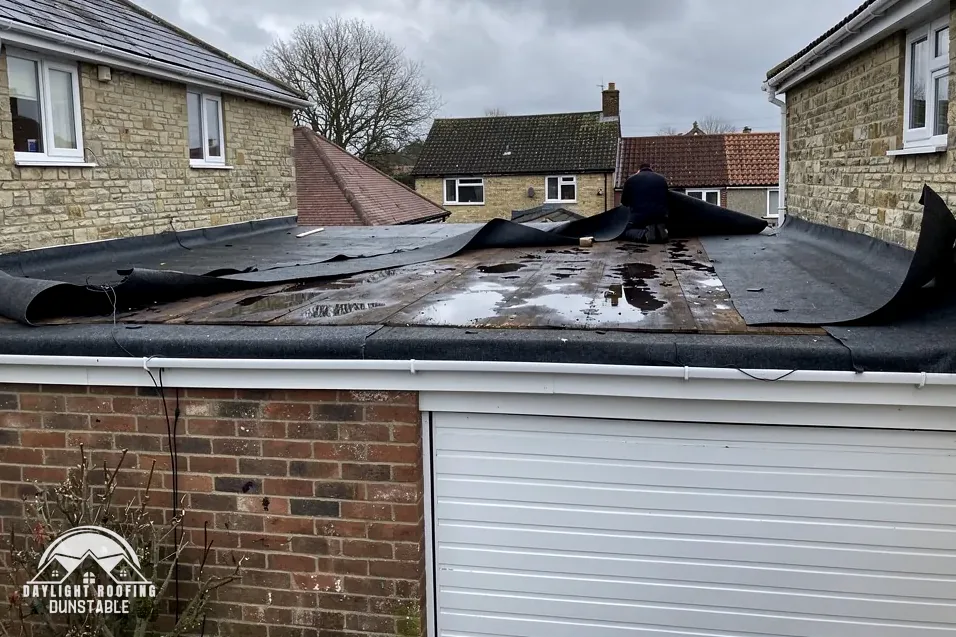
- Covering: clay tiles, concrete tiles, natural slate, lead and flat roof membranes each call for their own methods, and some steps cannot be hurried.
- Weather: rain, ice and wind decide whether work goes ahead on the day, and the page on repairing a roof in the rain covers what is workable when wet.
- Findings: a survey may turn up faults beyond the one you called about, and each extra fault adds to the job.
Once a survey is done, a realistic timescale can be given for that roof. If the survey finds that more than a patch is needed, the page on repairing or replacing a roof sets out how that choice is weighed against the wider roof repairs options.
Scaffold licences and the waiting time
The law behind scaffold licences is section 169 of the Highways Act 1980, which covers scaffolding that obstructs the highway. Granting the licence falls to the highway authority. For a repair, this is the one step outside anyone's control on site, because the length of the wait belongs to the council that issues the licence rather than to the roofer.
Councils publish their own processing times. Luton Council requires a minimum of 10 working days for an application, and issues its licences to the scaffolding company. Hertfordshire County Council says: "It usually takes 3 weeks to process an application." Each figure is that council's own, covering its own roads, and neither one is a forecast for any particular job.
Around Dunstable, the council that holds the licensing role is Central Bedfordshire Council, for the streets in its care; we arrange the licence with our scaffolder. Whether a given repair needs any scaffolding comes down to how the roof is reached. A fault that a ladder or low tower can serve may not call for a licence, while a high roof above a footway is more likely to. Work out the access first, and the licence question follows from it.
Make-safe first, permanent repair after
When water is coming in now, a temporary measure can limit the damage while the lasting repair waits on a licence, a delivery or a dry spell. The page on emergency roof repairs and making a roof safe explains what a make-safe involves and why it is a holding step rather than the finished job.
Materials set the pace as well. A tile, slate or length of lead that has to match what is already on the roof may need ordering in, and that can lengthen the gap between the make-safe and the lasting work. The lasting job is priced in a single sum, in writing, after the survey, so the scope is agreed before a date is booked and the gap is easier to plan around.
A picture sent to 07880 284133 on WhatsApp gives a useful head start. It shows the position of the damage and the route up to it, which helps to judge whether the job looks small. It is no substitute for the survey itself, because a bedroom stain can be metres away from the hole in the roof that caused it.