
The short answer
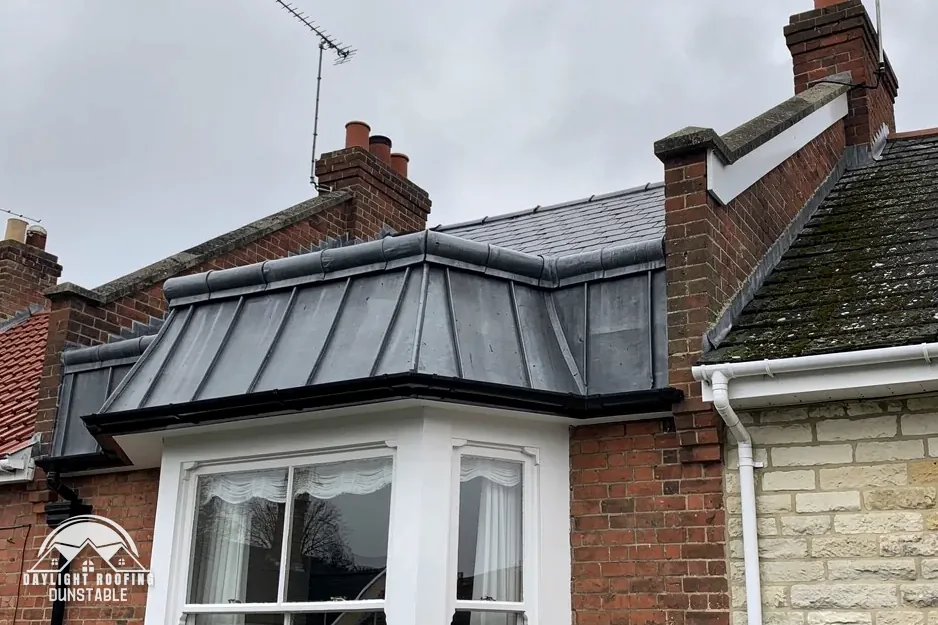
Flashing is a strip of lead or another weatherproof metal that seals the point where a roof butts against a wall, chimney, roof window or other upstand. It steers water onto the roof covering and away from the gap. When a flashing lifts, splits or pulls away from the masonry, rain can reach the roof structure and the ceilings below.
Where flashing sits
A tiled or slated roof sheds water by overlap, and overlap works only where the covering runs unbroken. At a chimney, against the side wall of a neighbouring house or around a roof window, the covering stops and something else begins. The gap between the two cannot be left to the tiles. Flashing bridges it, one edge tucked into the wall or frame and the other lapped over or under the covering, so that water is steered back onto the slope and away from the joint. The strip is thin, but the whole roof depends on it.
| Position | Job of the flashing |
|---|---|
| Chimney | Seals the stack where it passes through the slope |
| Side wall | Seals the roof edge against a rising wall |
| Roof window | Seals the frame into the covering around it |
| Dormer or porch | Seals the roof where a lower slope meets a wall |
Lead is widely chosen for flashings, because the metal can be worked tightly into awkward shapes. Other metals and prefabricated products are used as well, and the choice depends on the detail and the roof covering. Beside a taller wall, a stepped run of flashing follows the slope, with each step tucked into a brick course.
What flashing is made from
Rolled lead sheet is made to BS EN 12588 in codes 3 to 8, and the code sets the thickness: code 4, for instance, is 1.80 mm. Calder and Ecobat, both makers of lead sheet, give code 4 as 20.41 kg/m². Weights differ between the makers for some other codes, so a weight only means something once the maker is named. The specification for each job fixes which code suits which detail.
Lead can last a long time: MyJobQuote says correctly installed lead flashing can last for over 80 years. The words 'correctly installed' carry weight in that line, because a flashing fitted too tight, left unsupported or lapped too short can fail far sooner, and the metal itself is not necessarily the weak point.
Where lead is not used, a roof may carry a flashing of another sheet metal or a flexible product pressed into the joint. Cement or mortar fillets can sit at the same position, and they are a different kind of seal: rigid, and liable to crack when the building moves. The page on signs of a leaking roof shows how a failed seal of either kind can appear from indoors. Where the lead is hidden under a covering, only a survey will reveal its condition.
How a flashing fails
A flashing can fail in a handful of ways, and several of them can be spotted without touching the roof. The lead edge may peel away from the wall in wind. The sheet may split along a fold where expansion and contraction have stressed it. The mortar holding its upper edge into the brickwork may crumble, leaving the metal loose. Sealant applied over a flashing can dry out and open. Each of these leaves a gap that rain can enter.
From inside the house, the signs are a stain beside a chimney breast, a mark where a slope ends at a wall, or damp around a roof window frame. These marks can sit some way from the fault, since rainwater can run along a timber before it shows. The page on how to find a roof leak takes a reader through the checks in order.
A survey reads each flashing for lifted edges, splits, loose fixings and failed pointing, and the repair that follows depends on what is found. Some flashings need only their pointing renewed, while others need replacing. Where a roof needs wider work, the roof repairs hub sets out the options, and a photo on WhatsApp to 07880 284133 is a useful first step. Checking the lead for staining or white deposits is also worth doing.