
The short answer
On a strip and re-tile, tiles that are sound can be set aside and laid again, and broken or worn ones leave as waste. On a full replacement the old covering all goes. Asbestos cement sheeting is the exception: HSE's skip guidance for asbestos is to use a lockable one.
Reused or sent away
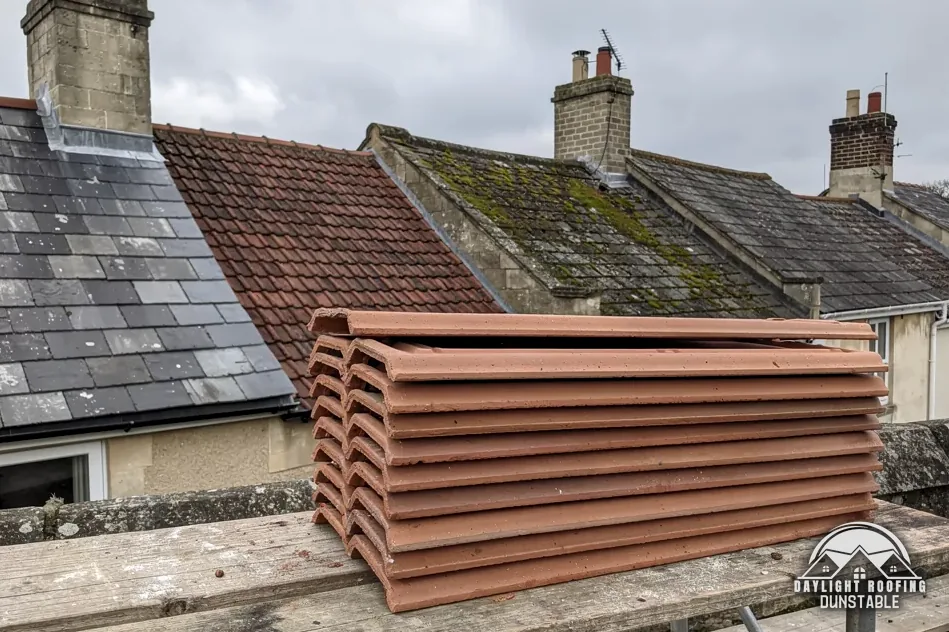
Every tile on a re-roof comes off the slope by hand and has to be sent somewhere. On a strip and re-tile, the tiles are judged as they are lifted. A tile with no cracks, no frost damage and no crumbling at the edges can be stacked and laid again. A tile that is split or worn through becomes waste. Ridge and hip tiles are handled separately: they are mechanically fixed to resist the calculated wind uplift, so old bedding is cleared away and the fixings renewed, because since the 2015 amendments mortar could no longer be relied upon as the only means of securing the roof covering, as Marley puts it.
A re-tile works only when enough of the old tiles pass, and a shortfall in numbers is covered by matching new tiles or by reclaimed ones. HomeBuilding gives a lifespan of 50-80 years for reclaimed Welsh slate, which is worth asking about if a firm proposes reclaimed material for your roof.
On a full replacement with a different covering, none of the old tiles go back. The new covering has its own gauge, weight and fixings, and the battens and underlay beneath it are renewed. The what happens during a roof replacement page follows that job in order.
Tiles that cannot go back are still heavy. A pallet of broken concrete tiles weighs a great deal, which is a good reason for the written description of the work to say where the old covering ends up.
When the old covering is asbestos cement
Clay and concrete tiles are not asbestos. A roof of cement sheets, on a garage or an older extension for example, can be. HSE's rule for any building of that age is: "If the building was built or refurbished before 2000, assume that there is asbestos in it." It also says "AC roofs are always fragile", so nobody should go onto one to look. HSE also names white soffit panels under the eaves as a place where asbestos insulating board can be found, which matters for any job that touches the roofline.
| Material | HSE category |
|---|---|
| Cement sheet, removed unbroken | Non-licensed work |
| Cement sheet, broken up | Notifiable non-licensed work |
| Insulating board, such as white soffit panels | Licensed work in most cases |
Where asbestos does come off a roof, the waste rules are firm. The skip guidance from HSE reads "Use a lockable skip for asbestos", so a lockable skip is the container, and an ordinary one with a sheet over it is not. A householder's consignment-note exemption covers domestic hazardous waste "other than asbestos waste", so asbestos sits outside the exemption. Whether a particular council site takes it is for that council to say.
Asking who takes it away
Waste from a roof is a question to settle before work starts, not after the skip arrives. Ask the firm in plain words whether any tiles are being reused and who carries the rest off. GOV.UK describes waste carriers registering as upper tier or lower tier, so you can ask whoever takes it for their registration details and check them.
A quote that describes the work in words will say whether the covering is stripped and replaced or stripped and re-laid. Ours is one total price given after a survey, with whatever the roof turned up told to you in plain words.
- Is any of the old covering being reused, and how many tiles are expected to need replacing?
- Who carries the waste away, and are they a registered waste carrier?
- If the roof is cement sheeting, how is it being treated under HSE's rules?
If you spot sheeting that might be asbestos, stop. Do not break, drill or sweep it, and ring 01582 935272, or message a photo to our WhatsApp number, 07880 284133.
The wider roof replacement page shows how a re-roof is built up, and the covering options page compares what could go on in place of the old tiles.