
The short answer
Re-roofing is stripping a roof's old covering and renewing it, together with the underlay and battens beneath, so the roof is weathertight again without rebuilding the structure. It is a different undertaking from a repair. Building Regulations approval applies once the job passes the Planning Portal's limits.
What re-roofing covers
Picture a pitched roof as a stack. Rafters form the frame at the base, spaced across the roof, underlay sits over them, battens run across the underlay, and the covering you see from the road is laid on the battens. Re-roofing renews the top three layers and leaves the frame alone, unless the survey shows the rafters need attention of their own.
Two routes lead to the same result. A strip and re-tile lays the old tiles that passed inspection back onto new battens and underlay. A full replacement fits a new covering throughout, either the same kind as before or a different one. The covering options page compares the materials.
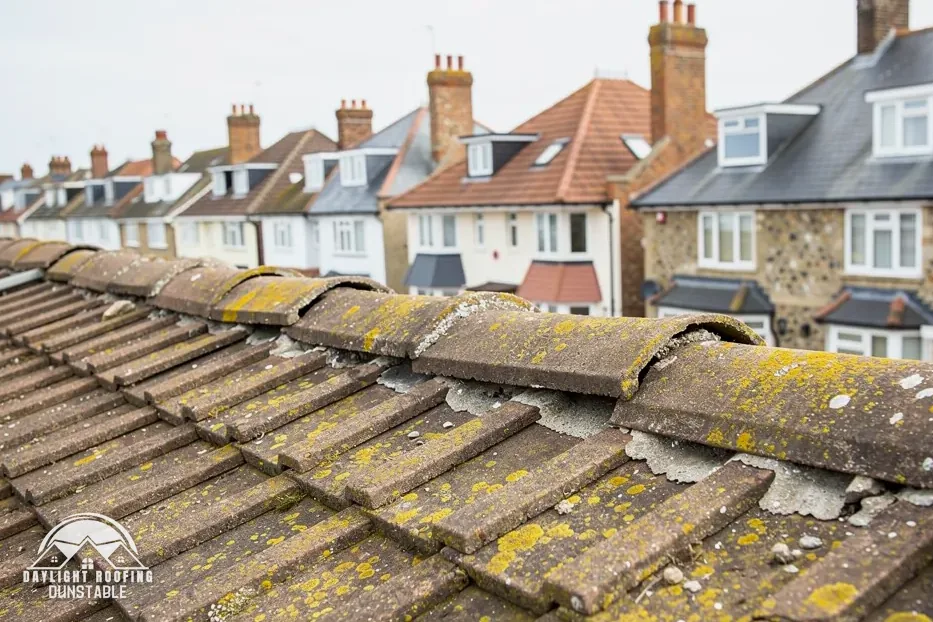
Repair means treating one fault, such as one cracked ridge tile or a lifted flashing, and leaving everything else on the roof as it is, with the cause traced and put right. The cost is small beside a full re-roof, but it buys time and not a new roof. Re-roofing is for the day when the whole covering has run out of working life, or when the battens and underlay under it have failed. The signs you need a new roof page lists what points that way.
Two sets of rules sit over a re-roof
Building Regulations and planning ask different questions, so a re-roof can be dealt with under one and not the other. The table sets out each in brief.
| Question | Answer in brief |
|---|---|
| Building Regulations | Approval once either Portal limit is passed |
| Heavier covering | Approval where it adds 15 per cent or more to the weight |
| Insulation | Part L, where more than 50% of the roof is renovated |
| Planning | Class C, normally permitted development for a house |
| Listed building | Listed building consent for changes to its character |
The Portal's two limits are less than 25 per cent of the building envelope and less than 50 per cent of the roof. A whole-roof job goes past the second. Its main page reads: "In most situations, this work will need Building Regulations approval." The Building Regulations and Part L page has the detail, including the structural check the Portal advises for a heavier covering.
On planning, Class C of the General Permitted Development Order covers "Any other alteration to the roof of a dwellinghouse", and re-roofing sits inside it. Listed status, an Article 4 direction or a conservation area can alter the picture, and a call to your council settles it. The planning guide on this site goes through the questions to put to the council.
When a re-roof is the right call
The deciding question is how much life the covering has left. HomeBuilding gives approximate lifespans for the main coverings, and a roof that has passed its range, or shows damp and rot across several slopes, points toward a re-roof rather than another repair.
| Covering | Approximate lifespan |
|---|---|
| Welsh slate | 100+ years |
| Spanish natural slate | 75-100 years |
| Clay tiles | 60-80 years |
| Plain concrete tiles | 40-50 years |
These are approximate figures from one source, and none is a forecast for one particular roof. Age alone does not settle the matter, and a covering is not judged by its date on the calendar: a covering inside its range can still be failing at the battens, and one near the end of its range can be sound. Only a survey of the roof gives the answer for yours, and one written total follows it. Ask what the survey found and how the covering, the battens and the flashings were judged, so the choice follows what was found on your roof, not a count of years.
To start, call 01582 935272 or send a photo to our WhatsApp number, 07880 284133. The wider picture is on the roof replacement page.