
Call 01582 935272

Brill · 30 road miles west

Roofers in Brill

Verge, re-roofing, repair and loft conversion roof work in Brill, 29.7 road miles west of Dunstable: the roof is looked at first, and the price comes once, in writing.

Get a written quote

Call 01582 935272WhatsApp us

Council
Buckinghamshire
Road miles
30
Conservation area
Brill
Building control
Buckinghamshire Council

Roofs by All Saints, the windmill and Church Street

Brill is a village in Buckinghamshire, 29.7 road miles west of Dunstable, about 52 minutes away by road. Brill parish had 1,153 usual residents at the 2021 Census. Buckinghamshire Council designated the Brill conservation area, so a house in the village may fall inside it, and the council can confirm for a particular address. Whether an Article 4 direction removes further permitted development rights at a given house is another question for the council, and we check with the council first, ahead of any figure.

Planning applications for Brill roofs go to Buckinghamshire Council as the local planning authority, and the planning guide shows how re-roofing, roof windows and dormers are treated. The roof gets a survey before any price is mentioned, the survey describes what it finds in ordinary words, and a single written total comes after. A gable end that has lost tiles is a job for roof repairs, and a whole slope that has failed a job for pitched roofing.

  1. 01Church of All SaintsListed Grade II*, National Heritage List entry 1124287, first listed on 21 December 1967, a Church of England church.
  2. 02The WindmillListed Grade II*, entry 1124265, first listed on 25 October 1951, so any work on it goes to the council first.
  3. 03Flats, the Manor HouseListed Grade II*, National Heritage List entry 1332781, first listed on 25 October 1951, with a roof that needs the listed route.
  4. 0428 and 30 Church StreetListed Grade II, entry 1332778, so any roof work there begins with a conversation with the council.
  5. 05Earthworks near Brill ChurchA scheduled monument, National Heritage List entry 1006925, near Brill, where any works must be authorised.
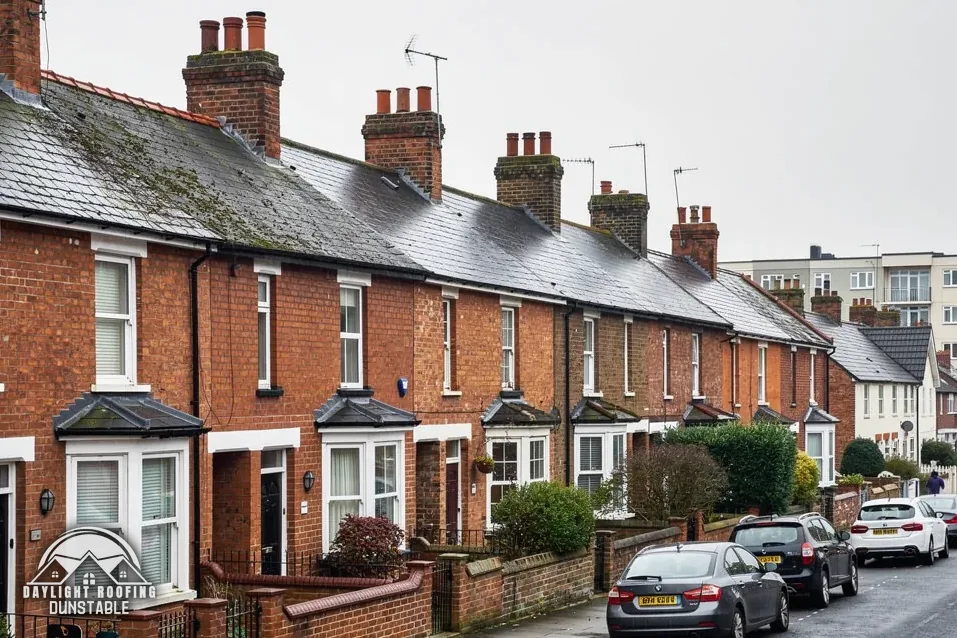
A Victorian brick terrace with slate roofs and tall chimney stacks

Verge, loft and listing terms

Dry verge
A clipped plastic or metal edge to the roof, in place of mortar.
Scheduled monument
A site protected by law, where works need authorisation.
U-value
A measure of how much heat passes through a roof or wall.
Gable
The triangular top of the end wall beneath a pitched roof.

The plain-as-day roof check

Care, monuments, verges and loft insulation: Brill checks

4 checks about 3 minutes to read

  1. Care and skill in the work
  2. Ground near the earthworks
  3. A dry verge
  4. Insulating a loft conversion

01 Care and skill in the work

The law gives you a standard to hold any roofer to. Section 49 of the Consumer Rights Act 2015 reads "Service to be performed with reasonable care and skill". If a repair fails soon after it was done, photograph the failure, note the date and keep the quote. A leak that returns beside a patch is evidence in itself, and a dated photograph from inside the loft is better than a description.

A roofing contract signed on your doorstep can be cancelled up to 14 days after the contract, the count starting the day after it is made; an earlier start is allowed only on your written request. Brill owners with a failed repair can lay that dated photograph and the quote before Citizens Advice ahead of writing to the firm. The Citizens Advice consumer helpline is 0808 223 1133, and Trading Standards does not advise individuals.

02 Ground near the earthworks

The Earthworks near Brill Church are a scheduled monument (entry 1006925). Under the Ancient Monuments and Archaeological Areas Act 1979, carrying out works there is an offence unless they are authorised. Consent is the Secretary of State's to grant, and Historic England receives the applications. A scheduled monument has its own authorisation system, so the listed building process plays no part in it.

That matters for a roof job only if the job touches scheduled ground: a scaffold base, a skip, a delivery route or a trench near the monument. A roof job on a house well away from the earthworks does not touch them. If your property adjoins the monument, say so when you ask for a survey, so that access is planned around it from the start, and so that nothing is set down on the protected land by accident. A photograph of the boundary between your garden and the monument shows how close the two are.

03 A dry verge

A verge is the roof edge at a gable. Where it was bedded in mortar, you can see cracks, a gap where the mortar has dropped out, or tiles that have pushed outwards. Marley's note is that mortar "could no longer be relied upon as the only means of securing the roof covering" since the 2015 amendments to BS 5534. A dry verge system holds the edge with clips and screws, and BS 8612:2018 is the specification for it.

MyJobQuote says a dry verge system "usually falls between £500 and £2,000", in a page dated 8 October 2026, and its figures carry no VAT basis. Treat that as a published guide and no more: the range depends on how long the gable edges are and how high the scaffold must reach, which is why a Brill gable is priced after it has been seen. Stand across the road from a gable and look at its line against the sky: a bulge or a dip tells you where the edge has moved.

04 Insulating a loft conversion

Turning a loft into a room brings the roof into the energy rules. Approved Document L says a roof being retained in a loft conversion, if its U-value is above 0.35, should be upgraded to 0.16 where that is feasible. Where it is not feasible, or the work would not pay back within 15 years, the roof is upgraded as far as the 15-year payback allows, and AD L says an upgraded thermal element should generally stay at or below 0.7 W/m²K.

Approved Document B adds the escape arrangements, which depend on the height of the new storey above ground, and the work goes through building control. Buckinghamshire Council has its own building control service, and its building control page gives the contact route. Before you pick a roof window for a conversion, check whether the unit sits in the plane of the slope or on a kerb, because the energy figures differ.

The dashed ring takes in the nearest towns and villages we cover around Brill. Map tiles © Esri; map data © OpenStreetMap contributors.

Brill roof questions, one at a time

01Where does a survey of a Brill gable verge begin?

It begins from across the road, looking at the edge's line against the sky, and then continues up close at the tiles along the verge, the way they are fixed and the board or end piece beneath. It checks mortar that has cracked or fallen out and any tiles that have moved, and it compares the two gables if the house has a pair. Anything else seen on the roof is described in plain words, and the price afterwards is a single written total. A photograph of each gable end taken square-on shows us what we are dealing with before anyone calls at the house.

02Does living in the Brill conservation area change a roof job?

Buckinghamshire Council designated the Brill conservation area, and your house may be within it or outside it, which the council can confirm for your address. The planning guide explains how a house roof is treated for re-covering, roof windows and dormers, so this answer leaves those rules there. An Article 4 direction can remove further permitted development rights, which is why we check with the council first, and not afterwards. A written reply from the council is worth keeping with the quote, since it records what the council said about the house.

03Does the Windmill or the Manor House need consent for a roof repair?

The Windmill is listed Grade II* (entry 1124265), as is Flats the Manor House (entry 1332781), and 28 and 30, Church Street are listed Grade II (entry 1332778). Consent is needed for works "in any manner which would affect its character as a building of special architectural or historic interest". Whether a repair reaches that point is for Buckinghamshire Council to judge, so the question goes to it before work is booked. Get the council's reply on paper and file it among the house papers, because the same question can come up again at the next repair.

04Which consent route applies to roof work at All Saints, Brill?

The Church of All Saints is a Church of England church, listed Grade II* (entry 1124287). All Saints, as a Church of England church in use within the faculty jurisdiction, follows the faculty system and not listed building consent. A roof lead or covering replacement made exactly like for like belongs in List B, which needs the archdeacon's written notice and not a full faculty. Outside work may also meet the usual planning tests, which are separate from the faculty system. A house in Church Street is judged on its own listing, never on the church's.

05Can scaffold or a skip go on the ground near the Brill earthworks?

Earthworks near Brill Church are a scheduled monument (entry 1006925), and works there must be authorised, with consent given by the Secretary of State and Historic England receiving applications. If a roof job would put a scaffold base, a skip or a vehicle track on scheduled ground, that is a question for the authorities before work starts, so tell us in advance. A roof job elsewhere in the village does not touch the monument at all. Neither a scaffold in a back garden away from the earthworks nor a skip on a drive raises the question.

06How much is a scaffold licence for a Brill street?

On or over a road, scaffolding needs a licence under section 169 of the Highways Act 1980, and Buckinghamshire Council issues them for Brill. Buckinghamshire Council charges £402.78 for 28 days, £69.09 for a renewal and £777.63 for a retrospective licence. Buckinghamshire Council states: "You must be a registered scaffolding company to apply for a licence". We arrange the licence with our scaffolder, and your single written quote covers the scaffold. A scaffold on your own land, away from the road, does not raise the licence question.

07What can a Brill homeowner do if a roof repair does not hold?

Photograph the failure with a date, keep the quote and any messages, and write to the roofer describing the fault. Section 49 of the Consumer Rights Act 2015 requires a service to be performed with reasonable care and skill. The Citizens Advice consumer helpline, 0808 223 1133, gives advice on next steps. Trading Standards does not advise individuals. If the work was agreed at home after a survey, the 14-day cancellation right is a separate matter, and it has already ended if more time has passed.

08What does a dry verge cost in a published guide?

MyJobQuote's page of 8 October 2026 says a dry verge system installation "usually falls between £500 and £2,000", and it gives no VAT basis. Which? Trusted Traders price a new ridge tile at £80 to £300 excluding VAT, from its November 2025 survey of 11 traders, which is a separate item from a verge. Both come from third-party pages, so neither is a quote. A Brill roof with two long gables will differ from one with a short run, and we give one written total after the survey, with the scaffold and the edge work inside it.

09What insulation standard applies to a Brill loft conversion?

Approved Document L, in the 2021 edition, expects a retained roof above the 0.35 threshold to be upgraded to the improved 0.16 where feasible, within a simple payback of 15 years or less where the full upgrade is not feasible. AD L 2026 applies only from 24 March 2027, with its tables renumbered. Roof windows are judged on the rows for roof windows, 1.4 W/m²K or Window Energy Rating Band B minimum, and rooflights on 2.2 W/m²K. Building control looks at the whole conversion, so the roof insulation and the escape route are raised together, and the survey takes in the roof's depth and the position of any existing window openings.

Get a written price for your roof

10-year workmanship guarantee, in writing

Tell us about your roof

Call WhatsApp Written quote