
Call 01582 935272

Waddesdon · 22 road miles west

Roofers in Waddesdon

Flat roof renewals, pitched roof repairs and roofline work for houses and extensions in Waddesdon. The roof is surveyed first, then one total is put in writing.

Get a written quote

Call 01582 935272WhatsApp us

Council
Buckinghamshire
Road miles
22
Conservation area
Waddesdon
Building control
Buckinghamshire Council

Roofs on Waddesdon High Street and the streets behind

Waddesdon is in Buckinghamshire, 21.7 road miles west of Dunstable, roughly 39 minutes in the car. At the 2021 Census Waddesdon parish had 1,976 usual residents. Planning here is handled by Buckinghamshire Council, which designated the Waddesdon Conservation Area. Waddesdon Manor is listed Grade I, the Church of St Michael Grade II*, and houses on the High Street carry Grade II listings, so the status of a building is the first thing to establish on some jobs.

One house can carry a flat-roofed extension, a pitched main roof and a porch, each with its own covering and its own way of letting water in. The survey covers every roof on the property, and the outcome is relayed plainly before one written total is quoted. For the membrane work see flat roofing, and for a leak that needs tracing see roof repairs. Porch and garage roofs get checked on that visit too.

  1. 01Waddesdon ManorListed Grade I (entry 1117804), first listed on 21 December 1967, the highest grade; roof work to it sits wholly within the listed building regime.
  2. 02Church of St MichaelGrade II* (entry 1117800) and a Church of England church, which puts its roof repairs under the faculty system.
  3. 03High Street listed housesNumbers 101 and 101a (entry 1117802) and 91 and 93 (entry 1319278) are Grade II, so a roof change there raises the listing question.
  4. 04Flat-roofed extensionsA rear or side extension with a membrane roof is surveyed for falls, laps, upstands and outlets.
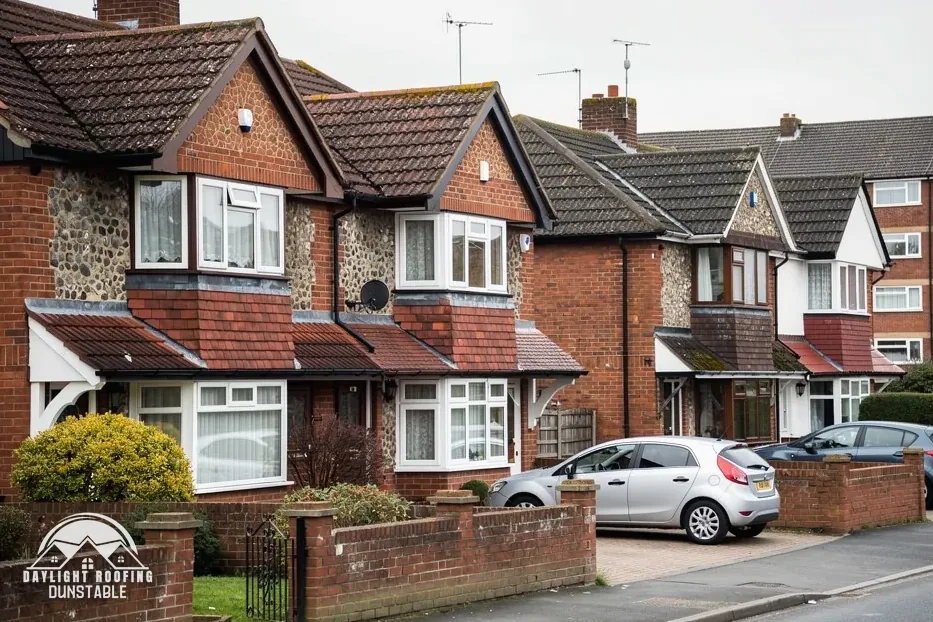
Edwardian brick and flint semi-detached houses with tiled gables

Waddesdon terms, made plain

Fall
The gentle gradient that lets rain drain off a flat roof.
Upstand
The upturned rim of a membrane at the point where it butts against a wall.
EPDM
A single sheet of synthetic rubber used to cover a flat roof.
Ponding
Rainwater left sitting in a hollow of a flat roof after a shower.

The plain-as-day roof check

Reading a flat roof at Waddesdon from the ladder foot

4 checks about 3 minutes to read

  1. Falls and standing water
  2. The membrane itself
  3. Upstands, edges and trims
  4. Outlets, gutters and downpipes

01 Falls and standing water

No flat roof is perfectly level: it is laid to a slight fall so that rain runs to an outlet. NFRC's key points on BS 6229:2025 give "a minimum 1:80 finished fall for general roof areas and internal gutters". IKO adds that "To achieve a 1:80 fall, the code of practice says that the roof should be designed for a fall of 1:40". After rain, a puddle that is still there a day later points to a dip in the deck. A hose test is the plain way to confirm a suspected dip: run water onto the roof and watch whether it reaches the outlet or stops short of it.

Standing water loads the roof, wears the surface and tests every small flaw in the covering. A dip may come from a sagging deck, a joist that has moved, or boards laid without enough fall. The survey looks at whether the fall can be restored when the roof is re-covered, and says plainly if the deck itself has to be replaced, which changes both the scope and the total.

02 The membrane itself

The three membranes to tell apart are felt, EPDM rubber and fibreglass, known as GRP. For EPDM, HomeBuilding says 25-30 years and Less says it typically lasts 30 to 50. For GRP, HomeBuilding gives 25-30 years and Less 25 to 40. For felt, HomeBuilding gives 10-15 years and Less says torch-on felt lasts 10 to 20 years depending on quality and installation. Whichever covering is on the roof, the lifespan of any membrane depends on its details as much as on the sheet, and the laps, corners and penetrations are where a roof of this kind shows its age.

Look at the surface for blisters, splits at seams, cracks where the sheet folds at a corner, or a dull, crazed finish on a felt roof. A blister is a pocket of trapped moisture, and a split at a seam is a way in. BS 6229:2025 covers flat roofs with continuously supported flexible waterproof coverings, which means membranes. Lead is not covered by it. If the covering is felt and has been patched several times, a full renewal is more sensible than another patch, and the survey says so.

03 Upstands, edges and trims

At the foot of a house wall the membrane turns up as an upstand, and its top edge is covered by a flashing or a trim. At an open edge, a drip or edge trim throws water clear of the fascia. Look for an upstand that has slipped down, a trim that has lifted, or a hairline gap where sealant has shrunk away from the brick. Where a flat roof sits beneath a window or a door, the upstand has to be high enough to stay clear of splashing water, which is a detail to look at on any threshold.

These small details can fail before the broad surface does, and a damp stain inside can trace back to one of them rather than to a hole in the middle of the sheet. For that reason the survey begins with the upstands and trims, then works inward, before it judges the covering as a whole and decides between a patch and a full renewal. A rotten fascia board behind the trim is a related fault; the board carries the edge trim, so repairs to the two are done together.

04 Outlets, gutters and downpipes

Water leaves a flat roof by an outlet, a gutter or a spout. An outlet clogged with leaves or moss turns a roof into a shallow pond, and a gutter on a flat roof can have little fall of its own. Check that the rain is leaving by the route it was meant to take, and that the downpipe discharges clear of the wall and over a drain. Over a porch or a bay, a little flat roof may drain to a short length of gutter with a single downpipe, and the whole system depends on that one outlet staying clear.

After a heavy shower, look at where the water runs and whether the outlet is clear. If a membrane is being replaced, an outlet that is too small or badly placed can be improved at that point, which is far easier than coming back to it later. Where an old downpipe is cast iron or aluminium, its brackets and joints are looked at too, because a loose pipe can pull a short gutter out of line.

The dashed ring takes in the nearest towns and villages we cover around Waddesdon. Map tiles © Esri; map data © OpenStreetMap contributors.

Waddesdon flat and pitched roof questions

01How long can a flat roof on a Waddesdon extension last?

HomeBuilding gives EPDM 25-30 years, GRP 25-30 years and felt 10-15 years. Less gives EPDM 30 to 50 years, GRP 25 to 40 years and felt 10 to 20 years depending on quality and installation. HomeBuilding and Less disagree, and neither describes your roof, because the build-up, the falls and the details round the edges all change the outcome. The survey judges the roof it is looking at. On a roof that has been patched several times, a full renewal may cost less over its life than another patch, and the survey says whether that applies.

02How does the Waddesdon conservation area bear on a flat roof?

Buckinghamshire Council designated the Waddesdon Conservation Area, and where its boundary falls on your road is a point for the council to confirm. Repairing a rear flat roof like for like raises less than swapping the covering on a roof seen from the street. Read our planning permission guide, then give the council your address before accepting a quote for anything beyond repair. It can also say whether an Article 4 direction applies, which would add further limits. Photographs of each elevation taken from the road make the first phone call with the council much quicker.

03Which High Street houses at 91 to 101a are listed, and what follows for their roofs?

The listings are 101 and 101a, High Street (Grade II, list entry 1117802, first listed 29 January 1985) and 91 and 93, High Street (Grade II, entry 1319278). Work to a listed building that would be done "in any manner which would affect its character as a building of special architectural or historic interest" needs listed building consent. Matching the existing covering raises a smaller question than switching to a new material, and Buckinghamshire Council can say which applies to a given High Street house. Ask the council about the listing at the same time as you ask about the conservation area, as the two are separate questions with separate answers.

04Which permission route covers the roof of St Michael's church?

The Church of St Michael is Grade II* (list entry 1117800, first listed 21 December 1967) and is a Church of England church. Within that denomination the faculty system takes the place of listed building consent, and where only the lead covering is renewed in the same material, the archdeacon's written notice may be sufficient. Separately, Buckinghamshire Council rules on any planning side of the exterior work, so the church and the council both hear about St Michael's roof before anyone orders materials or books a scaffold. The church says which of the two routes it is on.

05Does renewing the membrane on a flat roof bring in Part L?

It can. AD L calls the laying of a fresh waterproofing membrane on a flat roof renovation work. Where more than 50% of the surface is renovated, the whole roof has to reach the improved standard wherever that is feasible. Table 4.3 gives a 0.35 W/m²K threshold and an improved 0.16 W/m²K, with a relaxation where meeting 0.16 could not achieve a simple payback of 15 years or less. The survey works out what share of the roof the job reaches before the covering is chosen.

06What might a flat roof renewal cost in Waddesdon?

Which? Trusted Traders priced felt at £1,400 to £3,500 and rubber (EPDM) or PVC with new boards at £1,950 to £4,000, both for a single garage of 6m by 3m, excluding VAT, in November 2025. MyJobQuote says that in 2026 the average flat roof replacement costs between £1,500 and £6,000. Those are national ranges that give a sense of scale, not a price for your roof, while the quote for yours is a single sum worked out once the survey is done. A figure for a larger roof with more detail, such as a dormer flat top or several upstands, would sit higher than a single garage.

07Who signs off a flat roof renewal in Waddesdon?

Building control is carried out by Buckinghamshire Council's own service or by a registered building control approver. The council's own team provides a completion certificate, and a registered approver provides a final certificate instead. Contact details for the council's team are on its building control page. A full renewal reaches past half of the roof, beyond the Planning Portal's limit, so we check the route with building control before work starts. A registered approver may also be involved if the owner chooses that route, and the paperwork differs accordingly.

08Can a lantern or skylight go on a flat roof at the back of the house?

Under AD L, a lantern or skylight raised on its own kerb is a rooflight, which carries a limit of 2.2 W/m²K, whereas a window sitting level inside a sloping roof plane is a roof window. Planning is separate. The limits on roof alterations refer back to the house's original roof, so they do not settle a lantern on an extension added later. Put the question to Buckinghamshire Council, and see our skylights and roof windows page for the products. Mention the opening size you have in mind, since the choice between a flush window and a kerb-mounted unit drives the rest. A photo of the opening, and of the ceiling below it, helps us see what you are planning.

09Is a scaffold on the High Street licensed?

Where a frame is placed over the footway or carriageway, the highway authority, Buckinghamshire Council, must license it, and its licences are for registered scaffolding companies only. Buckinghamshire Council's charge is £402.78 for 28 days, and a retrospective licence costs £777.63. We arrange the licence with our scaffolder. A frame that stays entirely inside the garden of the property does not obstruct the highway, which keeps it outside the licence. Buckinghamshire Council lists a renewal at £69.09 for a frame that outlasts the first 28 days, so say how long the work is expected to take.

Get a written price for your roof

10-year workmanship guarantee, in writing

Tell us about your roof

Call WhatsApp Written quote