
Call 01582 935272

Little Gaddesden · 7 road miles south

Roofers in Little Gaddesden

Little Gaddesden lies south of Dunstable, 7 road miles away and about 14 minutes by road. Before any price, the roof is looked at, and the price comes afterward as one written total.

Get a written quote

Call 01582 935272WhatsApp us

Council
Dacorum Borough
Road miles
7
Conservation area
Little Gaddesden
Building control
Check with the council

Roofs round John of Gaddesden's House in the Chilterns

Little Gaddesden parish had 1,133 usual residents at the 2021 Census. The Church of St Peter and St Paul (Church of England) is listed Grade I (National Heritage List entry 1100424, first listed 30 November 1966). John of Gaddesden's House is listed Grade II* (entry 1100427, first listed 14 May 1952), as is The Manor House and No 55 (entry 1100390, first listed 14 May 1952), and 42 is Grade II (entry 1174592). Listing leaves a house its right to carry out roof work under permitted development, and adds listed building consent for changes that reach its character.

Little Gaddesden Conservation Area is designated by Dacorum Borough Council, and the village sits within the Chilterns National Landscape. Applications are made to Dacorum, as the local planning authority; the Chilterns Conservation Board is consulted and gives advice. The planning guide carries the roof tests. For building regulations, check with Dacorum Borough Council's building control team, and see pitched roofing and roof repairs.

  1. 01Parish church roofGrade I and Church of England: the faculty system covers roof work, and any exterior planning question is raised on its own.
  2. 02John of Gaddesden's HouseListed Grade II* (entry 1100427): a roof alteration reaching its character needs listed building consent.
  3. 03The Manor House, No 55Grade II* listed (entry 1100390); the council says whether a repair counts as matching or altering.
  4. 0442, a Grade II houseListed Grade II (entry 1174592), so a re-cover is read against the entry before any price is written.
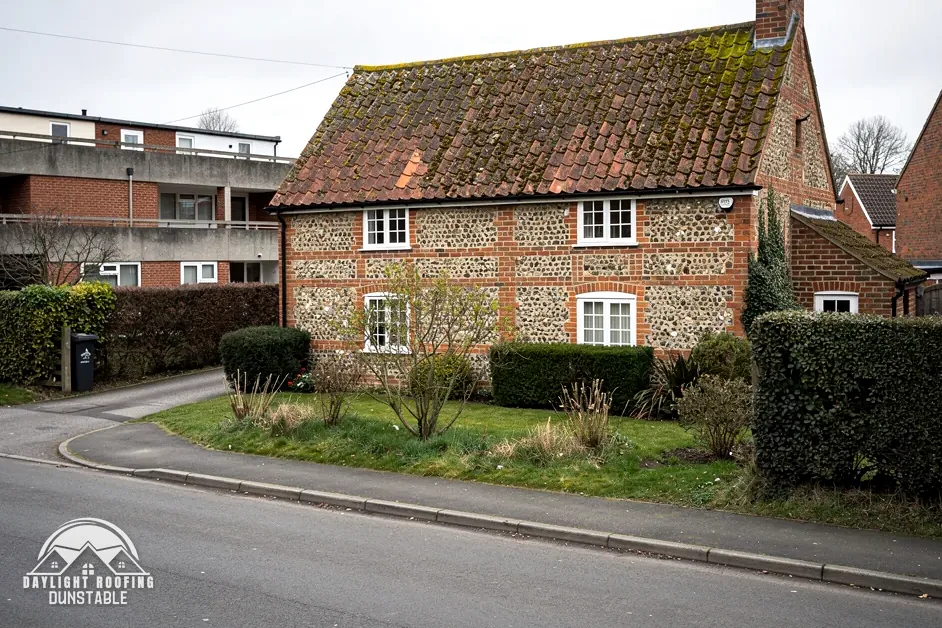
A flint and brick cottage with a clay tile roof beside a quiet road

The roof, in plain words

Plain tile
A small, flat roofing tile set in overlapping rows to form the surface.
National Landscape
A designated area of outstanding natural beauty, also called an AONB.
Consultation
A request for comment that a council sends to an advisory body.
Boundary wall
A wall marking the edge of a plot, which a roof may abut.

The plain-as-day roof check

Clay, walls, councils and storms: Little Gaddesden roof checks

4 checks about 3 minutes to read

  1. Clay tiles and the Board's note
  2. Where a roof meets an old wall
  3. The council and the Conservation Board
  4. Pictures to keep after a storm

01 Clay tiles and the Board's note

The Chilterns Conservation Board's roofing note of 2007 says "plain clay tiles are universally predominant" on the Chilterns' traditional buildings, and the sentence goes on to describe their "textural richness and distinctive dark orange or red colour". The note is design advice for the Chilterns, and Little Gaddesden is a village inside the hills. Tiles on a particular house are read from the house itself, since what the Board describes is a pattern across the hills and not a fact about each roof. Marley, quoting the BRE, gives "a minimum life expectancy of 60 years" for clay roof tiles, and HomeBuilding gives clay tiles 60-80 years.

Clay tiles have minimum pitches by product, and the list runs from 15° up to 40°. Marley lists its clay Canterbury at 40°, Ashdowne at 35°, Hawkins and Acme Single Camber at 30° and the Lincoln pantile at 15°. Canterbury is a Marley product name and not a place. A roof pitched below a tile's minimum cannot take it, and a survey measures each slope before a covering is chosen.

02 Where a roof meets an old wall

The Chilterns Conservation Board's flint note of 2003 says flint "is often combined with brick, both in the walls of older buildings and in boundary walls around estates, farmsteads and gardens". A roof can end against such a wall, and the line where they meet is an abutment, sealed with lead or another metal flashing that is tucked into a joint in the wall and laid down over the slope.

Look at the flashing for a lifted edge, at the wall's pointing above it for loss, and at the covering below for a stain. A ladder against a flint wall is awkward and risky, so start with a look from an upstairs window, or use binoculars from the lawn. A gap between wall and roof lets rain run behind the flashing and into the wall, where the damp can appear on a room wall away from any ceiling. Old pointing around flint is a place where that gap can start, so the wall above the flashing is read as well as the flashing. The survey follows the join along its length, as one fault there can hide another further along.

03 The council and the Conservation Board

The Chilterns National Landscape is, in the Board's words, "split across nine local planning authorities", and those authorities "have the responsibility for housing allocations and development decisions". The Board itself says it works "in an advisory role", and it has no power to grant or refuse consent.

For Little Gaddesden that means applications go to Dacorum Borough Council, with the Board consulted. A householder planning a re-cover therefore deals with one authority for permission and one set of Building Regulations questions, and the Board's role is advice to the council, not a second approval to obtain. The Board does not decide or approve anything. Dormers and other roof enlargements are dealt with in the planning guide, which is where the rules sit, and listed building consent and conservation-area questions stay with the council as well.

04 Pictures to keep after a storm

The Financial Ombudsman Service says "a storm usually involves violent winds, usually with rain, hail or snow", and also "Rain, hail or snowfall by itself can constitute a storm". It adds that it will "usually look at expert reports and photos". Dated pictures taken from more than one angle show the Ombudsman what the roof looked like before any repair. Photograph the damage before anything is moved, with dates visible, and from more than one angle.

Where an insurer says an exclusion applies, "The insurer has to prove that the exclusion applies - for example, with an inspection report." "For most complaints, a business has up to 8 weeks to consider a complaint." Separately, the 6 months for taking a case to the Ombudsman count from the date on the final response. Notify the insurer without delay, and keep fallen tiles dry in case they are asked for.

The dashed ring takes in the nearest towns and villages we cover around Little Gaddesden. Map tiles © Esri; map data © OpenStreetMap contributors.

Little Gaddesden roof questions in the Chilterns

01What can be seen of a tiled roof from a Little Gaddesden lane?

Standing in the lane, sight along the ridge, then work down the courses for a tile out of line or a patch of a different colour. Check the chimney stack for lean, and look along each gutter for a droop; binoculars help with ridge ends and hips. A picture taken square-on from across the road and sent on WhatsApp is enough for an opening opinion; the survey on the roof then shows what a photograph cannot, such as lifted tiles and loose fixings, and what it found is described in plain words.

02Who decides on roof work in Little Gaddesden, inside the Chilterns?

Dacorum Borough Council is the local planning authority, and applications are made to it, whatever advice the Board gives. The Board is consulted and gives advice, and has no say in granting or refusing consent. The village also has a conservation area designated by Dacorum, which is a separate layer for any address inside it, and the council confirms whether a given house falls inside the boundary. An Article 4 direction can remove further permitted development rights, so we check with the council first. The planning guide covers the roof tests, including dormers, so they are not repeated here.

03How are roof repairs at St Peter and St Paul consented?

The church is Church of England, in use and Grade I, so "the faculty jurisdiction of the Church of England" applies and not listed building consent. List B takes in "The like for like replacement of roof lead or other material covering the roof of a listed building", and for that job a written notice from the archdeacon suffices. Work on the outside may still call for planning permission, and that question goes to Dacorum Borough Council. The faculty route belongs to the Church of England, so a church of another faith would be a different case.

04Do John of Gaddesden's House and the Manor House need special consent?

Both are listed Grade II*, so works that would affect their character need listed building consent, and the council decides whether a given repair counts as an alteration. The listing does not strip them of their roof-work permitted development rights. Recovering in another material, or cutting a new opening, goes to the council first. The conservation area is a separate layer on top for any address inside it, and a house can be subject to both. Repairs that match what is there are a different question from alterations, and the council answers that too.

05What do published guides say about reroofing a garage near Little Gaddesden?

MyJobQuote's page of 26 October 2026 puts garage roof replacement at between £750 and £3,500 on average for 2026. Its rubber roofing page of 9 October 2026 says "typical rubber roofing prices of around £60 per square metre mean the average rubber roof costs £1,050 fully installed". The figures are third-party and are not combined. A written total for your garage follows a survey of its deck, its falls and its walls, and a garage with an older sheet roof may need a different approach.

06What does Hertfordshire County Council require for scaffolding on a lane?

Hertfordshire County Council charges £134 for a 14-day licence and £59 for every week after, and "It usually takes 3 weeks to process an application." Its insurance requirement is a "minimum of £10 million". We arrange the licence with our scaffolder. A lane with no pavement may leave no footway to keep clear, yet a scaffold standing in the road still obstructs it, so the licence question turns on where the poles stand. Where a footway exists, "A 1.2m clear walkway must be maintained at all times on the footway."

07How big must an escape window be in a Little Gaddesden loft conversion?

Approved Document B para 2.10 asks for "A minimum area of 0.33m2", "A minimum height of 450mm and a minimum width of 450mm", and a bottom to the openable area of "a maximum of 1100mm above the floor". Escape windows serve storeys up to 4.5 m above ground. Where a conversion makes a storey higher than that, para 2.5 calls for either a protected stairway or an alternative escape route. Check the route with Dacorum Borough Council's building control team before the design is fixed, because the window and the stair are one question.

08Could soffits or sheets on an older Little Gaddesden house hold asbestos?

HSE advises "If the building was built or refurbished before 2000, assume that there is asbestos in it." It lists "AIB white soffit panels to underside of roof eaves" and notes "AC roofs are always fragile". Do not drill or scrub a suspect panel. Asbestos cement carefully removed whole is non-licensed work, while work on insulating board is treated differently: HSE makes it licensed work where the risk assessment indicates that it will not be of short duration. Waste goes in a lockable skip, and nobody should walk on a fragile asbestos cement roof. Leave a suspect panel untouched until a competent person has identified it.

09What does CDM 2015 mean for a Little Gaddesden homeowner who orders a re-roof?

The domestic client's duties pass to "the contractor for a project where there is only one contractor", and to the principal contractor where there are several. HSE says "A domestic client is any individual who has construction work carried out on their home", outside any business. The contractor prepares "a construction phase plan". A homeowner can ask to see it, and the dates, before work begins. For a small roof the plan is short; its job is to record how the roof is reached and how people below are kept safe, so it is worth asking for even on a modest job.

Get a written price for your roof

10-year workmanship guarantee, in writing

Tell us about your roof

Call WhatsApp Written quote