
Call 01582 935272

Totternhoe · 2 road miles west

Roofers in Totternhoe

Totternhoe is 2.4 road miles from Dunstable. We repair, re-cover and re-roof its houses, and a written price in one sum follows a visit to the roof.

Get a written quote

Call 01582 935272WhatsApp us

Council
Central Bedfordshire
Road miles
2
Conservation area
Totternhoe
Building control
Central Bedfordshire

Totternhoe roofs, from St Giles to Castle Hill Road

Totternhoe is 2.4 road miles from Dunstable, to its west, and the drive takes about 6 minutes. It falls under Central Bedfordshire. At the 2021 Census, Totternhoe parish had 1,197 usual residents. Four listed buildings can be named without guessing: Grade I for the Church of St Giles, and Grade II for The Court House, Cross Keys Inn and 213, Castle Hill Road. Anyone with a roof on a listed building has more people to consult than a neighbour in an ordinary unlisted semi.

Planning for a Totternhoe address belongs to Central Bedfordshire Council, which also designated Totternhoe Conservation Area. Whether a particular house falls inside it is the council's to say. National rules are laid out in our planning guide, and a full new covering is described on the roof replacement page. Our order of work is plain: we survey the roof, say what turned up, and set one written total down afterwards.

  1. 01Church of St GilesGrade I, list entry 1159758, first listed 3 February 1967. A Church of England church, so repairs are decided under the faculty system.
  2. 02The Court HouseGrade II, list entry 1310872, first listed 26 September 1980. A roof job on a listed house goes to the council first.
  3. 03Cross Keys InnGrade II, list entry 1114766, first listed 29 April 1952. Work to its roof counts as work to a listed building.
  4. 04Totternhoe Castle earthworksA motte and bailey castle with medieval quarries and cultivation terraces: a scheduled monument, list entry 1020772, near Totternhoe.
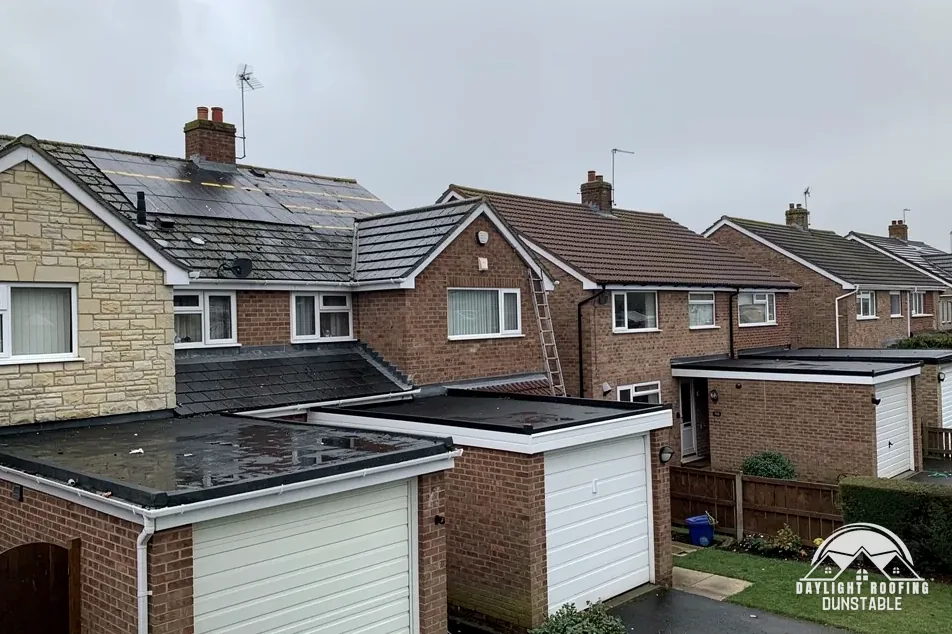
Brick semis with concrete tile roofs and flat-roofed garages

Totternhoe words, from eaves to monument

Eaves
Where the roof slopes down past the wall and overhangs it.
Flashing
Thin metal dressed round a stack or abutment so water runs away from the joint.
Batten
A timber lath fixed across the rafters; each tile hooks over one.
Scheduled monument
Protected by law: no works without prior authorisation.

The plain-as-day roof check

Four checks for a Totternhoe roof, ridge to gutter

4 checks about 4 minutes to read

  1. Ridge and hip tiles
  2. The valley between two slopes
  3. Soffits under the overhang
  4. Gutter fall and downpipes

01 Ridge and hip tiles

Step back from the building and look along the ridge, the line where the slopes join. Expect it to run straight, every ridge tile level with the next and no gap at the joints. Hips, the sloping edges of a hipped roof, take the same test. A tile that has dropped, tilted or opened a joint lets wind and rain reach the timbers beneath. Count along the run if you can: a gap, or one tile sitting higher than its neighbours, marks the spot where something has moved. Marley's technical pages report that since the 2015 amendments to BS 5534, mortar "could no longer be relied upon as the only means of securing the roof covering".

The standard expects the ridge and hip courses to be mechanically fixed against the uplift the wind is calculated to cause at that particular site. The dry-fixed alternative, with no mortar bed at all, is set out in BS 8612:2018. Cracked, crumbling mortar along a ridge is therefore a cue to look closer, and a fresh smear of mortar alone is not the answer. Which? Trusted Traders priced one new ridge tile at £80 to £300, excluding VAT, in a survey of 11 traders gathered in November 2025. A ridge that looks sound from the ground can still hide failed bedding, which only a close look along the joint line shows.

02 The valley between two slopes

Where two slopes meet in an internal angle, the valley carries run-off from both into the gutter. From the lane, look for a dark streak along the line, moss gathering in it, or tiles cut ragged where they meet the lining. Indoors, a brown ring on the ceiling beneath that angle tells the same story. A split lining sends water beneath the tiles on both sides, so a small fault here lets in more than its size suggests. Where a slope meets a chimney stack, the flashing and the lining meet at that point too, so the same check applies there.

Binoculars show cut tiles better than a glance. Leaves and grit that bank up in a valley hold water against the tile edges, so clearing them from the lawn or an upstairs window is sensible, and climbing onto the roof for the job is not. If the lining itself looks broken, a photograph sent by WhatsApp lets us begin the conversation about what a repair would involve before anyone visits. A valley that is dry on top can be wet beneath: stained timber seen from the loft is the proof, and a torch shone along the lining from below shows it better than any view from outside.

03 Soffits under the overhang

Soffits are the boards that close the gap beneath the overhanging eaves. Look up from the ground for boards that sag, split or show bare patches where paint has gone. Fascias, the boards that the gutter brackets screw into, deserve the same look: soft timber that gives under a thumb, or a gutter pulling away at one end, means the fixings have lost their bite. HSE lists "AIB white soffit panels to underside of roof eaves" among the places asbestos insulating board has been used, and its advice reads: "If the building was built or refurbished before 2000, assume that there is asbestos in it."

An older soffit board is therefore never drilled, sanded or snapped to find out what it is. Most work on asbestos insulating board is licensed. If the fascias are uPVC, one retailer says they "can typically maintain reliable performance for between 20 and 40 years" when correctly installed, which is a retailer's statement about the product and not a promise about any one house. Our guttering, soffits and fascias page covers the roofline in full.

04 Gutter fall and downpipes

A gutter that still holds water after the rain has stopped has lost its fall, the slope that leads water toward the outlet. Brett Martin gives the fall as 1 mm for every 600 mm of gutter. Watch a run in heavy rain: water spilling over the front lip, a weeping joint or a green smear on the wall beneath points to a sagging bracket, a failed seal or a clogged outlet. Cast iron, aluminium and plastic gutters fail in their own ways: a joint that weeps, a bracket rusted through, a length that has cracked. Naming the material when you send a photograph helps.

Look at the downpipes too. A pipe that has swung off its bracket, or ends above a cracked gully, empties against the brickwork when it should empty into the drain. A damp patch low on an outside wall under a downpipe deserves a photograph, taken where the pipe meets the ground, before the next dry day fades the stain. A chimney stack shedding water onto that wall is covered on the chimney repairs page.

The dashed ring takes in the nearest towns and villages we cover around Totternhoe. Map tiles © Esri; map data © OpenStreetMap contributors.

Totternhoe roof questions, answered plainly

01Which parts of a Totternhoe pitched roof can be checked from the garden?

Four features show from the ground with binoculars: the ridge line, the row of tiles along the eaves, the chimney pots and the flashing round each stack. A ridge that dips, tiles that have slipped out of line, a pot that leans or a gap in the metal are all worth noting. A ladder is neither needed nor advised. We will look at a photograph sent through WhatsApp, and anything else seen at the survey is mentioned alongside the fault you pointed out, so the written total covers the whole picture rather than a single fault. A phone with a zoom lens does the same job from the lawn as a climb would, with none of the risk.

02Does the Church of St Giles need listed building consent for roof repairs?

St Giles is a Church of England church, listed Grade I (list entry 1159758). A church in use within "the faculty jurisdiction of the Church of England" goes through the faculty system and not through listed building consent. In some like-for-like cases the archdeacon's written notice is enough, and that is lighter than a full faculty. Whether planning permission is also wanted for outside work depends on the ordinary planning tests, so the faculty answer never settles that second question alone. That route concerns the church building itself. A private house in Totternhoe is covered by the listed-building and planning rules instead.

03How does Grade II listing alter a roof job at The Court House or 213, Castle Hill Road?

Both carry a Grade II listing (list entries 1310872 and 1310909). Listed building consent is required for works "in any manner which would affect its character as a building of special architectural or historic interest". Planning belongs to Central Bedfordshire Council, so an owner raises a roof repair or a re-cover with the council at the outset. What counts is the effect on the building's character, which is a wider test than whether the job is labelled a repair or a replacement, and a council officer is the person to confirm it. Cross Keys Inn is listed Grade II (list entry 1114766) and sits under the same wording, so a commercial building is judged by the same test as a home.

04Does living in Totternhoe Conservation Area limit what can go on a roof?

Central Bedfordshire Council designated Totternhoe Conservation Area, and its own conservation guidance says permitted development rights are stricter for properties within conservation areas. Whether an individual address lies inside the area is a question for the council, which holds the boundary. An Article 4 direction can remove further permitted development rights, so we check with the council first. A dormer follows different rules from a like-for-like covering, and the planning guide sets that out in full. For a house that is also listed, the listing adds its own consent requirement on top of whatever the conservation area asks, and the two are separate questions to put to the same council.

05Totternhoe scaffolding: whose job is the licence?

A licence is required from the highway authority whenever a scaffold obstructs a road or pavement (Highways Act 1980, section 169). On Central Bedfordshire's roads the council is that authority, and we arrange the licence with our scaffolder. The scaffold is a line within the written quote, giving the one total that follows the survey as the sum you are asked to accept. Where a house is set back and the scaffolding would stand wholly on its own land, whether any licence applies is a point for the council. A scaffold does not escape the licence requirement by looking small, and the section 169 wording covers any scaffolding that obstructs the highway.

06Is Building Regulations approval needed to re-roof in Totternhoe?

Under the Planning Portal test, an application is not normally needed when "Less than 25 per cent of the total 'building envelope'" is affected and "Less than 50 per cent of the roof is affected". Stripping a whole roof overshoots the 50 per cent limit. On its main page the Portal adds: "In most situations, this work will need Building Regulations approval." Central Bedfordshire Council runs its own building control team on 0300 300 8635, and the council says planning questions should not be put to that number. Once the finished job complies, the council's team hands over a completion certificate, and a registered building control approver is the other route, issuing a final certificate in its place.

07What if a Totternhoe garage has a cement-sheet roof?

HSE: "AC roofs are always fragile". No one should step on such a roof. Sheeting taken away whole and carefully is non-licensed work, while sheeting left in a damaged or fragmented state becomes notifiable non-licensed work. HSE's skip rule reads "Use a lockable skip for asbestos", and the household exemption from consignment notes is for waste "other than asbestos waste". Photograph the roof from the ground and send it across before any roofing work is planned, and leave the sheets undisturbed in the meantime. HSE also lists asbestos cement rainwater goods among its non-licensed products, which is worth knowing if the garage gutter is cement as well.

08Is a Totternhoe contract signed at your door open to cancellation?

After a survey at your door, the Consumer Contracts Regulations give 14 days to cancel: "the cancellation period ends at the end of 14 days after the day on which the contract is entered into", with day one being the morning after signing. A written request is the only way work begins inside those days, and the request leaves the cancellation right intact, though the customer can owe for the work carried out up to that point. A repair visit you specifically asked for as urgent carries no cancellation right. Separately, the Consumer Rights Act 2015 section 49 carries the heading "Service to be performed with reasonable care and skill", and that duty applies whether or not a contract is cancelled.

09What should a Totternhoe owner do after storm damage?

Get the damage on camera before any of it is shifted; after that, let the insurer know. The Financial Ombudsman Service says it will "usually look at expert reports and photos", and that "Rain, hail or snowfall by itself can constitute a storm". "For most complaints, a business has up to 8 weeks to consider a complaint" before the ombudsman can take the case up, and the ombudsman's number is 0800 023 4567. Keep the photographs together with any report, because an insurer weighs both. The written price for a full repair follows the survey.

Get a written price for your roof

10-year workmanship guarantee, in writing

Tell us about your roof

Call WhatsApp Written quote