
Call 01582 935272

Great Kingshill · 23 road miles south-west

Roofers in Great Kingshill

Roof repairs, re-roofing and eaves work for Great Kingshill homes in the Chilterns, with the roof surveyed first and any bat or nesting question raised before work.

Get a written quote

Call 01582 935272WhatsApp us

Council
Buckinghamshire
Road miles
23
Building control
Buckinghamshire Council

Roofs at Great Kingshill, where the loft may have lodgers

Great Kingshill lies in Buckinghamshire, a 22.5 road mile run south-west of Dunstable that takes about 40 minutes. The village sits in Hughenden parish, which had 8,265 usual residents at the 2021 Census, and inside the Chilterns National Landscape. The Chilterns Conservation Board has an advisory part only: it responds to consultations while Buckinghamshire Council, the planning authority, makes the decisions. Conservation areas exist close by, at Great Missenden and Four Ashes. The whole of Great Kingshill is covered by one council for planning, building control and scaffold licences, which keeps the questions about a roof in one place.

A roof can have wildlife living in the loft or under the eaves, and the law protects some of it. A roofer who comes across a bat roost or an active nest should stop and take advice before going on, and that is why the question is raised at the survey instead of mid-job. We look over the roof first, tell you plainly what we found and put one written total in front of you. Our roof repairs and pitched roofing pages describe the work.

  1. 01Cockpit Hole FarmhouseThe farmhouse and its attached barn are Grade II (list entry 1481713), first listed on 10 February 2023.
  2. 02Stag House and MeadowcroftStag House (entry 1125749) and Meadowcroft (entry 1332050) are Grade II, so roof work there turns on the building's character.
  3. 03Missenden and Four AshesConservation areas lie close to the village; for your own address, check with Buckinghamshire Council.
  4. 04Roof spaces with wildlifeA loft or an eaves gap can hold a protected bat roost or a bird's nest in use or being built, which changes how roof work is planned.
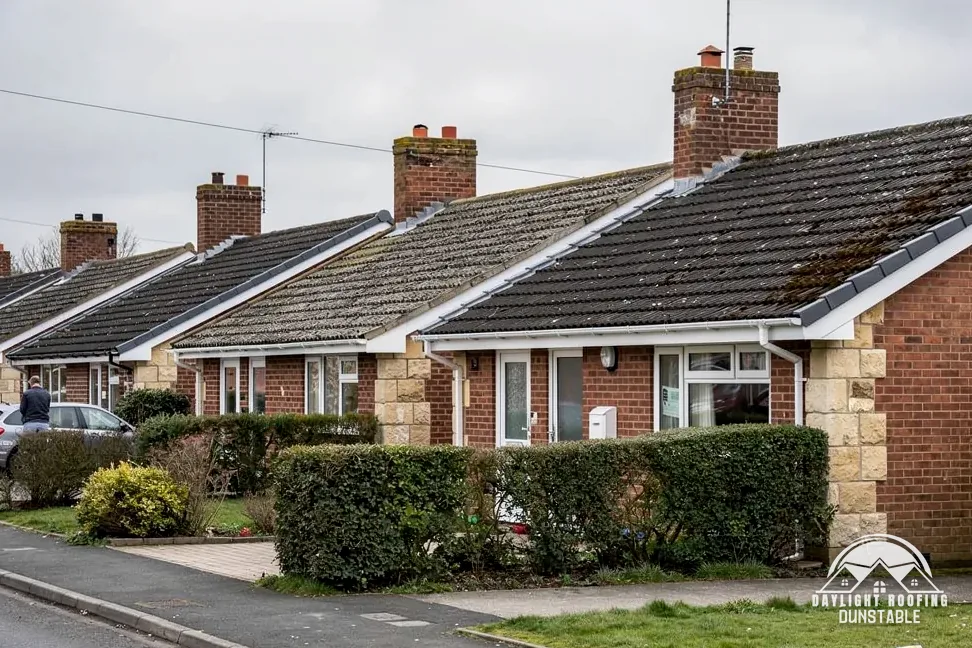
Street of 1960s brick bungalows with concrete tile roofs

Great Kingshill terms, made plain

Bat roost
A place where bats shelter or breed, protected by law.
Natural England licence
Natural England's permission to carry out roof work that would harm protected wildlife.
Soffit
The board under the roof overhang, where it meets the wall.
Ridge
The horizontal line along the top where two roof slopes meet.

The plain-as-day roof check

Four things to check on a Great Kingshill roof with wildlife

4 checks about 4 minutes to read

  1. Droppings and staining
  2. Gaps at the ridge and eaves
  3. Licences for work on a roof
  4. Nests in the soffit

01 Droppings and staining

From the hatch, torch in hand, keep your feet on the joists and your weight off the ceiling. Look for small dark droppings on the insulation, on the joists or on the floor beneath the ridge, and for grease marks round gaps at the eaves. A heap of droppings that builds beneath one spot suggests an animal returning to it, and the place where it sits is worth noting with a photo before you do anything else. Droppings are one sign you can see from the hatch, and staining on a joist or round a ridge board shows where animals pass in and out. A phone photo from the hatch is enough to describe it.

In GOV.UK's bat guidance every species is protected, along with its breeding sites and resting places. The Habitats Regulations make it an offence to do what "damages or destroys a breeding site or resting place of such an animal", and the offence has no intent word. If you find droppings or see a bat, tell us when you ring, and the survey takes it into account before any roof work is planned. Do not vacuum, spray or wash an area where droppings have built up. Wait for advice, because disturbing a roost, even to clean, is the thing the law is concerned with.

02 Gaps at the ridge and eaves

Small creatures use small openings: a lifted ridge tile, a gap beside a verge, a missing run of soffit board, or a space where the felt stops short of the eaves. Look from the ground for staining on the wall beside such a gap, droppings below it, or birds going in and out. A hole that serves as an entrance is a different thing from a hole that is only a defect. A gap that has been in the same state for years may be a long-used access point, and that is a reason to leave it open until you have had advice and not to fill it as a tidy-up.

The law reaches beyond disturbance. Under section 9(4) of the Wildlife and Countryside Act 1981 it is an offence to disturb a protected animal while it shelters, or to block its way in or out, when done "intentionally or recklessly". That is why a gap should not be stuffed or sealed on impulse. Ask first, and let the survey establish what is using the space and what the repair has to allow for. Once the position is clear, the repair can be designed to keep a safe route for the animals while still keeping the weather out, where the licence or advice allows it.

03 Licences for work on a roof

Where bats are present, GOV.UK's guidance names "repairing or replacing a roof" as one of the activities that may need a licence from Natural England. A licence is permission for particular work, with conditions, that would otherwise harm a protected animal or its roost. A householder or a roofer cannot assume one, and cannot do without one if it is needed. Natural England is the body that issues the licence, and its conditions can cover timing, methods and what is left in place afterwards, which is why the advice has to come first.

If a roost is confirmed, roof work waits for the right advice and, where required, the licence. That can alter the order of events and the dates, so it is better to meet the question at the survey than halfway up a scaffold. A confirmed roost is a fact about the building, and the written price follows what the survey establishes about the roof as it stands. None of this makes a roof job impossible. It means the first conversation is about the roof space and what lives in it, and the second about the covering.

04 Nests in the soffit

Birds use gaps in eaves, soffits and ridge ends, and a nest shows as straw or twigs poking out of a gap. Section 1 of the Wildlife and Countryside Act 1981 makes it an offence to intentionally do something that "takes, damages or destroys the nest of any wild bird while that nest is in use or being built". The Act's own words are intentionally, and in use or being built. A nest in a soffit can be difficult to see from below, so listen as well as look: chirping from a gap or birds returning every few minutes with food is a strong sign that one is in use.

So the test is whether the nest is occupied or under construction. An old, empty nest is not the same case as one with eggs or chicks in it. If you can see birds carrying material or feeding young at a gap, mention it before work begins, so that the job can be planned around that part of the roof and not simply carried out over it. Roof work that does not touch the nest area may be arranged to go ahead around it, and the survey is where that is worked out.

The dashed ring takes in the nearest towns and villages we cover around Great Kingshill. Map tiles © Esri; map data © OpenStreetMap contributors.

Great Kingshill roof and wildlife questions

01What should I do if I find bats in my Great Kingshill loft?

Leave them alone and tell us when you ring. Damaging or destroying a bat roost is an offence whatever the intent of the person who does it, and roof work that could affect bats can need a Natural England licence. Do not seal gaps, clear droppings or start repairs near the roost. The survey takes in what you have seen alongside what the roof needs, and the way forward is settled with the right advice before any work is planned. A picture of what you found helps. If you have a camera with a flash, keep it off the animals; one shot of the droppings, or of the gap they use, is plenty.

02Does the Chilterns designation change who decides a roof application?

No. The Chilterns Conservation Board's part is advisory, and it responds to consultations; Buckinghamshire Council decides planning applications. What the designation does alter is the planning position for certain roof changes, and our planning permission guide sets those out in one place. For a re-roof that matches the existing covering, the ordinary tests continue to apply, and the council can confirm that for your house. That includes any roof window, dormer or enlargement, and the planning guide explains where each one sits.

03Is Great Kingshill itself inside a conservation area?

Conservation areas are named close to the village, at Great Missenden and Four Ashes. That is a different statement from saying a street in Great Kingshill is covered, and the boundary that counts is the one round your own house. For your own address, the council to ask is Buckinghamshire Council, which can tell you whether your road falls inside one and whether any direction takes away further permitted development rights. A short phone call with the address to hand settles it, and the answer can be kept with your deeds.

04What do the Cockpit Hole Farmhouse and Stag House listings mean for roofs?

Cockpit Hole Farmhouse and attached barn is Grade II (list entry 1481713, first listed 10 February 2023), Stag House is Grade II (entry 1125749, first listed 4 July 1985) and Meadowcroft is Grade II (entry 1332050). Where roof work would affect a listed building's character it needs listed building consent, and a barn attached to a listed farmhouse is part of the listing. Buckinghamshire Council can say which side of that line a given repair falls on. Because the listing includes the attached barn, a roof repair there is treated as work to a listed building, however separate the barn looks.

05Which council deals with a roof in Great Kingshill?

Buckinghamshire Council, for all of it. It is the planning authority, it runs its own building control service, with contact details on the building control page of its website, and it is the highway authority that licenses scaffolding on the road. Hughenden is the parish named in the census figures and is a separate matter from the council: the village lies in Hughenden parish, which had 8,265 usual residents at the 2021 Census. That one authority answers the planning, building control and scaffold questions, so one call can clear several points at once.

06What licence does scaffolding at a Great Kingshill house call for?

A frame standing on the pavement, or out in the road, needs a licence from Buckinghamshire Council, which grants them only to registered scaffolding companies. Buckinghamshire Council charges £402.78 for 28 days, £69.09 to renew and £777.63 for a licence sought after the frame is up. We arrange the licence with our scaffolder. A scaffold on your own drive or lawn is not a highway matter, though it still wants a firm, level base. A frame fixed to your own wall stands on your own ground only if it is wholly within your boundary, so measure before you assume.

07How long does a roof covering last?

HomeBuilding, last updated 30 September 2025, gives approximate lifespans of 100+ years for Welsh slate, 75-100 for Spanish slate, 50-80 for reclaimed Welsh slate, 60-80 for clay tiles and 40-50 for plain concrete tiles. They are approximations and say nothing certain about a particular roof, which is judged on its condition and its fixings. The survey looks at yours and tells you plainly how much of its life appears to remain. Whether a covering should be repaired or replaced is a question of condition tile by tile, not of its age alone.

08Does flood risk change roof work in Great Kingshill?

Flood risk is worked out per site rather than per village. GOV.UK's long-term flood risk service reports on four kinds of risk to an area, river, surface water, reservoir and groundwater flooding, but it says nothing about the chance of one house flooding. For a planning application, it is the Environment Agency's flood map for planning that shows a site's flood zone. How a roof drains is its own question, and the survey covers it. Ground and roof drainage are different: the gutters and downpipes are what carry roof water away, and they are checked at the survey.

09Could an Article 4 direction affect my Great Kingshill roof work?

Directions have been made near the village. An Article 4 direction can remove further permitted development rights, so we check with the council first. What a given direction covers is not something a general guide can say, so ask Buckinghamshire Council whether a direction covers your property, quoting the full address. Do it before any change to the roof is planned, and keep the council's reply with the house papers. It is also worth asking at the same call whether your house is in a conservation area or listed.

Get a written price for your roof

10-year workmanship guarantee, in writing

Tell us about your roof

Call WhatsApp Written quote