
Call 01582 935272

Widmer End · 24 road miles south-west

Roofers in Widmer End

Slate and tile repairs, chimney work, gutters and farm-building roofs around Widmer End, each roof surveyed first, with the price given as a single written sum.

Get a written quote

Call 01582 935272WhatsApp us

Council
Buckinghamshire
Road miles
24
Building control
Buckinghamshire Council

Widmer Farmhouse, its barn and Widmer End houses

Widmer End is a village in Buckinghamshire, 24.1 road miles south-west of Dunstable: allow 43 minutes by road. It lies in Hughenden parish, which had 8,265 usual residents at the 2021 Census. Planning here is Buckinghamshire Council's business, and so is building control, which it provides itself. Hughenden Manor, Four Ashes and Totteridge are conservation areas close to the village, each within a few miles, with Penn and Tylers Green and Amersham Hill also in reach, and any individual address, including whether an Article 4 direction applies to it, is for Buckinghamshire Council to say, so check with that council.

Widmer Farmhouse, a barn beside it and Primrose Farmhouse are listed, which makes farm-building roofs a heritage subject in this part of the parish. An ordinary house is simpler. The survey is the first step; what it finds, together with whatever else is wrong on the roof, is put to you in plain language, and a written total follows it. A tired slope of slates may be a slate roofing job, and a failed junction a repair.

  1. 01Widmer FarmhouseListed Grade II (entry 1125752, first listed 7 December 1973), so alterations touching its character need listed building consent.
  2. 02Bramble Barn Piranor BarnGrade II under entry 1125753, also first listed on 7 December 1973; even matching-material repairs go to the council first.
  3. 03Primrose FarmhouseGrade II listed (entry 1160490), so a different covering needs Buckinghamshire Council's view before anything is ordered.
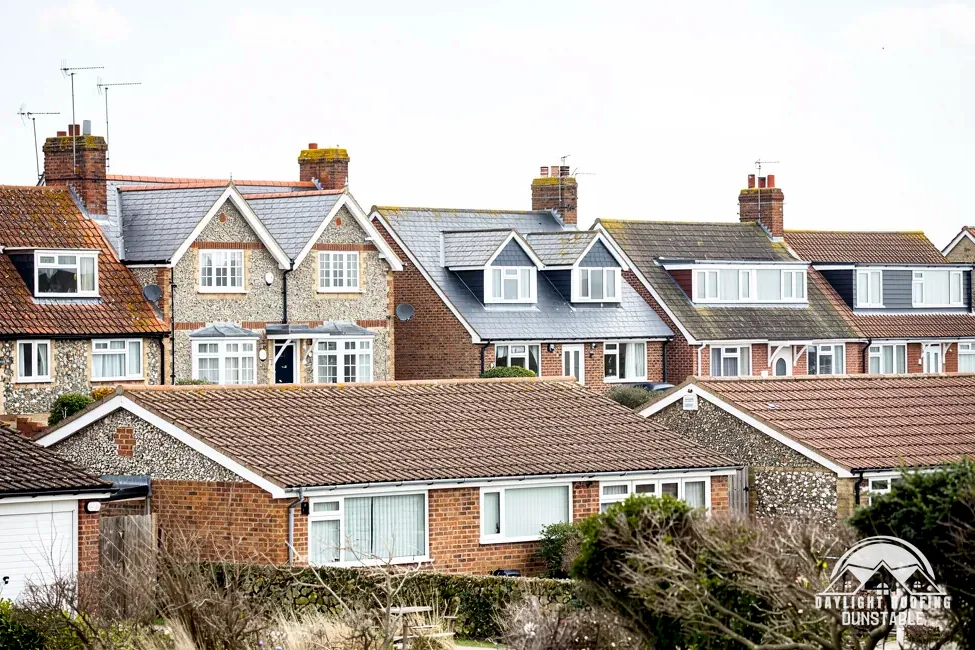
A row of low bungalow roofs on the flat land of the Selsey peninsula

Terms on this page

Hip end
The sloping end of a roof, where two planes meet at an outward corner.
Hook fixing
A metal clip that carries a slate instead of a nail through it.
Abutment gutter
A lead-lined channel at the foot of a higher wall, draining along it.
Asbestos cement
A sheet material once used for roofing, fragile and not to be broken up.

The plain-as-day roof check

Four signs on a Widmer End roof

4 checks about 3 minutes to read

  1. Hip tile ends
  2. Slate fixings
  3. Wall-side gutters
  4. Ceiling stains below the roof

01 Hip tile ends

Where a hipped roof's sloping ridge runs down to the eaves, the join is covered by a row of capping tiles, and the lowest one is held with a bracket or a bed of mortar. Look at the hip lines from across the road for caps knocked out of line, a crack in the mortar along their edges, or a bracket that hangs open. At the bottom end of a hip a loose cap can slide off and fall to the ground.

A hip whose mortar has failed can be rebuilt with fixings that hold each cap mechanically, in place of a fresh bed of mortar that would only crack again. That is a bigger job than re-pointing, and it is the sort of finding the survey spells out before a price is set. Binoculars on a clear day show whether the capping runs straight, and whether any cap has a hairline crack through it, and if you send us a photograph by WhatsApp we can see what you are describing before a visit is arranged.

02 Slate fixings

A slate depends on its nail or hook, and the fixing can give out while the slate itself is still sound. A slate that has slipped shows as a gap in the course, a tail that hangs below the rest of its course, or a fragment in the gutter. Where the nails have corroded, the neighbours may follow, so one slipped slate is a prompt to look along the whole course and the courses either side.

The pitch of the roof limits which fixing can be used, and the survey measures it. HomeBuilding's lifespan figures run from 100+ years for Welsh slate to 75-100 for Spanish and 50-80 for reclaimed Welsh. They are approximate, and a slate roof's age says less than the state of its fixings.

03 Wall-side gutters

Where a lower roof runs into a higher wall, as with a gable beside a single-storey extension, the water has to be carried along the join, and a lead-lined channel called an abutment gutter does it. Look at the lead for splits, a bulge where water has pooled, a blocked outlet, and damp on the wall above the line of the lead. These channels collect debris readily, since leaves and moss settle in them, and a channel that has silted up overflows into the wall beside it.

Brett Martin gives a fall of 1 mm for every 600 mm towards the outlet for guttering, and the same principle applies to a lined channel: if the fall is lost, the water stands. MyJobQuote says correctly installed lead flashing "can last for over 80 years", which is a statement about correct installation. A chimney that stands beside such a channel deserves a glance too, since water off the stack runs into it.

04 Ceiling stains below the roof

A brown ring on an upstairs ceiling is the part of a leak you can see, but the ring is only the end of a path. Water may have entered at a slipped slate, run down a rafter and soaked a section of the ceiling a metre away, or travelled along the felt before dropping through a gap. Note its shape: a ring that spreads after each spell of rain suggests a roof fault, while one that shows on cold mornings may be condensation.

Outline the damp patch lightly in pencil, date it, then photograph it. If it has grown a week later, the leak is active. A survey takes the stain's position and works back to the section of roof overhead, so a stain near the chimney sends it to the flashings first. A short note of when you first saw the stain, and what the weather had been doing, is worth having to hand when you ring, as is the room's position in the house relative to the chimney and the eaves.

The dashed ring takes in the nearest towns and villages we cover around Widmer End. Map tiles © Esri; map data © OpenStreetMap contributors.

Widmer End roofs: your questions, plainly

01Why does a slate roof in Widmer End lose slates one at a time?

A corroded fixing can let a sound slate go: each slate hangs from a nail or hook, and when that rusts through the slate slips. Neighbouring fixings of the same age may be in a similar state, so a single slipped slate is a prompt to check the whole course, and the course above it, where a slate that has slid can leave a gap for rain. Slates that have slipped in ones and twos are re-fixed individually, whereas a slope that sheds them over its full width wants re-slating. A photograph taken from the lawn or lane and sent by WhatsApp shows us how widespread the slipping is. If the slates are old, matching replacements can be the real difficulty, and the survey says whether reclaimed or new ones would suit the roof.

02What do the Grade II farm buildings mean for roof repairs?

Widmer Farmhouse (list entry 1125752) and the Bramble Barn Piranor Barn (entry 1125753) were first listed on 7 December 1973, and Primrose Farmhouse is entry 1160490; all three are Grade II. For a listed building, work "in any manner which would affect its character as a building of special architectural or historic interest" needs listed building consent. Where the repair uses matching materials, Buckinghamshire Council is told ahead of the work, so that nothing is left to argue about once the roof is open, and the council can say which parts of a farm building's roof count as part of the listing.

03Does a nearby conservation area or an Article 4 direction change my plans?

Only if your own house is covered, and Buckinghamshire Council can say. Hughenden Manor, Four Ashes, Totteridge, Terriers, Amersham Hill and Penn and Tylers Green all lie close to Widmer End; being near one does not put a house in the area. Ask Buckinghamshire Council whether an Article 4 direction covers your address. Before a new covering is ordered, put your address to the council, and read our planning permission guide for how the tests run. Keep the council's reply with your quote, because a reply given in writing settles what was agreed.

04Who needs the scaffold licence for a Widmer End house?

Scaffolding that blocks a pavement or carriageway needs a licence from Buckinghamshire Council, which is the highway authority here. The fees at Buckinghamshire Council are £402.78 for 28 days, £69.09 for a renewal and £777.63 for a licence obtained retrospectively. As Buckinghamshire Council puts it: "You must be a registered scaffolding company to apply for a licence." We arrange the licence with our scaffolder. A frame put up wholly on your own land needs no licence, and any licence that is needed forms part of the written quote.

05Is fixing to BS 5534 a legal requirement for new tiles?

No. Marley says installing to BS 5534 "isn't required by law". It also says the 2015 amendments made clear that mortar "could no longer be relied upon as the only means of securing the roof covering". BS 5534:2014+A2:2018 is the code of practice's current edition, and tile fixings are specified for the site rather than copied from the last job. A re-cover is therefore fixed to the standard whether or not the law asks for it, and that specification is settled at the survey, not on the day the tiles go on.

06A neighbour's work is cutting into our shared wall. What notice is required?

Under the Party Wall etc. Act 1996 the owner doing the work serves a notice "at least one month before he intends the building work to start" for a new wall on the boundary line, and for work to a party structure the notice must "be served at least two months before the date on which the proposed work will begin". If you hear nothing, GOV.UK says: "You cannot assume that no response means they agree to the works." Silence from an adjoining owner for 14 days counts as dissent under the Act, which triggers the surveyor procedure and gives the neighbour no veto.

07What does HSE say about cement sheets on a Widmer End outbuilding?

On HSE's list, asbestos cement items such as roof sheeting count as non-licensed work, "provided the material is carefully handled/removed without breaking up". Sheeting that has been badly broken or substantially damaged moves the job into notifiable non-licensed work, a separate category. HSE adds that "AC roofs are always fragile", which is why no one should step onto one. Waste from the job belongs in a lockable skip, never an open one, because HSE's guidance says it is not good enough to throw sheeting over a standard skip. Children and pets should be kept clear of any broken sheets, and nobody should sweep or hose the debris. A roof of uncertain make should be left alone until it is identified.

08What if my insurer turns down a storm claim?

Begin with the insurer's own complaints procedure, and keep every letter it sends you. "For most complaints, a business has up to 8 weeks to consider a complaint", and the Financial Ombudsman Service takes it from there; its number is 0800 023 4567. Separately, you have six months to go to the ombudsman, running from the date given on the insurer's final response rather than from the storm itself. The ombudsman will usually look at expert reports and photos, so dated pictures of the damage, taken before anything was moved, are worth keeping alongside your policy.

09What does a new roof cost for a three-bedroom semi?

According to HomeBuilding (last updated 30 September 2025), a three-bedroom semi with a 65m² roof and plain concrete tiles "may cost between £10,000 and £15,000", while Welsh slate on the same property "might reach £18,000". The assumptions behind those figures belong to their publisher, and they are not our price; the page carries a date, so a later figure may differ. What we quote comes after surveying your roof, and comes to you as one total figure in writing. A semi with a bigger roof, steeper slopes or a hard-to-reach back slope sits above or below those figures, and the survey is what turns them into a sum for your house.

Get a written price for your roof

10-year workmanship guarantee, in writing

Tell us about your roof

Call WhatsApp Written quote